

Quick Answer: Who Was Di Renjie?
Di Renjie (狄仁杰, Dí Rénjié, c. 630–700) was a Tang dynasty (唐, Táng) legal official who rose to become a chancellor under Wu Zetian (武则天, Wǔ Zétiān). He is the historical figure behind Judge Dee.[6]
- Legal career: He reviewed criminal cases under Emperor Gaozong (高宗, Gāozōng).[1]
- Succession: He urged Wu to bring her son Li Xian (李显, Lǐ Xiǎn) back to court.[2]
- Literary legacy: Later Chinese detective fiction and Robert van Gulik’s English books turned him into a detective.[7][8]
The court histories describe his legal judgments and advice to rulers. The mysteries come from later fiction.
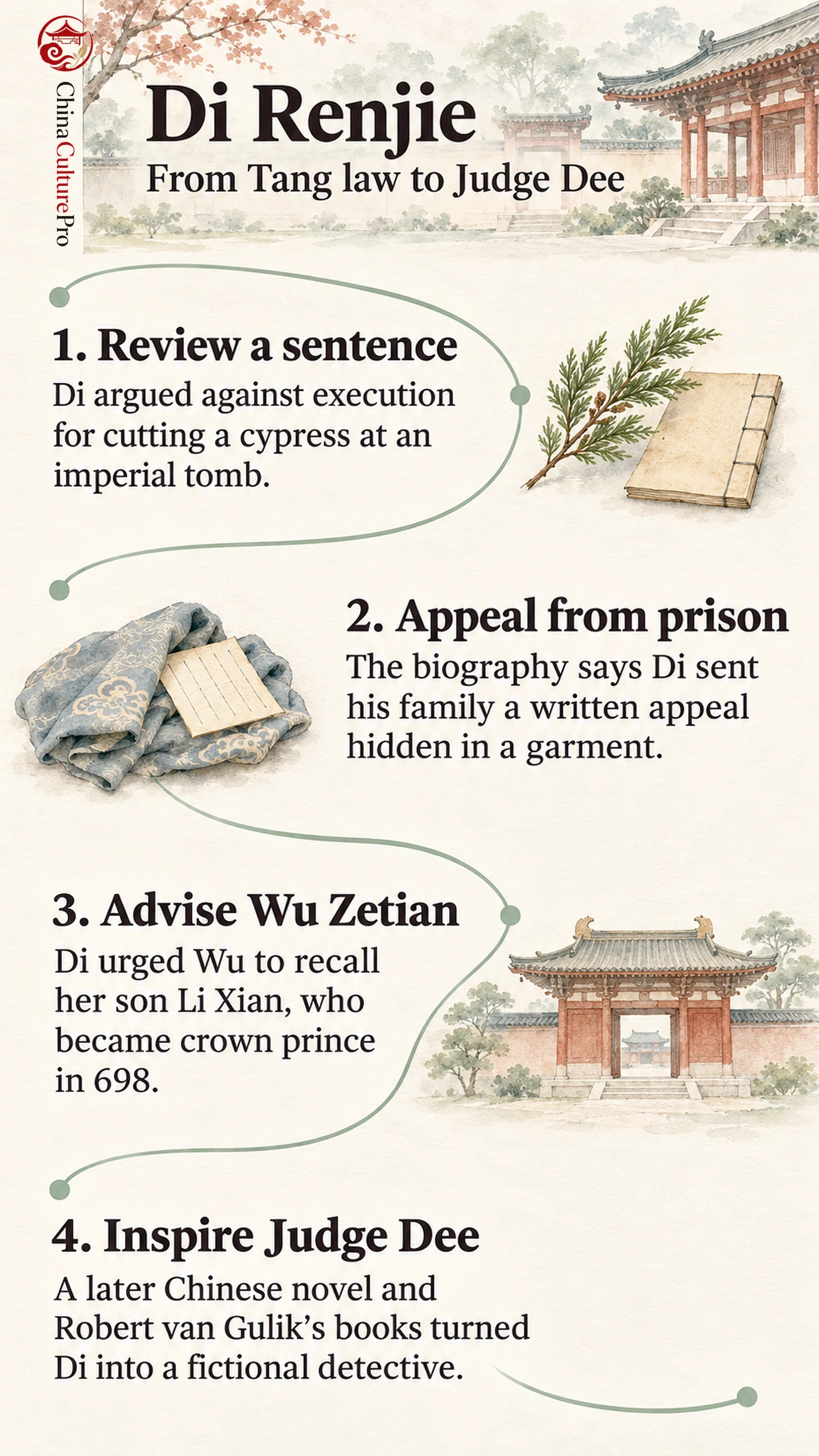
Read Di Renjie’s biographies for two kinds of argument at court. The cypress incident concerns how to punish an offense. The succession debate concerns whose family would rule.
What Di Renjie Did as a Tang Legal Official
Di held legal posts before joining the Court of Judicial Review (大理寺, Dàlǐ Sì). The Old Book of Tang (旧唐书, Jiù Tángshū) praises him for dealing with a large backlog of criminal proceedings.[1]
The biography recounts a dispute about a general named Quan Shancai (权善才, Quán Shàncái), who mistakenly cut a cypress at the imperial tomb of Zhaoling (昭陵, Zhāolíng). Gaozong called for his execution. Di argued that the law called for removal from office, and the emperor spared Quan. The dispute turned on sentencing.[1]
Prison and Return to Court Under Wu Zetian
After Wu established her own Zhou dynasty, called Wu Zhou (武周, Wǔ Zhōu), she made Di a chancellor. The official Lai Junchen (来俊臣, Lái Jùnchén) accused him of rebellion. According to the biography, a prisoner who confessed at once could escape a death sentence. Di confessed to the charge, then hid a written appeal in a garment sent to his family. Wu spared him and demoted him to a local post.[1] He eventually returned to senior office.[4]
How Di Renjie Influenced the Tang Succession
Wu’s nephews sought the succession. Di urged her to choose her son, arguing that he could honor her in the dynastic ancestral temple. The New Book of Tang (新唐书, Xīn Tángshū) puts Di at the center of the appeal. The Zizhi Tongjian (资治通鉴, Zīzhì Tōngjiàn) also records pressure from several advisers, including Ji Xu (吉顼, Jí Xū). In 698, Wu recalled Li Xian in the spring and named him crown prince in the autumn.[2][3]
Di recommended Zhang Jianzhi (张柬之, Zhāng Jiǎnzhī) for high office.[1]
In 705, Zhang helped overthrow Wu. Li Xian resumed the throne as Zhongzong (中宗, Zhōngzōng), restoring the Tang dynasty.[4][5]
How Di Renjie Became Judge Dee
The Chinese detective novel Di Gong’an (狄公案, Dí Gōng’àn) gives its magistrate three interwoven mysteries. One concerns the poisoning of a bride on her wedding night. Van Gulik translated material from the Chinese novel as Celebrated Cases of Judge Dee. He then wrote original stories, such as the investigation of a poet’s death in Murder in Ancient China.[7][8]
The scholar Vivienne Lo points to how little evidence survives for the kind of forensic investigation these stories give Di. The cypress episode and the poisoned-bride story illustrate the difference between a dispute about the punishment a law allowed and a fictional murder investigation.[6]
FAQs About Di Renjie
Was Judge Dee a real person?
Di Renjie was a historical official. Judge Dee is the name of the detective character based on him.[6][8]
Did Di Renjie lead the coup that restored the Tang?
Di died in 700, five years before the coup. He had argued for Li Xian’s return during the earlier succession debate.[2][4]
Were Judge Dee and Judge Bao the same person?
Judge Dee draws on Di Renjie of the Tang. Judge Bao draws on Bao Zheng (包拯, Bāo Zhěng), an official of the Song dynasty (宋, Sòng).[6]
Sources
[1] Liu Xu and others. Old Book of Tang, chapter 89, biography of Di Renjie
[2] Ouyang Xiu, Song Qi and others. New Book of Tang, chapter 115, biography of Di Renjie
[3] Sima Guang and others. Zizhi Tongjian, chapter 206
[4] Sima Guang and others. Zizhi Tongjian, chapter 207
[5] Sima Guang and others. Zizhi Tongjian, chapter 208
[6] Vivienne Lo. Dead or alive? Martial arts and the forensic gaze, in Film and the Chinese Medical Humanities
[7] Dover Publications. Celebrated Cases of Judge Dee, translated by Robert van Gulik
[8] University of Chicago Press. Murder in Ancient China: Two Judge Dee Mysteries