

Quick Answer: What Are Chinese Web-Novel Adaptations?
Chinese web novels (网络小说, wǎngluò xiǎoshuō) are prose stories published online, often in installments. Adaptations rework such fiction into screen productions or other media. To understand a particular project, identify its source author, the medium being used and the specific version you are watching.[1][2]
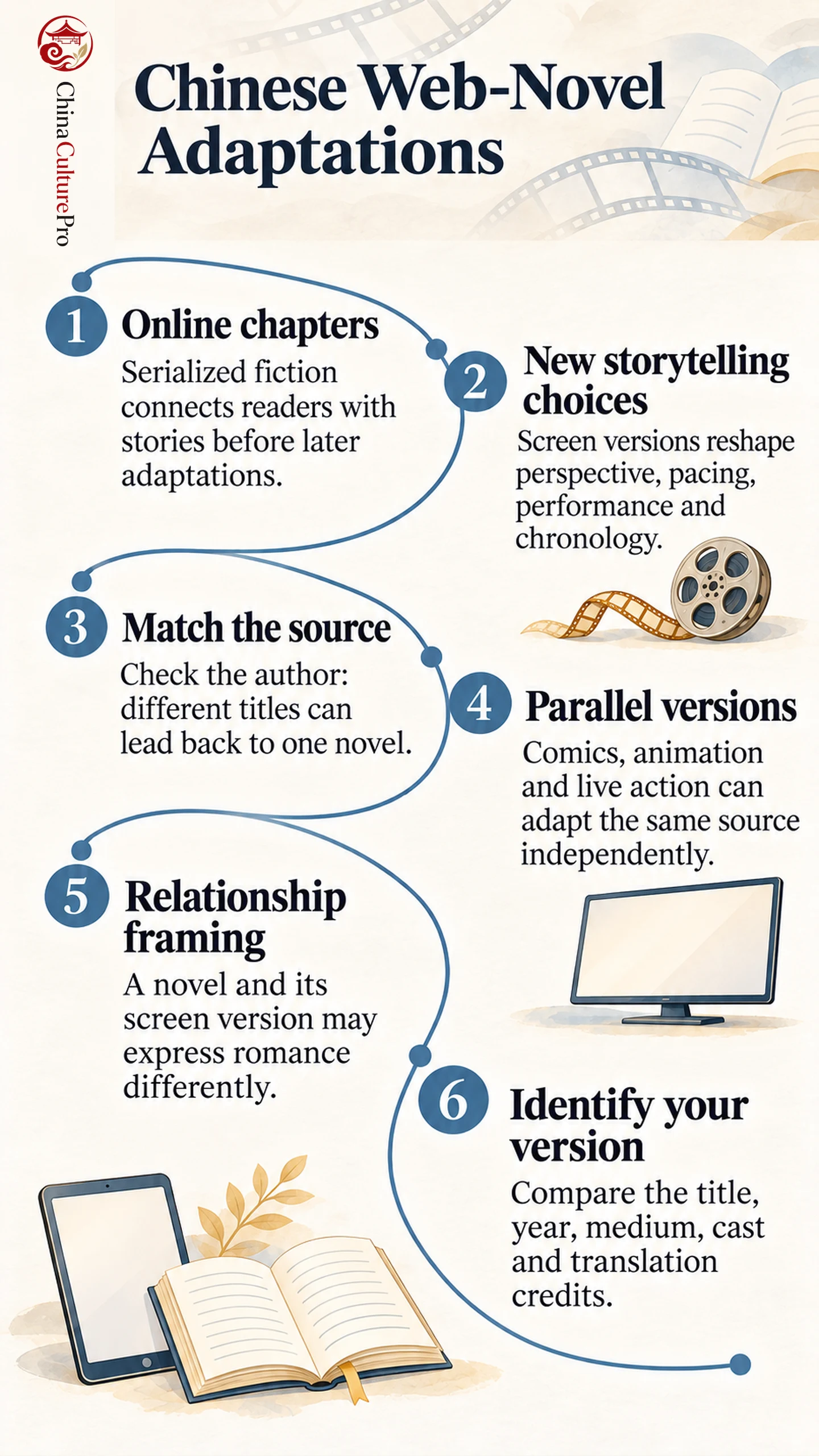
- Source: A novel can exist before its print translation, comic or screen adaptation.
- Medium: Live-action drama and animation organize performance differently.
- Version: Shared titles can cover productions with different casts, dates and story choices.
Compare the credits and narrative treatment before assuming that two versions tell the story in the same way.[3][8][9]
You may meet a character through an actor before discovering the online novel behind the role. Following that connection reveals another part of Chinese popular culture: stories moving between readers, publishers, creative teams and audiences, with each version making new choices.
From Online Serialization to an Adaptation Ecosystem
Online serialization lets readers encounter fiction in successive chapters. Its genres range across romance, imagined pasts, gaming and fantasy, and they can overlap. Research on web fiction emphasizes the relationship between these genres and the digital environments in which stories are produced and read. The guide to Chinese web novels explores the reading culture behind those forms.[1]
Popular stories can then enter a network of adaptations. China Literature describes developing works from platforms such as Qidian into comics, animation, films, television, web series and games. Its catalog includes Joy of Life and The King’s Avatar. This is one documented business setting for adaptation, alongside other publishers and platforms.[2]
A source credit identifies the underlying work. Screenwriting and directing credits identify other creative roles; check them before attributing a particular screen decision to the novelist.
What Changes When Words Become Screen Stories
Prose can move through a character’s thoughts, summarize background or explain a fictional system at length. A screen production has to find ways to make that information perceptible. Dialogue, performance, editing, settings, visual effects and sound can each carry part of the task. An internal judgment may become a visible reaction or a conversation.
Time can change even between related adaptations. Seven Seas’ comic synopsis places Wei Wuxian’s return thirteen years after his death; WeTV’s synopsis for The Untamed uses sixteen years. This small, checkable difference shows why a story’s chronology should be traced to the particular version being discussed.[11][12]
Genre sets further expectations. The King’s Avatar turns on professional gaming and a player’s return; Joy of Life uses an imagined imperial setting and questions of identity. The genre establishes a setting for comparison; the individual production determines its treatment. Chinese drama genres helps distinguish those storytelling conventions.[4][5][6]
Three Source Novels and Their Live-Action Versions
| Source novel | Autrice | Screen version | Comparison focus |
|---|---|---|---|
| The King’s Avatar | Butterfly Blue | The King’s Avatar, live-action series (2019) | Compare how a gaming comeback becomes performance and screen action.[4][5] |
| Joy of Life | Mao Ni, also written Maoni | Joy of Life, television series (2019) | Follow how identity and political intrigue are revealed in an imagined world.[6] |
| Grandmaster of Demonic Cultivation: Mo Dao Zu Shi | Mo Xiang Tong Xiu | The Untamed, live-action series (2019) | Compare narrative order and the framing of the central relationship.[3][7] |
The novelist’s name helps connect differently titled versions, as with Mo Dao Zu Shi and The Untamed. The publication history also helps identify the source: a later English edition or comic can become familiar to you first without being the original work.[3][11]
One Story Across Comics, Animation and Live Action
A novel need not pass through a comic before becoming a screen production. Seven Seas identifies Grandmaster of Demonic Cultivation as the novel series behind comics, animation and The Untamed. Its comic announcement explicitly describes the comic as an adaptation of the novels. These are related versions, with different ways to present the story.[11]
In Chinese comics, the reader navigates panels, captions and page or scroll layouts. Chinese animation gives movement, voices and sound a timed sequence. Live action adds actors, physical performances, locations and designed sets. These choices affect how a reader or viewer encounters a world, even where characters and major events are shared.
A continuing story can also branch into prequels, sequels and side narratives. Treat those labels as information to verify for the particular production. A shared fictional world does not make every installment a retelling of the same part of the novel.
Relationship Framing and Fan Readings
Relationship framing can be a substantial change. Mo Dao Zu Shi belongs to danmei (耽美, dānměi), Chinese Boys’ Love fiction centering romantic relationships between men. Its English publisher identifies that dimension of the novel alongside its historical-fantasy setting. The romance is part of the source’s identity.[3]
Research on The Untamed describes a more allusive screen presentation of the central romance. Gestures, exchanges and viewers’ interpretations therefore become important to discussing the relationship. It is useful to compare these choices directly instead of assuming the novel and screen version express everything identically.[7]
Audience responses also vary across languages and communities. A study of Spanish-speaking Untamed fans identified translation quality, genre confusion and different readings of queer representation as recurring concerns. Those findings concern that study’s audience, while showing why the same adaptation can invite different interpretations.[10]
How to Compare Books, Screen Versions and Translations
Begin with the experience you prefer. Reading first gives access to the prose before a performance supplies faces and voices. Watching first can help you recognize a cast of characters. Neither order prevents a useful later comparison. Choose one passage or scene and examine what each version lets you know, hear or see.
Confirm the title, year, medium and cast. Love O2O has both a 2016 film starring Jing Boran and Angelababy and a 2016 television series starring Zheng Shuang and Yang Yang. The medium and cast identify which production you mean.[8][9]
For the book, check the author, translator, edition and whether the publication is complete. For a series, check the season and its coverage of the source. Translated names, titles and honorifics can differ between editions, so keep track of which text and subtitles you are comparing. Publisher and production credits are the strongest starting points.[3][10]
FAQs About Chinese Web-Novel Adaptations
Are all Chinese dramas adapted from web novels?
No. Chinese screen productions have many sources, including original scripts, printed literature and historical material. Check the source credit of the individual series.
Is a comic always the source of the live-action series?
No. A comic can be a parallel adaptation of an earlier novel. The publisher’s records for Mo Dao Zu Shi distinguish the novels from the later comic.
Should you read the novel before watching its adaptation?
Either order can work. Reading first introduces the prose; watching first introduces a particular performance. Compare a specific passage and scene when you try the other version.
Does one screen season cover the whole novel?
Not necessarily. A season may adapt only part of a long story or reorganize its material. Check the version’s stated scope and the book edition rather than equating episode count with chapter count.
Sources
[1] Renren Yang, Chinese Literature and Thought Today. Felicities in Chinese Web Novel Genres
[2] China Literature. Company Profile
[3] Seven Seas Entertainment. Mo Xiang Tong Xiu Novel Licensing Announcement
[4] Webnovel. The King’s Avatar
[5] Netflix. The King’s Avatar (2019 Series)
[6] Apple TV. Joy of Life
[7] Global Storytelling, University of Michigan Publishing. Transmedia Adaptation, Sonic Affect, and Multisensory Participation in Contemporary Chinese Danmei Radio Drama
[8] Netflix. Love O2O (2016 Film)
[9] Netflix. Love O2O (2016 Television Series)
[10] Ana Gabriela Méndez Gutiérrez, SAGE Journals. Following The Untamed: Emerging Themes Among Spanish-Speaking Fandom
[11] Seven Seas Entertainment. Grandmaster of Demonic Cultivation Comic Licensing Announcement
[12] WeTV. The Untamed (2019 Series)