
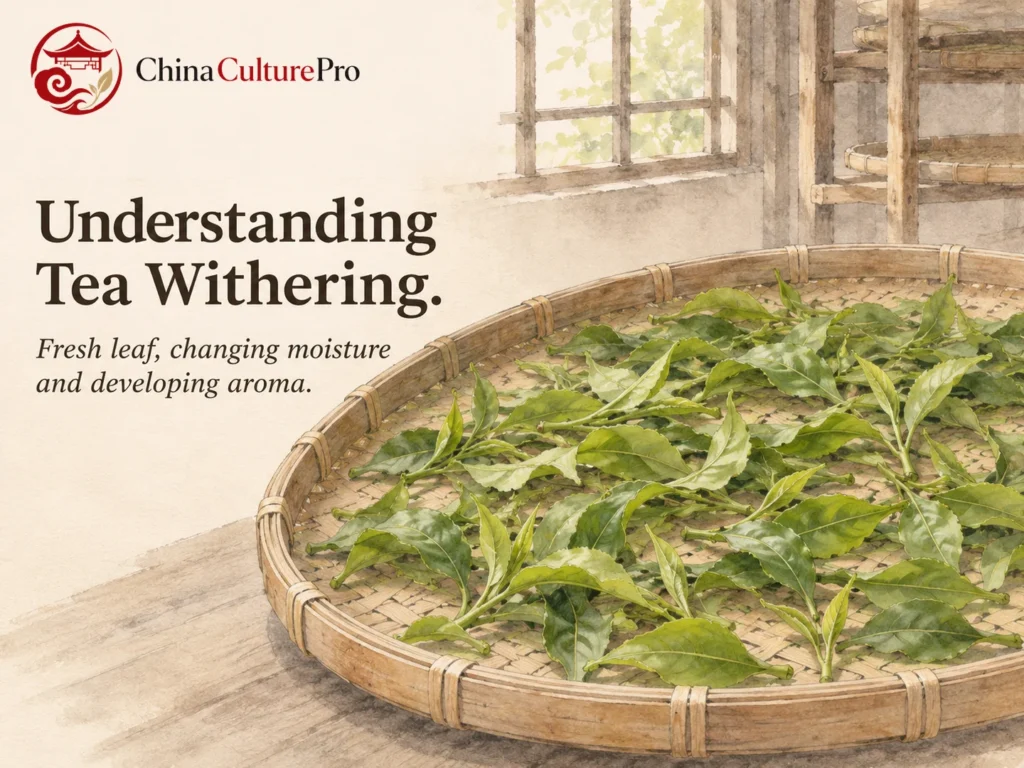

Quick Answer: What Is Chinese Tea Withering?
Tea withering(萎凋,wěidiāo)is an early processing stage in which freshly picked leaves lose part of their moisture while physical and biochemical changes develop.
- Leaf condition: Fresh leaves become less rigid and more manageable for subsequent handling.
- Methods: Sunlight, indoor spreading and air-assisted equipment offer different ways to manage the process.
- Flavor: Conditions during this stage can influence the aroma that develops in the finished tea.
Its place and extent depend on the tea being made. Withering is distinct from the later drying that prepares a finished tea for storage.

Fresh tea leaves spread across a tray still look far removed from the dry leaf in a packet. During withering, the maker manages a changing living material rather than simply leaving it to become dry. Understanding that distinction helps explain why two teas described as sun-withered need not taste alike.
What Changes in the Fresh Leaf
Water loss changes the leaf’s weight, volume and firmness. At the same time, chemical changes contribute to developing aroma and taste. These physical and chemical aspects belong together: a softer leaf is one observable part of a process whose flavor consequences are not visible from appearance alone.[1]
This preparation matters before operations such as tea rolling, which shapes and works the leaf. Withering itself is not the same operation as twisting, rubbing or compressing it. A description of “withered and rolled” identifies separate jobs rather than two names for one stage.
The useful question is what condition the maker is trying to achieve for the next operation. A photograph of drooping leaves, or a statement that they lost water, cannot explain the complete manufacturing decision.
Sunlight, Indoor Air and Withering Troughs
An account of Taiwanese partly oxidized tea describes solar withering followed by indoor withering and timely agitation. Sunlight supplies heat that speeds moisture loss; indoor resting continues the process under different conditions. The account identifies solar radiation, temperature, humidity and airflow as variables worth monitoring.[2]
Sunlight does not mean unlimited exposure. At a Yangmei research and training facility built in 2014, adjustable black shade netting beneath a glass roof allows the available light and heat to be moderated. This is a record of a particular facility, not the date when withering was invented.[3]
Indoor methods also differ: trays and air-assisted troughs describe different handling arrangements. The equipment name alone is not enough to reconstruct the treatment.
Ask how the leaves were handled and monitored. A single industrial setting does not supply a universal home-processing recipe.
Where Withering Fits in Different Tea Styles
Documented Fujian examples show why the word needs a tea-style context. The following routes describe particular traditions rather than a compulsory sequence for every producer.[4]
| Tea example | Place of withering | Distinction importante |
|---|---|---|
| Tieguanyin(铁观音,Tiěguānyīn) | Sun exposure, cooling and agitation precede fixation | Handling helps develop the leaf before heat control |
| Fuding white tea(福鼎白茶,Fúdǐng báichá) | Withering precedes gentle drying | The traditional route described omits fixation and rolling |
| Tanyang black tea | Withering precedes rolling and oxidation | Later operations develop a different finished style |
The table helps locate a stage; it is not a timetable. Comparing oxidation and fermentation separately avoids assuming that every change during leaf resting is microbial fermentation.
Likewise, fixation has a different role from moisture loss alone. The sequence around withering explains more than the isolated claim that a tea “uses traditional processing.”
What a White Tea Aroma Study Found
A 2022 experiment compared white tea withered indoors, in a withering tank and under sunlight. Sensory assessment found a stronger floral impression in the sunlight treatment and a stronger grassy impression in the tank treatment. Aroma analysis associated the floral difference particularly with geraniol and linalool, and the grassy difference with hexanal.[5]
These findings demonstrate a flavor consequence under the study’s conditions. They do not establish that sunlight always produces the finest tea, that every grassy note is a fault, or that the same result must occur in every cultivar and tea style.
When reading tea-aroma descriptions, distinguish an observed character from a quality ranking. “More floral” describes one sensory result; deciding which cup you prefer is a further judgment.
Reading Withering Claims Without Confusing Drying
Withering acts on fresh leaf early in manufacture. Final drying removes further moisture later in the route, while roasting may serve an additional flavor-development purpose.[1] The same energy source can therefore appear in different stages without making their purposes identical.
A claim of “sun-withered” does not mean that the finished tea was also sun-dried. Ask which stage the claim describes and which other operations followed it. That gives you a clearer basis for comparison than treating “sun,” “indoor” or “traditional” as a complete quality grade.
FAQs About Chinese Tea Withering
Is withering the same as drying tea?
No. Withering partially changes fresh leaf before later processing; final drying serves a later manufacturing purpose.
Must tea be withered in direct sunlight?
No. Indoor spreading and air-assisted methods also exist, and solar facilities may use adjustable shade.
Does every Chinese tea undergo the same withering?
No. Its extent and position depend on the tea style and manufacturing route.
Does sun withering always produce a better tea?
No. A favorable aroma result in one experiment is not a universal ranking of methods.
Sources
[1] Tea and Beverage Research Station. Tea classification and processing
[2] Ministry of Agriculture Academy, carrying the Tea Research and Extension Station release. Tea withering environment monitoring system, 2021
[3] National Taiwan Craft Research and Development Institute. Yangmei solar-withering facility record
[4] China Intangible Cultural Heritage Network. Fujian tea-making traditions, 2023
[5] Huiting Wu and colleagues. Effects of Three Different Withering Treatments on the Aroma of White Tea, 2022