
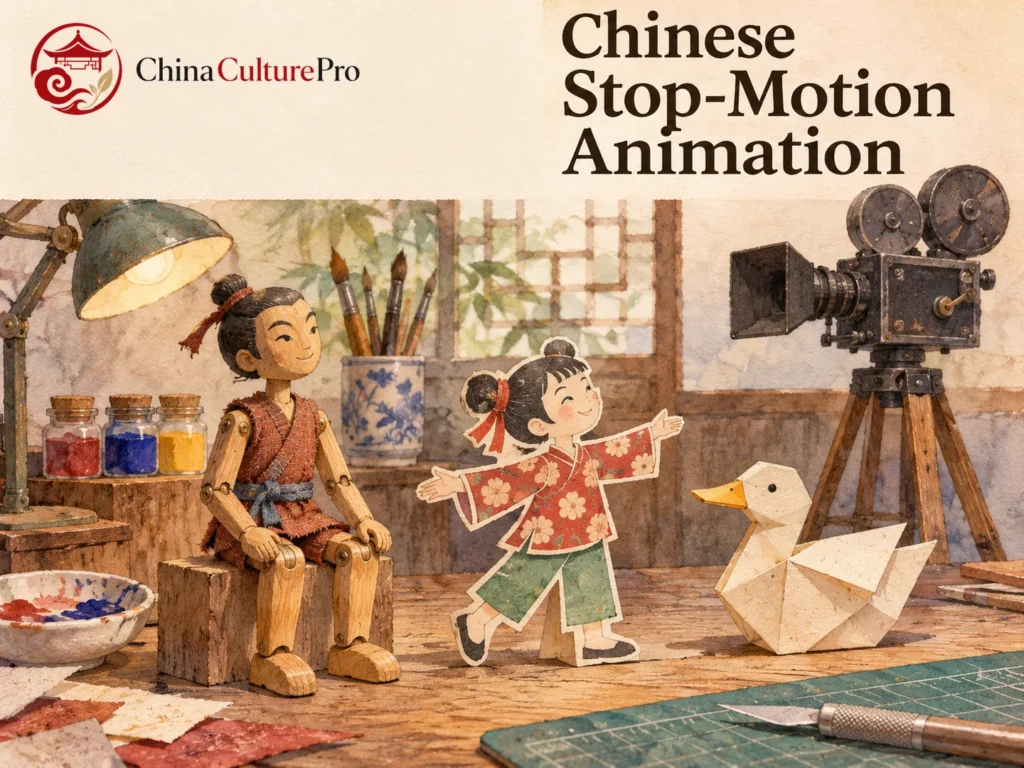

Quick Answer: What Is Chinese Stop-Motion Animation?
Chinese stop-motion animation (定格动画, dìnggé dònghuà) creates movement by changing physical figures or objects between photographed frames. Chinese studios have used three-dimensional puppets, flat jointed cutouts and folded paper. The materials give each film a different range of shapes, shadows and gestures.[1][2][3][4]
- Puppets: Solid figures move in miniature space.[4]
- Cutouts: Flat pieces move across or over one another.[1]
- Folds: Creased paper gives a figure volume and an angular silhouette.[3]
Compare a cutout and a folded figure to see how the same process can produce different silhouettes.
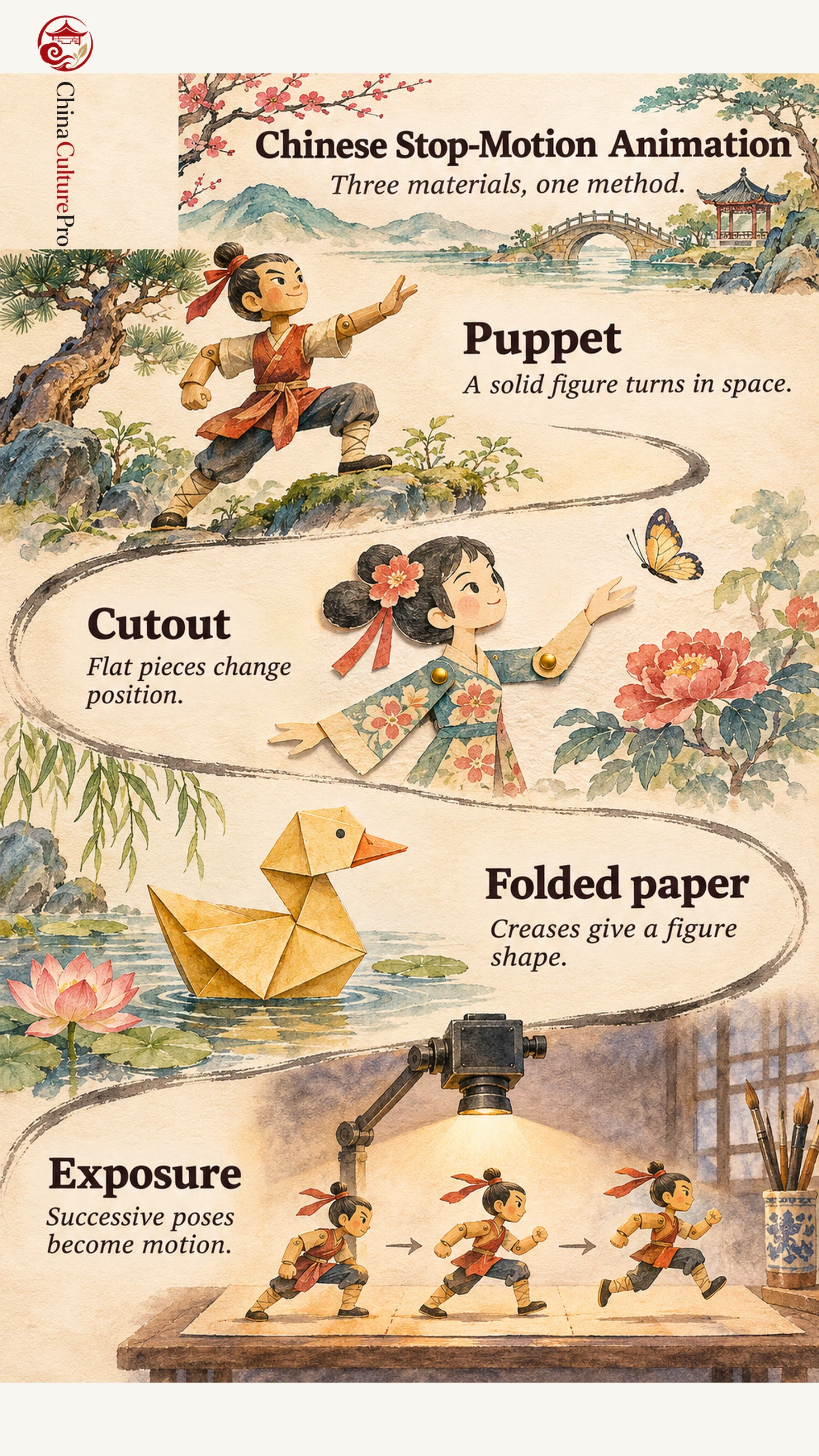
A puppet can turn toward the camera, and a cutout can slide across a painted field. Both can move on screen through the same basic principle, even though their physical shapes give the shots a different look.[1][4]
How Successive Exposures Create Motion
An animator changes a pose or position and captures another image. When the images play in sequence, the viewer sees movement. A held position can create a pause. A larger change between consecutive images can make a movement seem brisker.[1]
The effect depends partly on how objects occupy the shot. A shadow, a gap or a slight overlap can show where an object is as it moves. Those details can help the viewer follow the figure even during a small movement.
Flat Cutouts and Volumetric Puppets
In Chinese paper-cut animation, a jointed paper limb can swing across a flat background. The 1958 short Pigsy Eats Watermelon belongs to this tradition. Shapes overlap to suggest distance and movement without a solid model.[1]
A puppet has surfaces that can catch light at different angles. The 1963 feature Peacock Princess demonstrates how a production can build a larger story around that physical presence. Chinese puppet animation includes shorter fairy tales and recurring characters too.[2][4]
Folded Paper in The Clever Ducks
Yu Zheguang’s The Clever Ducks (聪明的鸭子, Cōngming de Yāzi, 1960) used folded-paper animation (折纸片, zhézhǐpiàn) at Shanghai Animation Film Studio. The paper creases give the ducks a different shape from the flat outline of a cutout. In the film, the angular shapes contribute to the ducks’ expressive motions.[3]
What Viewers Can Infer From a Film
Watch whether a figure turns in space, whether a foreground piece overlaps it and how light changes across its surface. These clues help form a question about the production. They cannot establish the method on their own. Digital animation can imitate many of the same effects. Chinese ink wash animation offers a separate example of a look that can be produced through different tools.[1][2]
FAQs About Chinese Stop-Motion Animation
Are All Chinese Paper Animations Cutouts?
Chinese studios also made folded-paper films. A folded figure has creases and physical depth, while a flat cutout stays largely planar.[1][3]
Is Ink Wash Animation Stop Motion?
Ink wash describes a visual tradition and associated techniques. Classic ink animation combined drawn and photographed elements, and its look can also be made digitally.[2]
Can Digital Animation Look Like Stop Motion?
Yes. Texture, lighting and timing can evoke stop motion. Look for production notes or credits that identify photographed objects when the distinction matters.
Sources
[1] China Cartoon and Animation Museum. Paper-cut animation: From folk art to animation classics
[2] M+. Chinese Mainland: Revisiting the Classics
[3] China Federation of Literary and Art Circles. The Clever Ducks
[4] Hong Kong Leisure and Cultural Services Department. Peacock Princess