


Quick Answer: What Is Chinese Spinach Amaranth?
Chinese spinach here means amaranth greens (苋菜, xiàncài), commonly the leafy vegetable Amaranthus tricolor. The edible parts include young leaves and stems; this is a leafy vegetable, not dry amaranth grain.[1][5]
- Forms: Green, red-purple and mixed-color leaves.
- Texture: Tender leaves soften in cooking; older stems can be fibrous.
- Uses: Garlic stir-fries and greens cooked with broth.
Confirm the vegetable rather than relying on the English word spinach alone.[2][3][4]
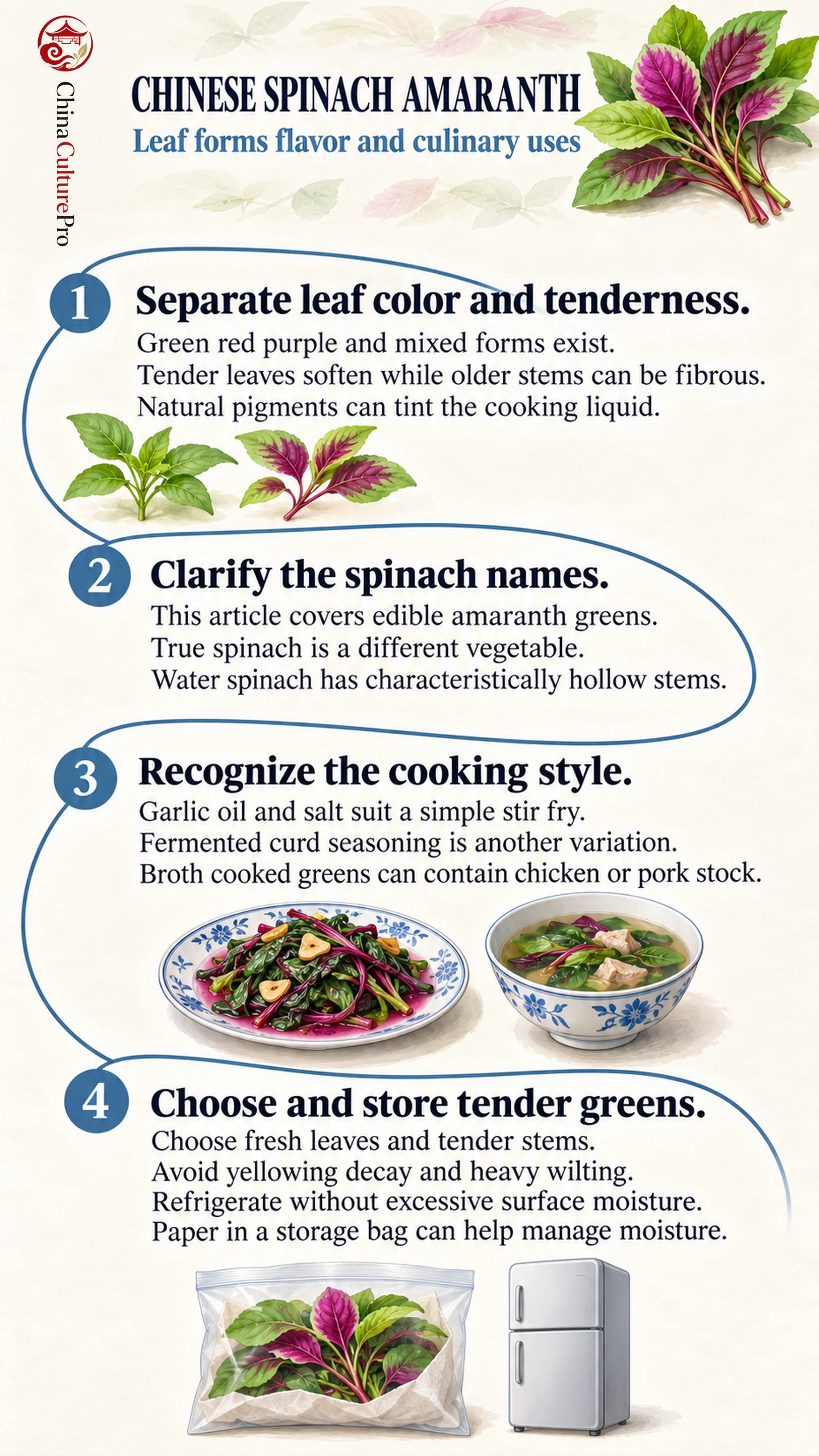
A bundle of green leaves with magenta centers can become a soft vegetable dish with pink-tinted juices. Color helps distinguish some market forms, but leaf age, stem tenderness and the surrounding seasoning matter just as much when choosing how to use it.
Green and Red Leaves, Tenderness and Cooking Color
Leaves range from broad oval to narrower, pointed shapes. Green, red-purple and mixed-color forms exist, with largely similar flavor in a documented cooking comparison.[1][2][4]
Tender leaves soften in cooking; older, fibrous stems can remain tougher. Maturity and color are separate characteristics.[2][3][4]
Red-purple pigments in amaranth belong to the betalain group. They can be extracted into water, explaining how colored leaves can tint surrounding liquid pink or red. That visible color transfer need not indicate added dye.[5]
Amaranth, True Spinach and Water Spinach
| Nom | What the name refers to here |
|---|---|
| Amaranth greens | The leafy amaranth discussed in this article. |
| True spinach (菠菜, bōcài) | The familiar spinach vegetable, a separate ingredient. |
| Water spinach (空心菜, kōngxīncài) | A leafy vegetable with characteristically hollow stems. |
Use the Chinese names and leaf or stem characteristics alongside the Chinese vegetable guide to clarify market labels.[1][3]
Garlic Stir-Fries and Broth-Cooked Greens
A simple stir-fry pairs amaranth with garlic, oil and salt. Fermented bean-curd seasoning is another documented variation.[2]
Amaranth can also be cooked with concentrated stock from chicken or pork bones. This broth-cooked preparation is not automatically a vegetarian dish.[3]
Choosing Tender Bunches and Keeping Them Fresh
Choose tender leaves and stems without yellowing, decay or heavy wilting. Flowering or coarse stems can indicate older, tougher produce.[2][4]
Refrigerate promptly, keeping leaves intact and avoiding excessive surface moisture. Paper inside a food-storage bag can help manage moisture. Use the greens promptly.[4]
FAQs About Chinese Spinach Amaranth
Is Chinese spinach the same as ordinary spinach?
No. Here it means edible amaranth, a separate vegetable.
Are red and green amaranth entirely different in flavor?
Not necessarily; their flavor can be largely similar.
Why can red amaranth color the cooking liquid?
Natural water-extractable pigments can enter the liquid; the color is not by itself proof of added dye.
Is a plate of greens in broth always vegetarian?
No. The stock may contain chicken or pork.
Sources
[1] National Parks Board Singapore. Amaranthus tricolor: Names, Leaves and Edible Parts
[2] Judy and Bill Leung, The Woks of Life. Stir-Fried Pink Amaranth Greens
[3] Maggie Zhu, Omnivore’s Cookbook. Chinese Greens: Names, Texture and Broth Cooking
[4] Wang Fudong and Ke Nanyan, Beijing Agricultural Technology Extension Station, published by China Food Safety News. Amaranth: Harvest Maturity and Household Storage
[5] Jay E Howard, Maria B Villamil and Chance W Riggins, Frontiers in Plant Science. Amaranth as a Natural Food Colorant Source