


Quick Answer: What Is Chinese Science Fiction Fandom?
Chinese science fiction (科幻, kēhuàn) fandom includes readers, writers, editors and translators who share stories and meet through magazines, online discussions and conventions. Chengdu became a center through the work of Science Fiction World (科幻世界, Kēhuàn Shìjiè) and international gatherings. In 2023 the city hosted the first Worldcon held in China.[1][2][4]
- Magazines: Editors brought work by different authors to a regular readership.[1][4]
- Translation: Readers gained access to works in additional languages.[3]
- Meetings: Conventions put readers and writers in the same space.[1][2]
Follow the magazine, translation and convention records to see different parts of the community.
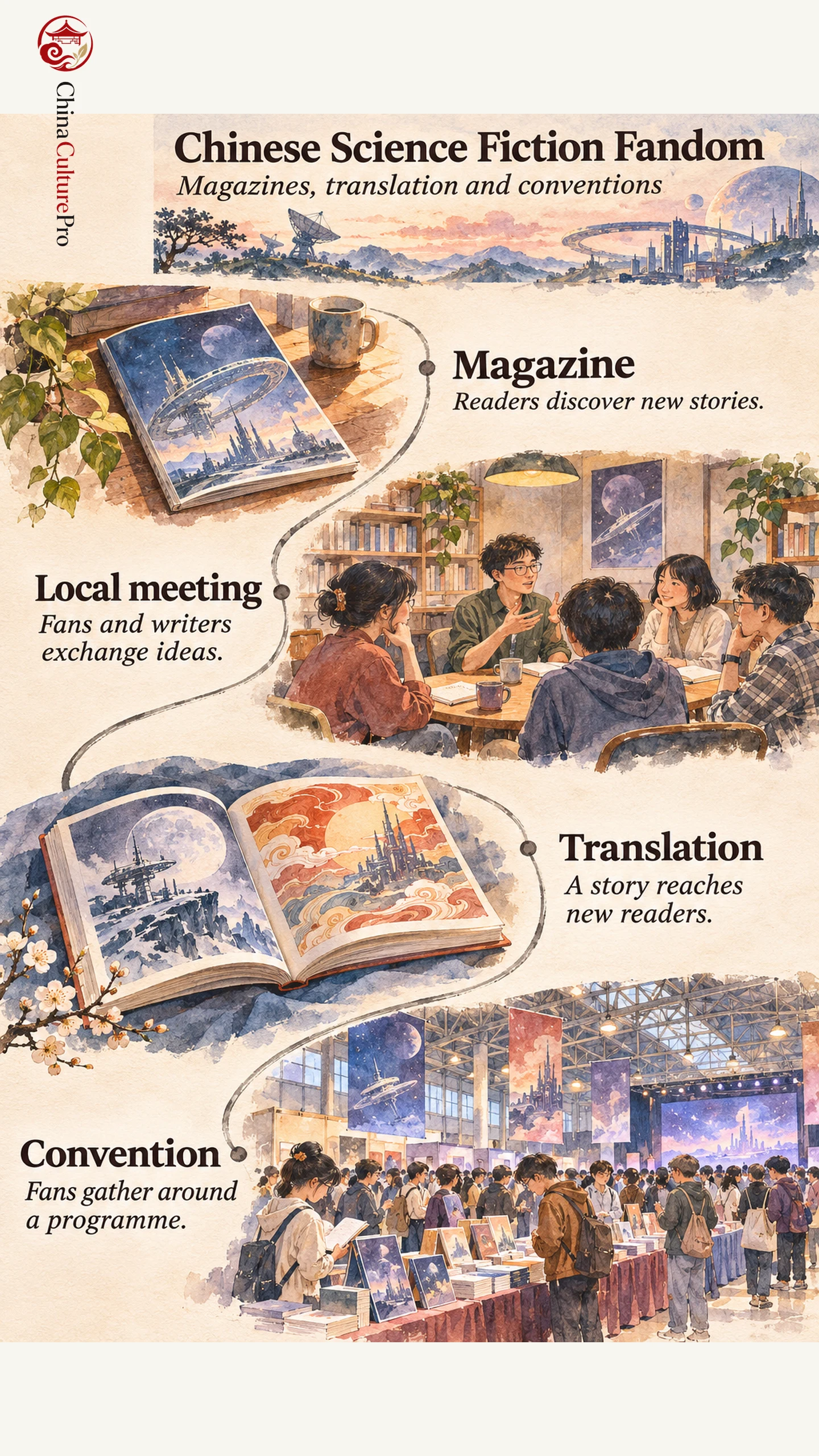
A reader can find a story in a magazine, encounter the same writer in translation and then hear a discussion at a convention. Chinese science fiction developed through such links long before its international awards drew new attention.[1][3][4]
How Magazines Connected Readers
A magazine can give readers a reason to return month after month. Editors bring together stories, writers find a recognizable venue and readers can follow developments in the genre. The Chengdu-based Science Fiction World became one of these meeting points in print. It is also an example of the periodical traditions behind Chinese reading culture today.[1][4]
Why Chengdu Became a Meeting Place
In 1991, the magazine helped organize the World SF annual meeting in Chengdu. Its account also records an international science fiction meeting in 1997, with writers and astronauts taking part. These were opportunities for exchange before the city hosted Worldcon. The 1991 World SF meeting and the 2023 Worldcon are separate entries in Chengdu’s convention history.[1][4]
How Translation Changed the Audience
Ken Liu translated Cixin Liu’s The Three-Body Problem (三体, Sāntǐ) into English. The English edition appeared in 2014 and the novel won the 2015 Hugo Award for Best Novel. That record identifies the translator and helps explain why readers in different languages encountered the book at different times.[3]
A translated novel and a Chinese web novel can find audiences through different publishing channels. The original title and translator’s name help you follow a particular work across those channels.
What the Chengdu Worldcon Revealed
The 81st World Science Fiction Convention ran in Chengdu in October 2023. Its programme included fan gatherings, exhibitions and talks. Those activities let readers meet people whose work they might otherwise have encountered only on the page.[2][4]
The Hugo Awards were also presented during the convention. Afterward, exclusions from the ballot raised questions about the administration of eligibility and prompted international criticism. The published award results and subsequent reporting document that dispute separately from the convention’s other activities.[4][5]
FAQs About Chinese Science Fiction Fandom
Was the 1991 Chengdu Event a Worldcon?
The 1991 event was a World SF annual meeting. The 2023 event was the World Science Fiction Convention, also known as Worldcon.[1][2]
Who Translated The Three-Body Problem Into English?
Ken Liu translated the novel by Cixin Liu. The first English edition was published in 2014.[3]
Did Chinese Science Fiction Fandom Begin With Worldcon?
Magazine networks and international gatherings in Chengdu predated the city’s 2023 Worldcon by decades.[1][2][4]
Sources
[1] Science Fiction World. Magazine and convention history
[2] Lifen Yao and colleagues. For a new era of symbiosis: The 81st World Science Fiction Convention
[3] The Hugo Awards. Official results for the Best Novel award in 2015
[4] Associated Press. How Chinese science fiction found a wider international audience
[5] The Hugo Awards. Official results for Chengdu Worldcon