


Quick Answer: What Is the Gougu Theorem?
The gougu theorem (勾股定理, gōugǔ dìnglǐ) is the Chinese right-triangle rule known in English as the Pythagorean theorem. Square the two sides that form the right angle and add those areas to get the area of the square on the hypotenuse.[1][2][3]
- A familiar example: Legs of length 3 and 4 give a hypotenuse of length 5 because 9 + 16 = 25.[1]
- A Chinese source: The Zhoubi Suanjing (周髀算经, Zhōubì Suànjīng) records right-triangle knowledge in a work concerned with mathematics and astronomy.[1][2]
- A visual argument: Zhao Shuang (赵爽, Zhào Shuǎng) explained the relationship by rearranging areas. Later editions preserve a diagram associated with that argument.[1][2][4]
The early text, the later commentary and the surviving printed diagram belong to different stages of transmission.[1][4]
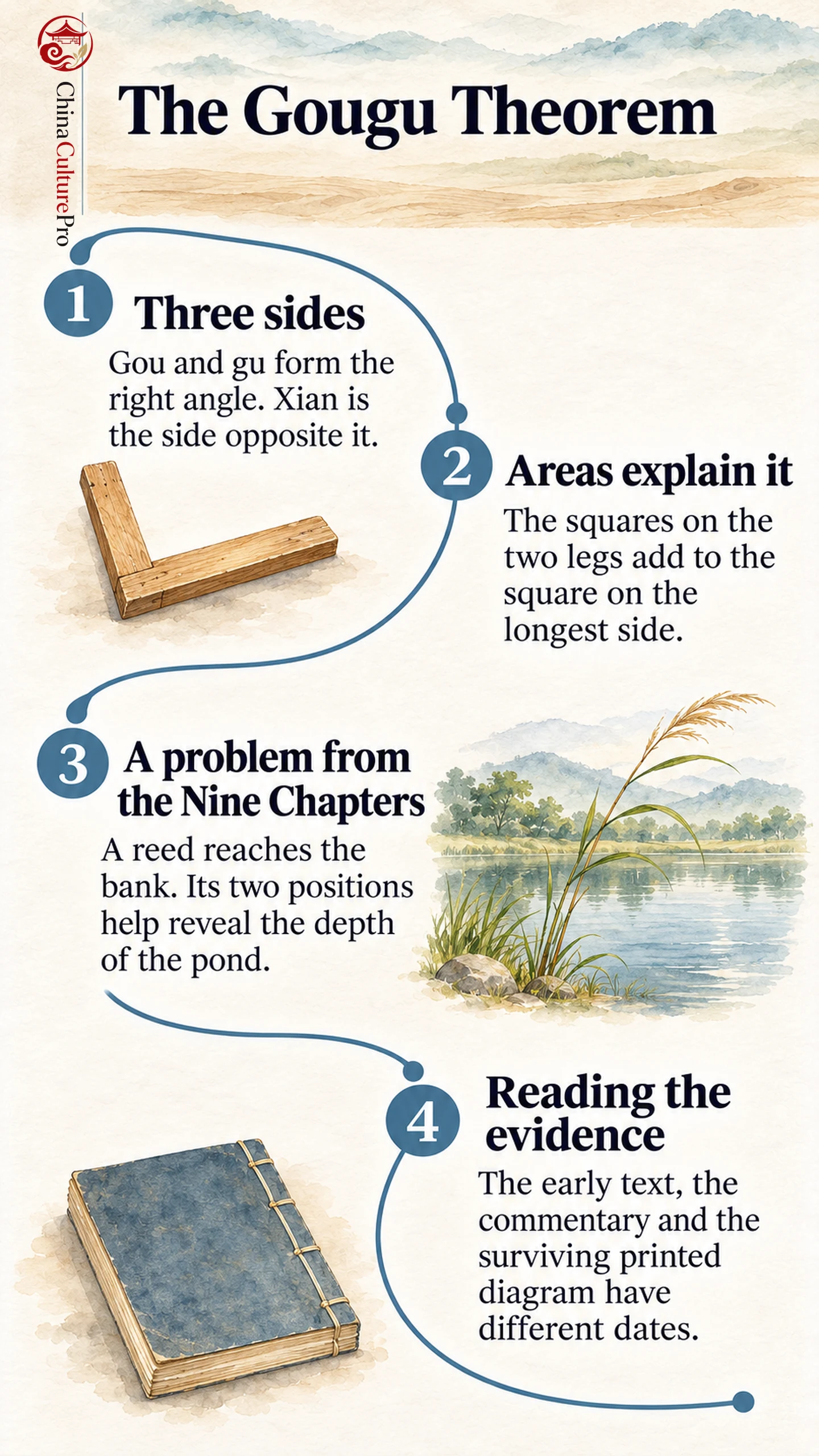
The Chinese rule can look familiar and still ask something different of a reader. A modern textbook often leads with letters and an equation. In Chinese mathematical sources, instructions for finding a distance sit alongside diagrams that make the equivalence of areas visible.
What Gou, Gu and Xian Mean
The shorter leg is gou (勾, gōu), the longer leg is gu (股, gǔ) and the hypotenuse is xian (弦, xián). In a measurement problem, these legs can represent a ground distance and a height. In a real drawing, identify the right angle first. The hypotenuse is always the side opposite it, regardless of which way the triangle points.[2][3]
In modern notation, if the legs are a and b and the hypotenuse is c, then a² + b² = c². The squares in the expression refer to areas. To find c after adding the two smaller squares, take the square root of the sum. To find a missing leg when you already know the hypotenuse and the other leg, subtract the known leg’s square from the hypotenuse’s square before taking the square root. Both operations follow from the same relation.[2][3]
A right triangle with legs 5 and 12 gives 25 + 144 = 169, so its longest side is 13. A triangle with legs 1 and 1 also follows the rule, even though its hypotenuse is not a whole number. The names describe positions and lengths. They do not require a particular set of numbers.[2][3]
How the Hypotenuse Diagram Shows the Rule
Imagine four copies of a right triangle with legs 3 and 4. Set the triangles inside a square so that the four hypotenuses form the outer edges. Arrange each long leg beside a short leg of the neighboring triangle. The exposed inner segments form a small square. Each of the four triangles has area 6, and the little square has side 4 − 3 = 1, so the outer square has area 4 × 6 + 1 = 25. That is also the sum of the areas of squares on the original legs, 9 + 16.[1][2]
The numbers make the rearrangement easy to follow, but the argument survives a change of lengths. The four triangles together have area 2ab. The central square has area (b − a)², taking b as the longer leg. Add these quantities and the cross terms cancel, leaving a² + b². The equation is a modern way to express the same area reasoning. It need not have been written in this notation to be a general argument.[2][4]
The drawing also helps explain why the rule involves squares. Sliding a triangle to another position preserves its area. The central square and four triangles can therefore account for the same total even when the pieces are grouped differently. The proof needs that area equality, rather than a measurement taken from the printed drawing.[2][4]
When examining a surviving page, ask what its diagram establishes. It shows how a particular edition presented the relationship between the areas. Its date cannot by itself date the first proof. The guide to primary and secondary sources explains why a later copy can be direct evidence for its own period and indirect evidence for an older text.[1][4]
How the Nine Chapters Uses the Rule
Chapter 9 of The Nine Chapters on the Mathematical Art (九章算术, Jiǔzhāng Suànshù) works with distances that have to be inferred. One problem starts with a square pond 10 units across. A reed grows at its center and sticks up 1 unit above the water. Pull its tip to the nearest edge and it just reaches the bank. How deep is the pond?[2]
The horizontal distance from center to bank is 5. If the depth is d, the upright reed has length d + 1. When pulled to the bank, the reed becomes the hypotenuse of a triangle with legs d and 5. In modern notation, (d + 1)² = d² + 25. Expanding and canceling the matching squares gives 2d + 1 = 25, so the water is 12 units deep and the reed is 13 units long. This describes the reasoning in modern terms. The historical text gives a computational rule for the answer.[2]
The problem shows where the practical work lies. Before applying the theorem, the solver has to find the right triangle and explain why the same length appears in two different positions. That habit also matters in Chinese surveying mathematics and in Liu Hui’s polygon calculations for pi, where the right triangle may have to be constructed inside a larger figure.[2]
FAQs About the Gougu Theorem
Did the Zhoubi originally contain the familiar diagram?
The familiar printed image is preserved in later editions. A Ming printing dated 1603 is one example. The diagram associated with Zhao’s commentary helps explain the theorem, while the date of that printing dates the surviving object.[1][4]
Does gougu work only for the 3–4–5 triangle?
It applies to every right triangle. The 3–4–5 example is convenient because all three side lengths are whole numbers and the areas are easy to compare.[1][2]
Does the Chinese evidence establish who discovered the theorem first?
The Chinese sources document early use of the relationship and several ways of explaining it. They do not establish the first person to discover it anywhere.[1][2]
Sources
[1] Frank J. Swetz and Victor J. Katz, Mathematical Association of America. Mathematical Treasures: Zhoubi Suanjing
[2] Victor J. Katz. A History of Mathematics, Chapter 7: Ancient and Medieval China
[3] Wen-Tsun Wu. Selected Works on the History of Chinese Mathematics
[4] The Mathematical Association. Zhao’s Lost Diagram