


Quick Answer: What Is Pure Land Buddhism in China?
Pure Land (净土, jìngtǔ) Buddhism in China centers on Amitabha (阿弥陀佛, Āmítuófó) and the aspiration for rebirth in his Pure Land. It is a tradition of belief and practice within Chinese Buddhism, rather than necessarily one exclusive institutional denomination.
- Religious goal: favorable conditions for progress toward awakening.
- Practice: nianfo (念佛, niànfó), including recollecting the Buddha and reciting his name.
- Communities: both monastics and lay practitioners participate.
Chinese Pure Land history should be understood in its own settings, rather than simply mapped onto Japanese religious institutions.[1]
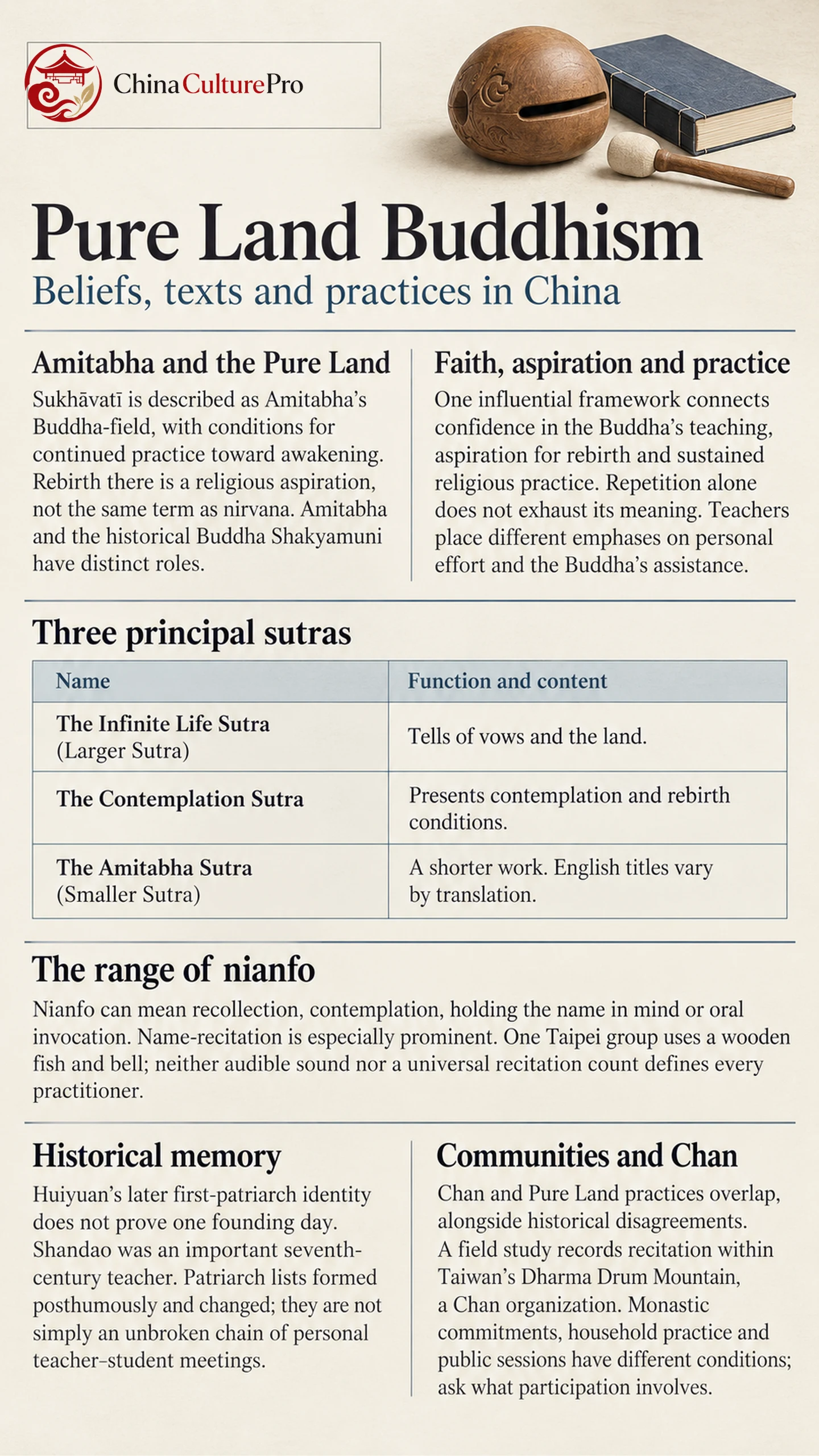
Hearing a congregation recite Amitabha’s name reveals one part of Pure Land practice. Its meaning also depends on scriptures, religious aspiration and views of the Buddha’s assistance. These elements help explain why Pure Land devotion appears across different Chinese Buddhist communities.
Amitabha and the Western Pure Land
Sukhāvatī (极乐世界, Jílè Shìjiè), often called the Western Land of Bliss, is described as Amitabha’s Buddha-field. In Pure Land teaching, its conditions support continued Buddhist practice and progress toward awakening. Rebirth there is a religious goal; it is not the same term as nirvana, nor simply the end of all further cultivation.[2]
The sutras describe Amitabha’s vows and the possibility of assistance for ordinary beings. Devotees understand these teachings as a source of confidence and hope. A cultural explanation can describe that conviction without treating rebirth or supernatural assistance as independently demonstrated events.[3]
Amitabha is also distinct from Shakyamuni, the historical Buddha. The scriptural accounts present Shakyamuni teaching about Amitabha and his land. Keeping the speaker and the Buddha being described separate prevents the common assumption that every mention of Buddha names one identical figure.[3]
The Three Principal Pure Land Sutras
| Chinese title and common English name | English naming variation | Reader’s orientation |
|---|---|---|
| Infinite Life Sutra (无量寿经, Wúliàngshòu Jīng) | Often called the Larger Sutra | Narrative of Amitabha’s vows and the establishment of his land |
| Contemplation Sutra (观无量寿佛经, Guān Wúliàngshòu Fó Jīng) | Also called the Meditation Sutra | Contemplation practices and accounts of conditions for rebirth |
| Amitabha Sutra (阿弥陀经, Āmítuó Jīng) | Often called the Smaller Sutra | A shorter description of the land and religious commitment to the Buddha |
These three texts are central reference points, but a familiar English title may differ between translations. Larger and Smaller distinguish two texts; they are not quality rankings. The Contemplation Sutra is a third work, not an expanded edition of the shorter text.[3]
Treat scriptural narratives and later commentary as different kinds of writing. A description of a vow or vision conveys Buddhist teaching; the date and circumstances of a Chinese commentary require separate historical evidence. The texts also belong within the larger world of Chinese Buddhist literature and practice.
Nianfo: Recollection and Reciting the Buddha’s Name
Nianfo has a wider meaning than chanting aloud. Depending on context, it can refer to recollecting a Buddha, contemplation, holding the name in mind or oral invocation. In Chinese Pure Land settings, Amitabha-name recitation became especially prominent. These meanings should not be collapsed into one sound or one method.[5]
Name-recitation invokes or honors the Buddha. It should not automatically be called a mantra merely because it uses a repeated sacred phrase. Nor does hearing a recitation tell an observer whether a participant’s main emphasis is aspiration for rebirth, mental recollection or another explanation supplied by the teacher.
The form can be communal or individual. Fieldwork in Taipei records a wooden fish (木鱼, mùyú) and bell accompanying one group’s recitation. Such ritual sound belongs to a particular session, rather than defining all nianfo. There is no single recitation count or timetable that defines every Chinese Pure Land practitioner; the relevant teaching and institutional setting supply those details.[8]
Faith, Aspiration and Practice
One influential formulation is faith, vows and practice (信愿行, xìn yuàn xíng). In this framework, the elements have connected but different jobs:
- Faith: confidence in the Buddha’s teaching and assistance.
- Aspiration: the intention to seek rebirth in the Pure Land.
- Practice: sustained religious activity, especially Buddha-name recitation in the teaching described here.
The formulation appears prominently in the letters of Yinguang (印光, Yìnguāng). It explains why mechanical repetition alone does not exhaust the tradition’s religious meaning: recitation is situated within commitment and a goal. Different teachers discuss personal effort and the Buddha’s assistance with different emphases, so one brief opposition between self-power and other-power cannot summarize every Chinese account.[4][2]
Historical Roots and Later Patriarch Lists
Huiyuan (慧远, Huìyuǎn), associated with a community at Mount Lu in the early fifth century, later became honored as the first Pure Land patriarch. That retrospective identity should not be confused with documentary proof that an independent Pure Land denomination was founded on one exact day. Research distinguishes the historical monk’s activities from the later uses of his memory.[7]
Shandao (善导, Shàndǎo), a seventh-century teacher, is important in the development of name-recitation teaching. Later patriarch lists linked influential figures across different centuries. The lists were formed posthumously and changed; they do not simply record one uninterrupted chain in which each listed master personally taught the next.[2][6]
This history allows for continuity without assuming institutional uniformity. Teachers, commentaries and communities transmitted practices while later authors organized their understanding of the past. Religious veneration of a patriarch and historical reconstruction therefore answer related but different questions.
Pure Land, Chan and Living Buddhist Communities
Chan (禅, chán) and Pure Land practice have often intersected. Historical research also documents tensions over how recollection, rebirth and awakening should be understood. Shared practice did not eliminate every disagreement, and doctrinal debate did not prevent people from participating in both.[5]
A field study of Dharma Drum Mountain (法鼓山, Fǎgǔ Shān) describes group Amitabha-name recitation within a Taiwanese Chan organization. The study records monastic leadership and lay participation, alongside different ways of explaining Pure Land. This is a concrete example of coexistence within one organization, not a standard for all Chinese Buddhists.[8]
Monastic commitments, household practice and public sessions at Temples bouddhistes have different conditions. When observing or learning, ask what a session involves and follow the host community’s conduct rules. A cultural overview explains beliefs and terms; it does not replace the community’s own teaching or ritual guidance.
FAQs About Pure Land Buddhism in China
Is Pure Land Buddhism Chinese or Japanese?
Both China and Japan have important Pure Land traditions. Their histories are connected, but Chinese practices should not automatically be treated as one Japanese-style independent sect.
Does nianfo always mean chanting aloud?
No. The term includes mental recollection and contemplation as well as oral invocation. Name-recitation is especially prominent, but volume alone does not define the practice.
Is the Pure Land the same as nirvana?
No. The Pure Land is understood as a Buddha-field conducive to progress toward awakening. Nirvana concerns liberation; the two expressions are not interchangeable place names.
Can Chan and Pure Land be practised together?
Yes. Chinese communities have combined them in different ways. Such overlap coexists with historical disagreements and different explanations of practice.
Is Amitabha the same as the historical Buddha?
No. Amitabha is the Buddha associated with the Western Pure Land; Shakyamuni is the historical Buddha who is presented as teaching about that land in the sutras.
Sources
[1] Charles B. Jones, University of Hawaii Press, original monograph description. Chinese Pure Land Buddhism: Understanding a Tradition of Practice
[2] Charles B. Jones, original Smithsonian Associates lecture handout. Pure Land Buddhism: An Easier Path to Nirvana?
[3] BDK America, canonical translation publisher. The Three Pure Land Sutras
[4] Yinguang’s letters, translated by Thich Thien Tam, practitioner text. Faith, Vows and Practice
[5] Morten Schlütter, original historical research. Who Is Reciting the Name of the Buddha? as Gongan in Chinese Chan Buddhism
[6] Chen Chienhuang; translated by Charles B. Jones, original historical analysis. The Process of Establishing and Justifying the Thirteen Patriarchs of the Lotus School
[7] Charles B. Jones, author’s research abstract. Was Lushan Huiyuan a Pure Land Buddhist? Evidence from His Correspondence with Kumarajiva About Nianfo Practice
[8] Jens Reinke, original field research. Innovation and Continuity in the Pure Lands: Pure Land Discourses and Practices at the Taiwanese Buddhist Order Dharma Drum Mountain