
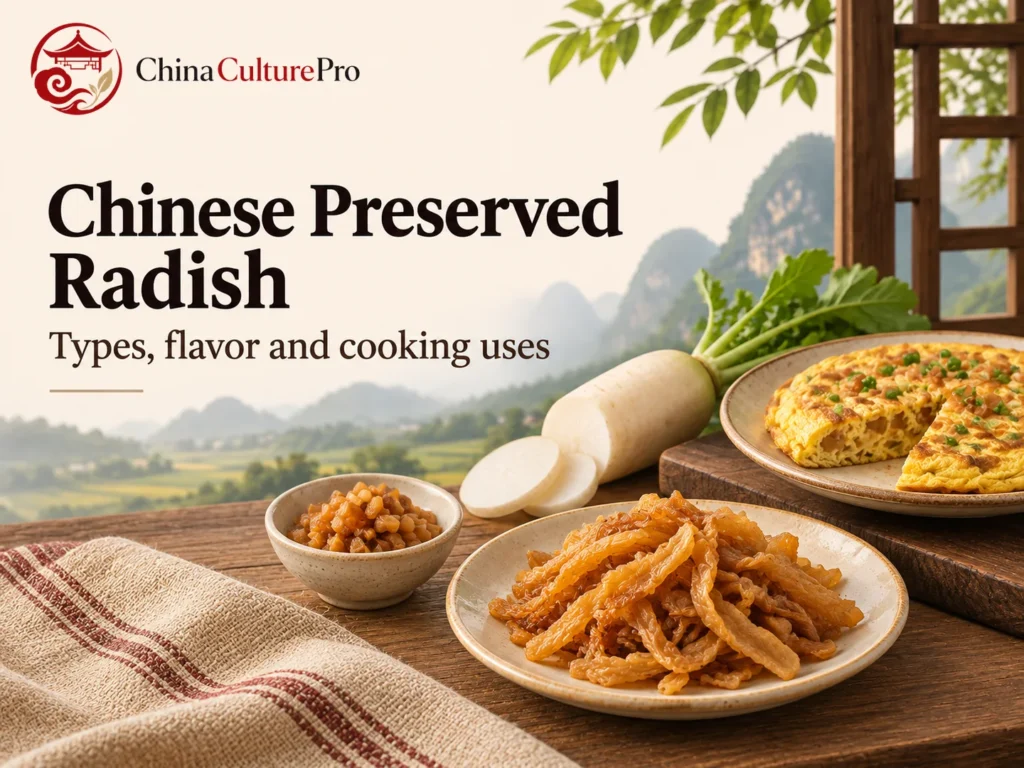

Quick Answer: What Is Chinese Preserved Radish?
Chinese preserved radish(萝卜干,luóbogān)is a cured radish-root ingredient made through processes such as salting and drying. It contributes concentrated seasoning and a distinctive bite to Chinese dishes. [1][4]
- Seasoning: Salty and sweeter versions exist.
- Cut: Strips, larger pieces and chopped products serve different purposes.
- Age: Ordinary crisp products differ from some darker, softer aged preparations.
- Uses: Eggs, fillings, rice accompaniments and soups are common settings. [1][4][5]
Those choices are separate: a chopped product can be sweet or salty, and dark color alone cannot establish age, quality or safety.

Small golden-brown pieces in eggs and darker radish added to soup may belong to the same broad preserved-vegetable family. Their texture and seasoning can be quite different. Knowing the cut, preparation and intended use helps you choose the ingredient a dish actually needs.
Luobogan, Cai Po and the Radish Behind the Names
The English spelling cai po(菜脯,càifǔ in Mandarin)is associated with a regional name for dried preserved radish. Related spellings include chai poh and chye poh. These should not be read as standard Mandarin pinyin; a Taiwanese-language dictionary records the pronunciation tshài-póo. [2][3][4]
The underlying ingredient is radish root. Salting and drying change its moisture and flavor, producing a cured vegetable rather than simply a smaller fresh radish. A supplier’s ordinary product, for example, lists only daikon radish and salt. Other preparations add sugar or further seasonings. [4][8]
Among Chinese preserved vegetables, this plant identity matters. Preserved radish identifies the root ingredient, not every brown chopped pickle. A preserved mustard stem is a swollen mustard stem, distinct from radish root. [10]
Sweet or Salty, Strips or Pieces, Young or Aged
Read three separate buying choices instead of looking for one universal “authentic” packet. A region’s sweet and salty recipes can differ, while cutting and aging add further distinctions. [1][4][5][8]
| Buying question | Points à vérifier |
|---|---|
| How is it seasoned? | A salt-led product differs from a sweetened one; sweetened radish can still contain salt. |
| How is it cut? | Strips or larger pieces retain a distinct bite, while diced radish distributes through eggs or a filling. |
| Is it an aged preparation? | Some aged products are much darker and softer, with a different flavor and intended cooking role. |
An ordinary preserved daikon product can remain crisp and snappy despite being dried and cured. “Dried” does not mean it must crumble into powder or become completely brittle. [4]
An aged product described by the same supplier is soft and supple, near black, and has earthy notes with a plum-like sweetness. That description belongs to that product, not to every dark radish in a market. Color alone cannot verify how it was made or how long it was kept. [5]
Likewise, a ready-seasoned diced radish is not identical to plain strips simply cut smaller. Its ingredient list may include sugar and preservatives as well as radish and salt. [8]
Regional Traditions: Xiaoshan and Meinong
Xiaoshan dried radish(萧山萝卜干,Xiāoshān luóbogān)is one documented regional tradition in Zhejiang. Field reporting describes producers working with radish strips through repeated salting and drying, with both traditional and newer spicy products in their range. This is a regional example, not a formula for every preserved radish. [9]
Meinong in southern Taiwan provides another useful distinction. Its documented sweeter preparation uses soybean meal, salt and sugar, while a salt-led preparation follows a different seasoning approach. A sweet label therefore does not mean the ingredient is unsalted or contains no soy-related material. [1]
These examples show how local practices shape a shared ingredient category. They do not require you to rank every version on a single scale or assume that the same English name means the same recipe.
How Preserved Radish Works in Eggs, Rice and Soup
A preserved radish omelet(菜脯蛋,càifǔdàn)pairs eggs with small pieces of cured radish; loosely stir-fried egg versions also exist. One Hakka-style radish and egg preparation uses finely chopped radish, garlic and scallions, producing tender eggs with small salty bites. [1][6]
That contrast helps explain its place alongside congee or plain rice. The mild starch base accompanies a strongly seasoned dish rather than needing the radish to act as its main vegetable portion. The egg dish can be eaten at different meals, not only breakfast. [6]
In Taiwanese food, chopped preserved radish also appears in stuffed rice dumplings and savory rice snacks. Small pieces distribute flavor through the surrounding ingredients, so the radish may be more noticeable in the bite than in the appearance of the finished food. [1]
Aged radish has another role: it can flavor soup, where a softer piece contributes its deeper cured taste. It should not automatically be selected for the crisp texture expected in a chopped radish stir-fry. [5]
These uses connect with Hakka cooking and other regional food traditions without making preserved radish exclusive to one community. [1][6][9]
Preparing a Product and Reading Its Label
Some plain salted radish is rinsed before cooking to reduce excess salt. Draining then helps you cut it or combine it with eggs as the recipe intends. This is a preparation choice for a particular product and dish, not a guarantee that rinsing removes every seasoning or makes any product safe. [6][7]
Other products are explicitly sold ready to eat. One diced version is labeled for immediate eating, mixing or stir-frying. Automatically washing that preparation as though it were plain salted strips could remove part of its intended seasoning. Follow the actual product directions. [8]
Choose intact packaging with clear identification and a known producer. A public-health buying guide notes that preservatives may be present in some products; their presence alone is not proof of poor quality. Check ingredients and handling instructions instead of judging solely by whiteness or darkness. [7]
If dietary restrictions matter, inspect seasonings and the complete dish. The Meinong sweet preparation illustrates possible soy-related ingredients, while an egg dish plainly includes egg. The word “radish” cannot establish the suitability of everything served with it. [1][6]
FAQs About Chinese Preserved Radish
Is Preserved Radish the Same as Preserved Mustard Stem?
No. Radish is a root ingredient; preserved mustard stem comes from the swollen stem of a mustard vegetable. [10]
Does Sweet Preserved Radish Still Contain Salt?
It can. The documented sweet preparation from Meinong uses salt along with sugar and soybean meal. Check the particular formula rather than reading “sweet” as “unsalted.” [1]
Must Every Preserved Radish Product Be Rinsed?
No. Rinsing is useful for some salted products used in cooking, while other preparations are labeled ready to eat. Follow the packet and the dish’s needs. [6][8]
Sources
[1] Taiwan Ministry of Agriculture. Radish in food culture: preserved radish and Meinong traditions
[2] Taiwan Ministry of Education. Cai po: Taiwanese language dictionary entry
[3] Taiwan Ministry of Education. Fu: Mandarin character entry in the concise dictionary
[4] Yun Hai Taiwanese Pantry. Preserved Daikon Radish: supplier ingredients and usage
[5] Yun Hai Taiwanese Pantry. Aged Preserved Daikon Radish: distinct product description
[6] Judy Leung. Hakka Eggs with Preserved Radish: original preparation
[7] Changhua County Public Health Bureau. Buying preserved radish: June 2025 consumer information
[8] Chaoshan Collection. Preserved Radish: original diced product ingredients
[9] China Food News via CNR. Xiaoshan dried radish: original field visits and producer interview (2023)
[10] Taiwan Ministry of Agriculture. Mustard: crop introduction and useful plant parts