
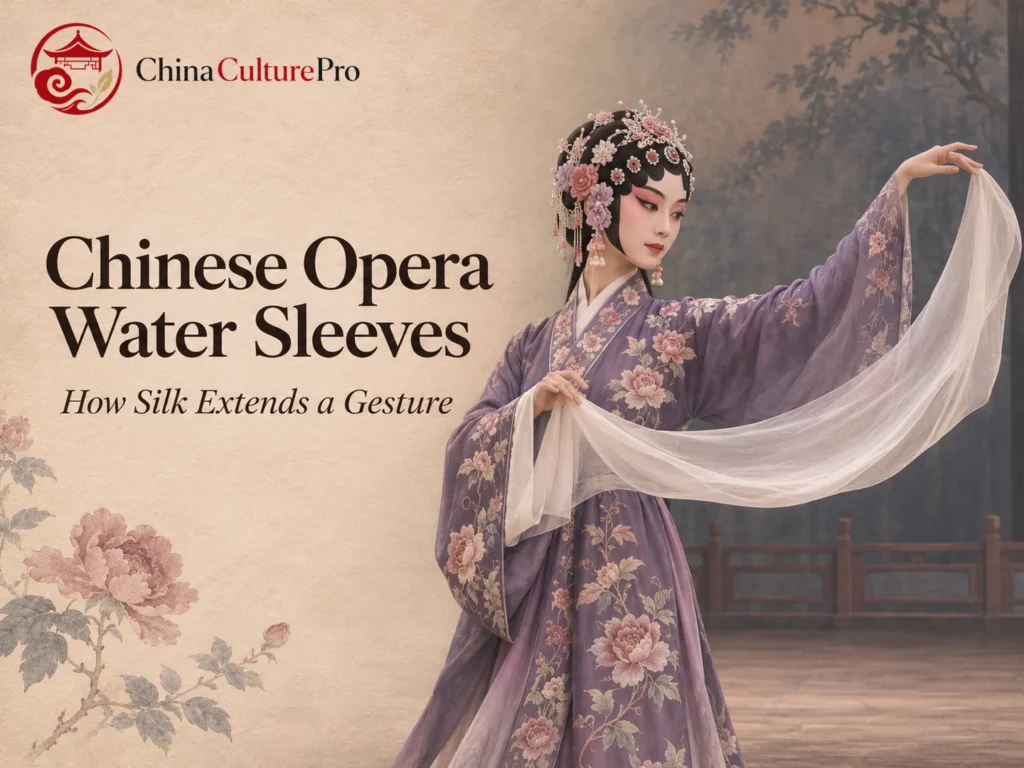

Quick Answer: What Are Water Sleeves?
Water sleeves (水袖, shuǐxiù) are lengths of fabric sewn onto the ends of costume sleeves. In Peking opera (京剧, jīngjù), they are traditionally white silk. A performer can gather the fabric at the wrist or let it unfold to make an arm movement visible from farther away.[1][2]
- Costume: The pale cloth extends beyond the cuff of the robe.[1][2]
- Gesture: The cloth can make a bow, a hidden face or a tearful pause easier to read.[1]
- Timing: Watch the fabric settle after the performer’s hand has stopped.[2][6]
Read the sleeve in relation to the face, posture and scene. The same kind of movement can serve different feelings.
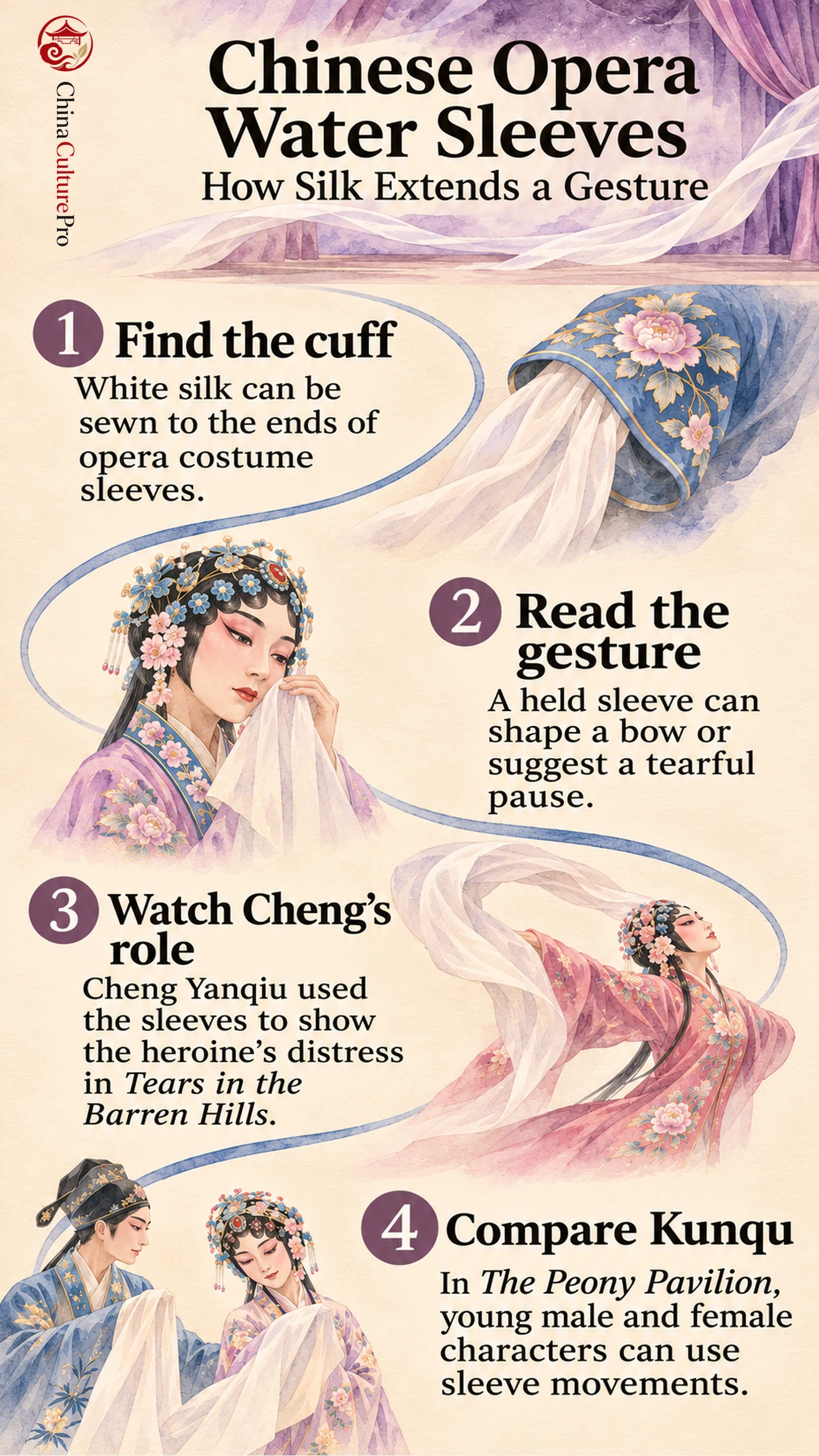
A performer can make the end of a sleeve quiver while the rest of the body stays nearly still. The pale cloth makes that small movement easier to see across the theater.
Where the White Silk Meets the Costume
In the Peking opera wardrobe, white silk can be sewn to court robes, formal robes and informal robes. When the fabric is folded back at the wrist, the embroidered part of the sleeve is still visible. When the silk hangs loose, its length gives a gesture a shape beyond the end of the hand.[1][2]
Look for the join with the robe when a performer raises a hand. The extension is part of the costume, and the long white shape is especially visible against a dark or patterned robe. Actors also rehearse in practice garments fitted with the extensions.[2]
What a Sleeve Gesture Can Show
A sleeve held across the body can give a bow a formal shape. A raised sleeve can conceal the face in a moment of shyness. Brushing a cheek with the cloth can suggest crying. A covered face can take on a different meaning depending on where the performer looks and what has just happened.[1]
The cloth can also draw a larger shape. Shaking a hanging sleeve makes small ripples. A broad flick can extend the direction of a look or give weight to a forceful line. An observer can follow the size and speed of the fabric’s movement to see where the action builds or subsides.[2][6]
Cheng Yanqiu’s Sleeves in Tears in the Barren Hills
Cheng Yanqiu (程砚秋, Chéng Yànqiū) used extended sleeve movement in Tears in the Barren Hills (荒山泪, Huāngshān Lèi). In a scene of the heroine’s distress, the sleeve movements help give her agitation a visible form. Cheng plays Zhang Huizhu (张慧珠, Zhāng Huìzhū) in the 1956 color film, giving viewers a record of his acting in the role.[3][4]
Watch how the reach of the cloth changes in the more agitated passages. A large arc can fill the space around the performer. A brief moment when the silk falls toward the body can change the pace again.[2][3]
Long Sleeves in Kunqu
Long sleeves also appear in Kunqu (昆曲, kūnqǔ). In The Peony Pavilion (牡丹亭, Mǔdān Tíng), young male and female characters can use shaking sleeves as part of their acting. That movement can intensify moments of sorrow, longing or joy.[5]
The same kind of gesture can belong to more than one role type. Notice how each performer combines the sleeve with the pace and posture of the character.[2][5]
FAQs About Chinese Opera Water Sleeves
Why are they called water sleeves?
The name refers to the way the fabric can ripple like water when an actor moves the sleeve.[1][6]
Do only female characters wear water sleeves?
Both male and female characters can wear them. In Peking opera, several kinds of robe have the white extensions in costumes for both groups of roles.[2]
Sources
[1] China National Peking Opera Company. What Do Water Sleeves Do in Peking Opera?
[2] Alexandra B. Bonds, ZoneModa Journal. Chinese Opera and Qin Wenbao: When Costumes Become Living Canvases
[3] China National Peking Opera Company. The Cheng Yanqiu School
[4] Beijing Daily. Cheng Yanqiu Performs Tears in the Barren Hills
[5] University of Georgia Open Scholar. Water Sleeve Analysis in The Peony Pavilion
[6] ChinaCulture.org. Beijing Opera Sleeve Skills