


Quick Answer: What Is a Chinese Opera Film?
A Chinese opera film brings xiqu (戏曲, xìqǔ) to the screen. It can record an excerpt or adapt a full stage work. Singing, movement and accompaniment carry the drama, while framing and editing change how the audience sees it.[1][2][5]
- Performance: Song, gesture and percussion can preserve recognizable stage conventions.[5][6]
- Film form: Close-ups and changes of setting can give a familiar play a different scale.[5]
- Variety: Mainland Yue opera (越剧, yuèjù) films and Hong Kong’s opera-derived musicals developed different sounds and styles.[2][3][4]
Check both the original opera form and the film’s language.
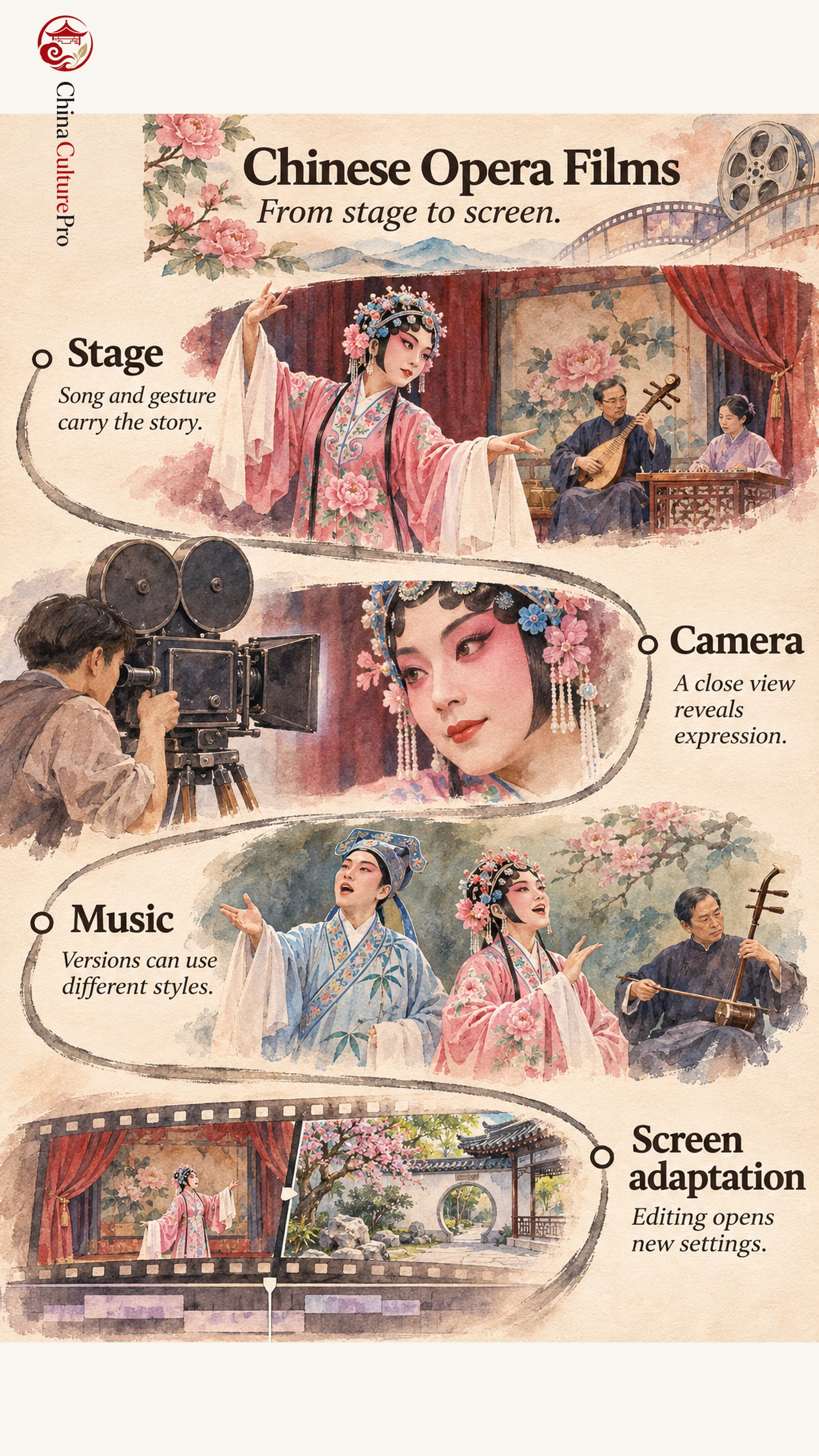
A performer sings a line, then the camera moves close enough to catch a small change of expression. The words and melody may be familiar to a stage audience. The framing gives a film audience a new way to watch that moment.[5]
From Dingjun Mountain to Full-Length Opera Films
In 1905, the Fengtai Photo Studio filmed Peking opera performer Tan Xinpei in an excerpt from Dingjun Mountain (定军山, Dìngjūn Shān). Film histories often use the event as a landmark in the emergence of domestically produced Chinese film. An excerpt from a performance was a subject that early audiences could already recognize. See Chinese silent cinema for the wider period.[1]
By the 1950s, full-length opera films had become part of the mainland industry. Hong Kong also developed a substantial body of Cantonese opera films and related screen musicals. These productions ranged from opera adaptations to costume films organized around songs.[2][3][6]
How the Camera Changes a Stage Performance
In a theater, you see the actor within the stage picture. A filmmaker can isolate a hand or face, or show another character’s reaction halfway through a sung passage. An outdoor location can also supply detail that an opera stage leaves to convention or gesture.[5]
The adaptation choices depend on what a film wants to preserve. A camera can make a regional form accessible to viewers far from the original troupe. In Chinese local opera revival, filmed excerpts also serve audiences learning to recognize a genre’s music and movement.
One Legend in Yue Opera and Huangmei Diao
The story of Liang Shanbo and Zhu Yingtai, often called the Butterfly Lovers in English, appears in a mainland Yue opera film first released in 1953 and in Li Han-hsiang’s The Love Eterne from 1963. The earlier film was a hit in Hong Kong after its local release in December 1954.[2][3]
The Love Eterne uses Mandarin and huangmei diao (黄梅调, huángméidiào), a musical style recognizable through tuneful, recurring sung passages. Compare the rhythm of the singing and the use of scenery in each film’s version of the same story. The guide to Chinese film music explains other ways songs and scores work onscreen.[2][4]
Cantonese Opera Films and Princess Chang Ping
In Princess Chang Ping (帝女花, Dì Nǚ Huā, 1976), John Woo retains many sung passages from Tong Tik-sang’s Cantonese opera. He also uses close-ups and turns descriptions of turmoil at the palace into visual action. The film offers a concrete example of a production that preserves an opera’s musical identity while changing what its audience sees.[5]
FAQs About Chinese Opera Films
Is an Opera Film a Recording of a Live Show?
Some films preserve a stage excerpt. Others use a stage work as the basis for a screen adaptation, with changes to the setting, framing or order of events.[1][5]
Are Chinese Opera Films All in Mandarin?
Language varies with production and tradition. The Love Eterne is in Mandarin, while Princess Chang Ping is in Cantonese.[4][5]
Which Chinese Opera Film Should I Watch First?
Try The Love Eterne for a complete Mandarin musical adaptation of a familiar legend. Choose Princess Chang Ping to see a Cantonese opera reworked for the camera.[4][5]
Sources
[1] Encyclopedia of China Publishing House. The Birth of Chinese Cinema
[2] Oxford University Press. The Opera Film in Chinese Cinema: Cultural Nationalism and Cinematic Form
[3] Hong Kong Film Archive. Heritage and Integration: A Study of Hong Kong Cantonese Opera Films
[4] Hong Kong Film Archive. The Love Eterne
[5] Hong Kong Film Archive. Princess Chang Ping
[6] Hong Kong Film Archive. Collection and Resources