


Quick Answer: What Is a Chinese Generation Name?
A generation character (字辈, zìbèi) can mark a person’s place within a family’s or branch’s sequence of generations. Relatives in the same genealogical generation may share it within their given names.
- Shared across relatives: A character can connect siblings and cousins within a family’s naming practice.
- Ordered across generations: A generation poem (派诗, pàishī) supplies characters to successive generations.
- Family-specific practice: Placement, participation and the sequence itself can vary between families and branches.
- A research clue: Matching characters need to be checked against family records and known relationships.
This custom does not apply to every Chinese name, and genealogical generation does not mean age group. [1][4]
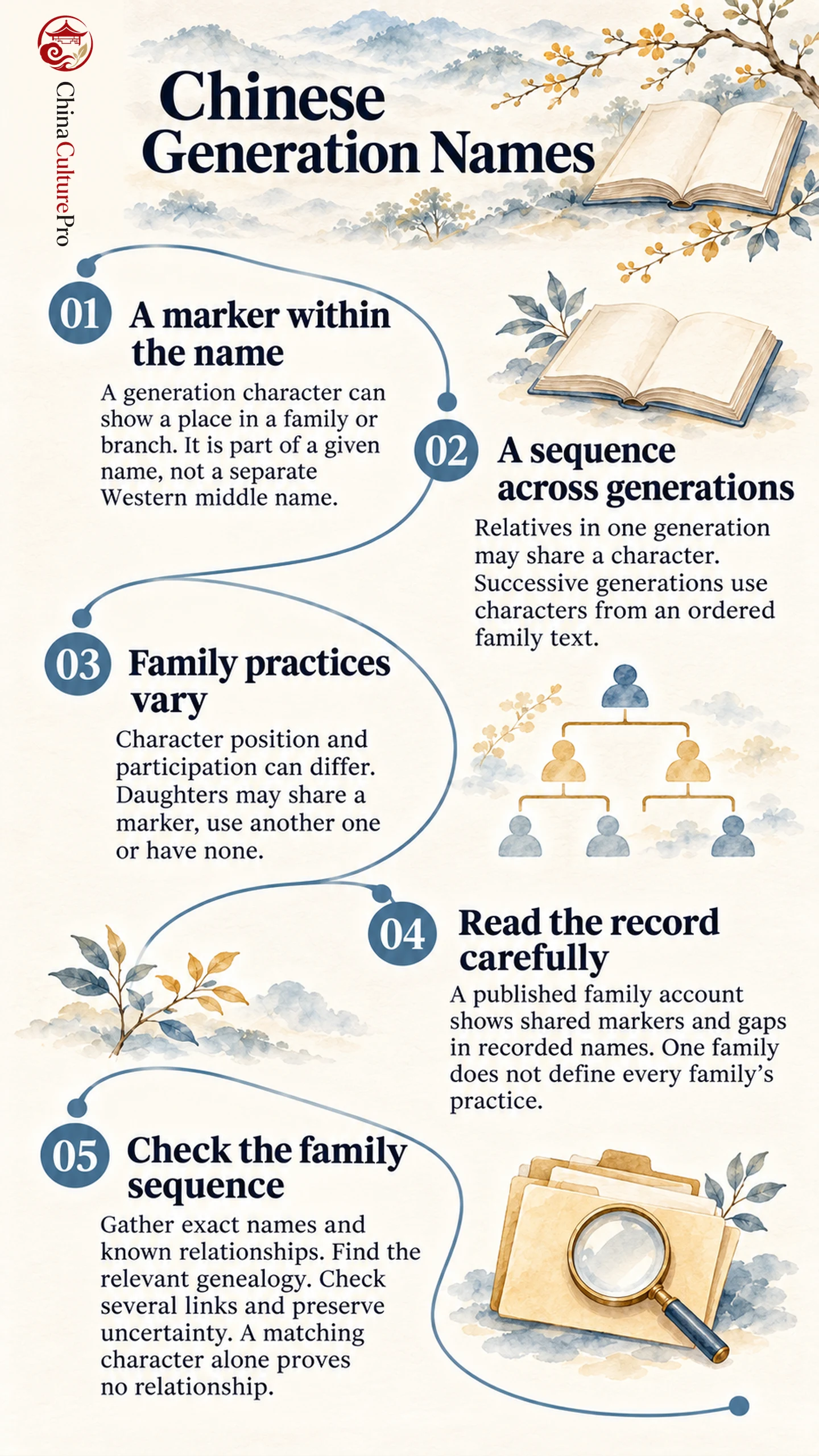
Two cousins may have different individual names but share one character. A parent and child may instead carry consecutive characters from a family text. Understanding that distinction makes generation names easier to read without assuming that every repeated character carries the same purpose.
A jiapu (家谱, jiāpǔ) is a family genealogy that may preserve the relevant sequence alongside relationships and other family information. Its contents and coverage need to be read in their own historical and family context. This guide fits within the broader system of Chinese names. [1]
A Generation Character Within the Given Name
A generation character is a character used within a given name to identify membership in a particular generation of a family or lineage. In this article, “generation name” refers to that shared-character practice rather than to a separate Western-style middle name. [2]
The surname identifies the family name; the given name can contain both a generation marker and an individually selected character. These are different functions within the name, not necessarily three separate name fields. For the basic division, see Chinese surname and given-name order.
Within a family that follows a sequence, the shared character helps place relatives in relation to one another. Traditional genealogies could connect that placement with appropriate conduct and forms of address. The character works because the family recognizes its position in a particular sequence, not because the character has a universal generation number. [1]
How a Generation Poem Works
A generation poem is an ordered text whose characters provide generation markers for successive generations of a family or branch. The text can express valued qualities, remembrance or hopes for descendants; naming research also describes sequences drawn from sentences and narratives. “Poem” should not be taken to mean that every sequence has one fixed verse form. [2]
The following is adapted from an illustrative teaching tree, not a verified historical pedigree. Its surname is Wang (王, Wáng); the three rows show consecutive generations in that example. Simplified characters and Mandarin pinyin are supplied here. [3]
| Position in the example | Example name | Generation character |
|---|---|---|
| Grandfather | Wang Yiming (王义明, Wáng Yìmíng) | Yi (义, Yì) |
| His son | Wang Lihe (王礼和, Wáng Lǐhé) | Li (礼, Lǐ) |
| This son’s sons | Wang Zhiyong (王智勇, Wáng Zhìyǒng) and Wang Zhiwei (王智伟, Wáng Zhìwěi) | Zhi (智, Zhì) |
The two brothers share Zhi, while their father and grandfather use earlier characters in the sequence. Cousins in this illustrative tree also share Zhi. The pattern links people across one generation and distinguishes successive generations. It is not a rule for every Wang family. [3]
Position, Gender and Family Variation
A marker may occupy the first or second character of a two-character given name. Looking only at the character immediately after the surname can therefore miss a family’s actual arrangement. A 2002 naming study explicitly notes variation in placement. [4]
The same study describes different practices for female names: no generation marker, a marker shared with brothers, or a different one shared with sisters. Historically male-oriented usage does not justify saying that daughters never receive generation characters. Nor does an example involving daughters establish a rule for another family. [4]
Branches may also have different sequences or adaptations. Ask which branch and record a sequence belongs to before trying to apply it to someone else. A name can be meaningful without following a generation poem, so this practice should not become a test of whether a person has a “proper” Chinese name. [2][3]
What One Published Family Account Shows
A published Wong family account from 2025 gives a concrete example. Wong is the family’s established spelling of the surname 黄 (Mandarin Huáng). The account identifies two brothers sharing Ting (廷, Tíng) and later relatives sharing Chuan (传, Chuán). It connects those characters to positions in the family’s poem. [5]
The author also explains that the genealogical book records sons, while the names of a few daughters are known through family recollections. That is a useful reminder that an apparent gap may reflect what a record includes, rather than who existed. It is evidence about this account’s coverage, not every genealogy. [5]
Keep established family spellings when working with such material. Mandarin readings help explain the written characters but need not replace the spellings used by the family. The distinction is explored in regional romanization of Chinese names.
Finding Your Family’s Generation Sequence
Start with records you can connect to known people. A matching poem found through a surname search is a candidate to investigate, not a finished family tree.
- Start with known relatives: Record the exact Chinese characters of known relatives’ names and their documented parent-child relationships. Keep established family spellings alongside the characters rather than replacing them with guessed Mandarin forms.
- Identify the relevant family record: Look for a genealogy connected with the family’s place, branch and known ancestors. Record its title, edition and generation sequence; a surname-only match is not enough.
- Compare the sequence with the family tree: Check whether the proposed characters fit several documented relationships and whether their positions are consistent with that family’s practice. Mark uncertain links and missing records instead of filling them from the poem alone.
These checks combine the naming pattern with the record’s identity and coverage. For related distinctions, see Chinese clan names and ancestral identity. The National Library of Singapore notes that genealogies also remain in private organizations and personal collections, and only part of the material has been digitized. An unsuccessful online search does not establish that no record survives. [6]
If you are choosing a new name rather than researching an existing one, first ask whether the family follows a sequence and whom it includes. Broader considerations belong in choosing a Chinese name; a surname alone cannot supply a mandatory character.
FAQs About Chinese Generation Names
Does everyone with a three-character Chinese name have a generation name?
No. A surname followed by a two-character given name does not reveal why those characters were selected. A generation marker needs evidence from the family’s naming practice or records.
Does a generation character tell you someone’s age?
No. It indicates a position in a family’s generation sequence when that sequence applies. People in one genealogical generation can have different birth dates; generation is not an age bracket or a person’s birth order among siblings. See Chinese family terms for distinctions between relationships and forms of address.
Does sharing a generation character prove that two people are related?
No. Shared characters can be clues, but names alone do not establish a relationship. Compare the relevant family records, branch information and documented links before treating a match as evidence of descent.
Sources
[1] Lee Meiyu, National Library of Singapore. The Jiapu Chronicles: What’s in a Name?
[2] Irena Kałużyńska. Traditional Chinese Generation Names
[3] FamilySearch. Understand Chinese Generation Poems
[4] Li Zhonghua and Edwin D. Lawson. Generation Names in China: Past, Present, and Future
[5] Gom Benn Scholarship Fund. What’s In a Name? Our Generational Poem
[6] National Library of Singapore. Chinese Genealogy Resources