

Quick Answer: Who Were Chinese Court Eunuchs?
Chinese court eunuchs (宦官, huànguān) were men who had been castrated and served within imperial households or their agencies. Most worked in palace service. Some acquired substantial authority when a ruler gave them command, access to information or an appointment beyond the household.[1][3][4][6]
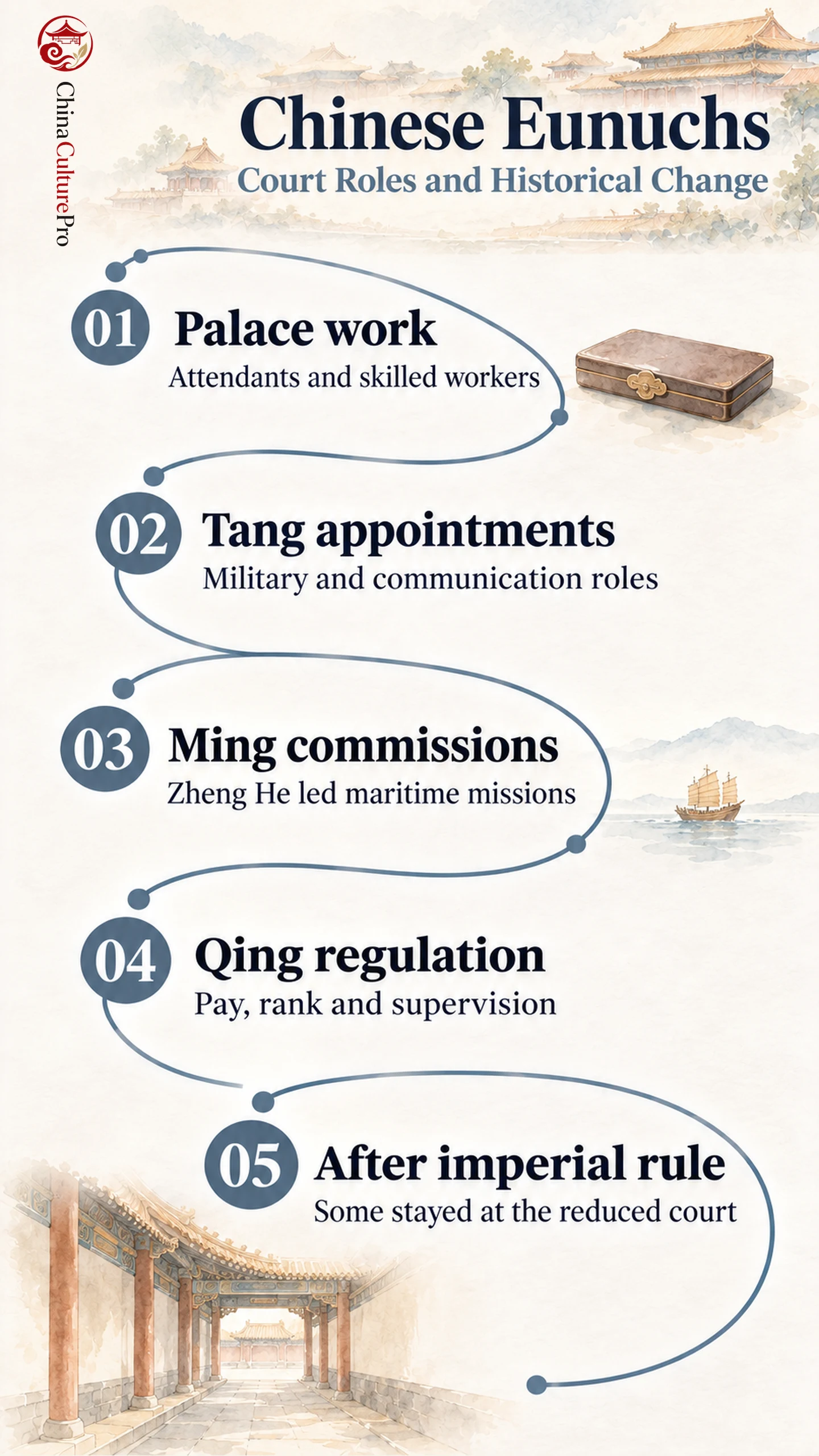
- Palace work: Eunuchs kept the household running and trained in different occupations. Their duties varied with their assignments.[1][2]
- Delegated authority: Tang and Ming rulers appointed certain eunuchs to military, security and diplomatic work.[3][4][5]
- Qing regulation: Qing emperors set rules to control their servants, while eunuchs formed social relationships of their own.[1][6][7]
The authority of a famous appointee describes one career. Ordinary service is more often visible in administrative records than in biographies.[1][2][6]
An apprentice learning an assigned trade at the Qing court and an envoy commanding ships for the Ming both held the status of eunuch. Their appointments placed them in very different relationships to imperial power. The distinction is part of reading Chinese history through the people who staffed its palaces.[2][3][5]
Why Imperial Households Employed Eunuchs
A large palace required attendants for its private rooms, ceremonies and routine work. Rulers used eunuchs in household service partly to control access to the inner palace and protect dynastic succession. Within the household, individual responsibilities varied. A rank-and-file attendant and a supervisor belonged to the same broad category, but their access, responsibilities and ability to act could differ greatly.[1][2][6]
Qing evidence shows that the route into service could be shaped by poverty, expectations of employment or pressure from family. Dale’s research traces how recruits could train under supervisors and learn specialized work. Assignments could be highly specialized. The occupations discussed by Dale include actors, medical practitioners and people who served in religious roles. Eunuchs served in the same palace world as imperial consorts and other staff, with roles defined by their particular duties.[1][2]
Tang and Ming Eunuchs Beyond the Palace Household
The Tang dynasty offers one example of expanded responsibilities. During the An Lushan Rebellion, the eunuch Li Fuguo (李辅国, Lǐ Fǔguó) served from 756 to 762 as chief of staff in a headquarters with military and civil responsibilities. It was also a channel for communication with the emperor. Peter Lorge traces a later communications office back to that headquarters. Its connection to the emperor helps explain why some eunuchs could influence policy even after Li Fuguo’s exceptional powers had passed.[3]
In the Ming dynasty, eunuch agencies could have roles in intelligence, military affairs, finance or diplomacy. The best-known maritime example is Zheng He (郑和, Zhèng Hé), who led seven expeditions between 1405 and 1433. His fleets traveled through Southeast Asia and across the Indian Ocean, an episode in the wider history of the Maritime Silk Road. The Ming court commissioned him to command the fleets. The appointment shows how far delegated power could extend in a particular career.[4][5]
The Ming court also used eunuchs to gather intelligence. The Eastern Depot (东厂, Dōngchǎng), established in 1420, had a eunuch director. Its information-gathering and surveillance were distinct from the work of an overseas envoy. Both assignments depended on imperial authorization, but their responsibilities and the people they dealt with were different. The Ming examples show how palace connections could serve more than one kind of state work.[4][9]
How the Qing Regulated Palace Service
Early Qing rulers inherited concerns about the extent of Ming eunuch power. They developed rules governing pay, ranks, discipline and supervision. The rules changed across reigns. Norman Kutcher describes Yongzheng’s reforms as an effort to restrain influence in princely households while also providing support. These measures included higher salaries, a reserve fund and a burial ground west of Beijing.[6][7]
Eunuchs also maintained ties to relatives and made connections with fellow workers and people outside the palace. Some formed informal households or joined associations of people from the same home region. Dale’s work uses the records of the Imperial Household Department (内务府, Nèiwùfǔ), among other sources, to examine those relationships. That evidence helps explain how the household surrounding Chinese emperors operated beyond its written rules.[1][2]
How the System Ended
The imperial household continued on a smaller scale after the Qing fell. Some eunuchs stayed at the smaller court of the former emperor Puyi within the Forbidden City. Dismissals and expulsions after the establishment of the republic left former servants looking for new livelihoods. Some could use their knowledge of the old court, while others had to find different kinds of work.[2][8]
What Surviving Sources Can Tell Us
A voyage record tells us what an exceptional envoy was sent to do. A household file can identify a position, a pay arrangement or a dispute. Recollections taken down after the empire add accounts of how some former servants experienced palace life. Each source makes different people visible. For a routine posting, historians may have to piece together records filed by the people who supervised the work. A memoir can add a former servant’s perspective, though it was recorded later and reflects what that individual remembered.[2][4][5][8]
FAQs About Chinese Eunuchs
Were most eunuchs powerful officials?
Most worked as attendants or in other palace occupations. Political or military authority belonged to individuals with particular appointments and access to the ruler.
Was Zheng He a eunuch?
Yes. He was a Ming court eunuch commissioned to lead seven maritime expeditions between 1405 and 1433.
Did palace eunuchs disappear when the Qing ended?
Some stayed in Puyi’s reduced palace household for a time after the dynasty fell. Their departure was a process that continued into the early republic.
Sources
[1] Melissa S. Dale. Inside the World of the Eunuch
[2] Norman A. Kutcher. Review of Inside the World of the Eunuch
[3] Peter Lorge. Military Institutions as a Defining Feature of the Song Dynasty
[4] Shih-shan Henry Tsai. The Eunuchs in the Ming Dynasty
[5] Columbia University, Asia for Educators. The Ming Voyages
[6] Norman A. Kutcher. Eunuch and Emperor in the Great Age of Qing Rule
[7] Norman A. Kutcher. Yongzheng’s Innovative Rules for Regulating Eunuchs
[8] Melissa S. Dale. Surviving the Fall of the Qing: Chinese Eunuchs Post 1911
[9] Shih-shan Henry Tsai. A Day in the Life of Yongle’s Court