


Quick Answer: What Are Chinese Date Buns?
Chinese date buns (红枣馒头, hóngzǎomántou) combine leavened wheat dough with jujubes. Some have fruit tucked into decorative folds; others have chopped fruit mixed through the dough. Steaming produces a soft bun rather than a baked pastry crust.[1][3][6]
- Base: Wheat-flour dough that rises before it is steamed.
- Fruit: Jujubes used whole, in pieces or in a decorative arrangement.
- Forms: Everyday buns and elaborate festive shapes both occur.
The name identifies the fruit and bun family. It does not promise a paste filling, a flower shape or one sweetness level.[3][5][6]
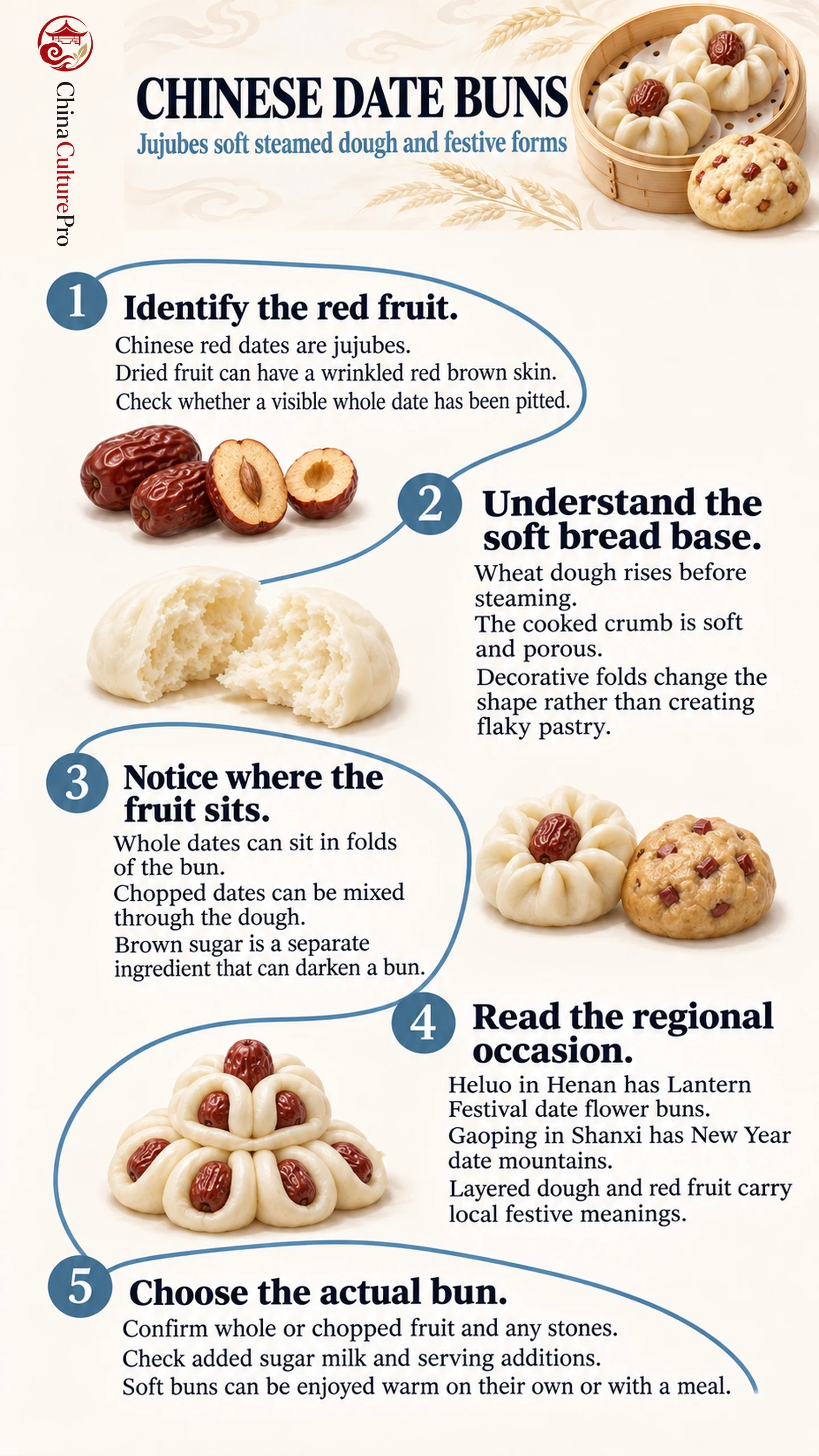
A red jujube tucked into white dough can be both an ingredient and a decoration. Chinese date buns range from simple fruit-studded bread to elaborate festive arrangements. Looking at the dough, fruit placement and serving occasion helps explain what each bun offers.
The Dates Are Jujubes
The red dates (红枣, hóngzǎo) used here are Chinese jujubes, Ziziphus jujuba. Palm dates are a different fruit. Dried jujubes can look date-like, which helps explain the English nickname.[2]
Jujubes naturally have a hard stone. Visible fruit is not proof that it has been pitted, so check before biting into a bun decorated with a whole date.[2]
Wheat Dough, Leavening and a Soft Steamed Crumb
The bread base belongs to mantou (馒头, mántou), the Chinese steamed-bun family. Flour and water make the dough, and leavening helps it rise. Some modern preparations combine yeast with baking powder; others use yeast without it. The fruit and the raising method are separate choices.[1][6]
The cooked interior is soft and porous, while the surface remains pale rather than developing an oven-browned crust. Folding the dough into petals changes the outline and creates sections that can be pulled apart; it does not turn the bun into a laminated, flaky pastry.[1][6]
Whole Dates and Chopped Dates Give Different Bites
| Date placement | What changes in the bite |
|---|---|
| Whole dates in folds | Fruit remains a distinct piece against the soft dough. |
| Chopped dates in the dough | Smaller fruit pieces are distributed through the bread. |
A brown-sugar version with chopped jujubes illustrates the second approach. Its darker dough comes from an additional ingredient, not simply from the presence of whole red fruit. A pale flower bun and a brown fruit-studded bun need not have the same sweetness.[1][3]
New Year Shapes and Local Festival Traditions
Decorative date-flower buns are known as zaohua mo (枣花馍, zǎohuāmó). In the Heluo region of Henan, they are prepared for the Lantern Festival, with dates set among folded or stacked dough. Flower-like arrangements are only one option; animal and other imaginative forms also appear.[5]
In Gaoping, Shanxi, makers prepare zaoshan (枣山, zǎoshān), or “date mountains,” for Nouvel An chinois. Layers of shaped dough and red jujubes express hopes for a better year. Zaoshan also serves as an ancestor offering there. These meanings belong to that setting, rather than a requirement attached to every everyday date bun.[4]
How to Choose and Serve Chinese Date Buns
Ask whether the fruit is whole or chopped, whether it has been pitted, and whether the dough contains added sugar or milk. Water-based and milk-based preparations both appear in home recipes. For vegan requirements, confirm the complete dough and any serving additions.[6]
These are soft breads that can be eaten warm on their own or alongside a meal. An ornamental flower bun can be separated along its folds. For other sweets using the same fruit, see Chinese jujube cakes.[1]
FAQs About Chinese Date Buns
What fruit is used in Chinese date buns?
Jujubes, often sold as Chinese red dates.
Do date buns always have a sweet paste filling?
No. Many have whole dates in folds or chopped dates through the dough.
Are Chinese date buns always flower-shaped?
No. Simple buns and more elaborate arrangements are both documented.
Are Chinese date buns automatically vegan?
No. Check the dough and additions, including any milk or dairy accompaniment.
Sources
[1] Wei Guo, original recipe, Red House Spice. Mantou: Chinese Steamed Buns
[2] Patrick Breen, Oregon State University Horticulture. Ziziphus jujuba: Jujube or Chinese Date
[3] 厨房里的晶晶, original posted home recipe. Brown Sugar and Red Date Open-Top Mantou
[4] Li Jinsha and Feng Ganlin, original workshop visit, Gaoping municipal publication. Steaming Decorative Buns before New Year
[5] Hu Shuqing, original text and photos, Luoyang Daily via Henan Taiwan Affairs Office. Steaming Jujube Flower Buns
[6] 个性胜过姿色I, original posted home recipe. Jujube Flower Buns for New Year