


Quick Answer: What Can You Say in a Chinese Condolence Message?
A traditional Mandarin condolence is 节哀顺变 (traditional: 節哀順變, jié āi shùn biàn). It expresses sympathy to someone bereaved; its literal wording concerns moderating grief and adapting to a loss. [1]
- A brief message: Acknowledge the sad news and express care in words you understand.
- The addressee: Words comforting the family differ from words remembering the person who died.
- A personal addition: Use a true memory or an offer of help you can actually provide.
- The family’s beliefs: Choose religious wording only when it fits their faith and wishes.
These examples use Mandarin readings. Chinese-speaking families have different languages, religious beliefs and funeral practices; no single formula captures every person’s preferences.
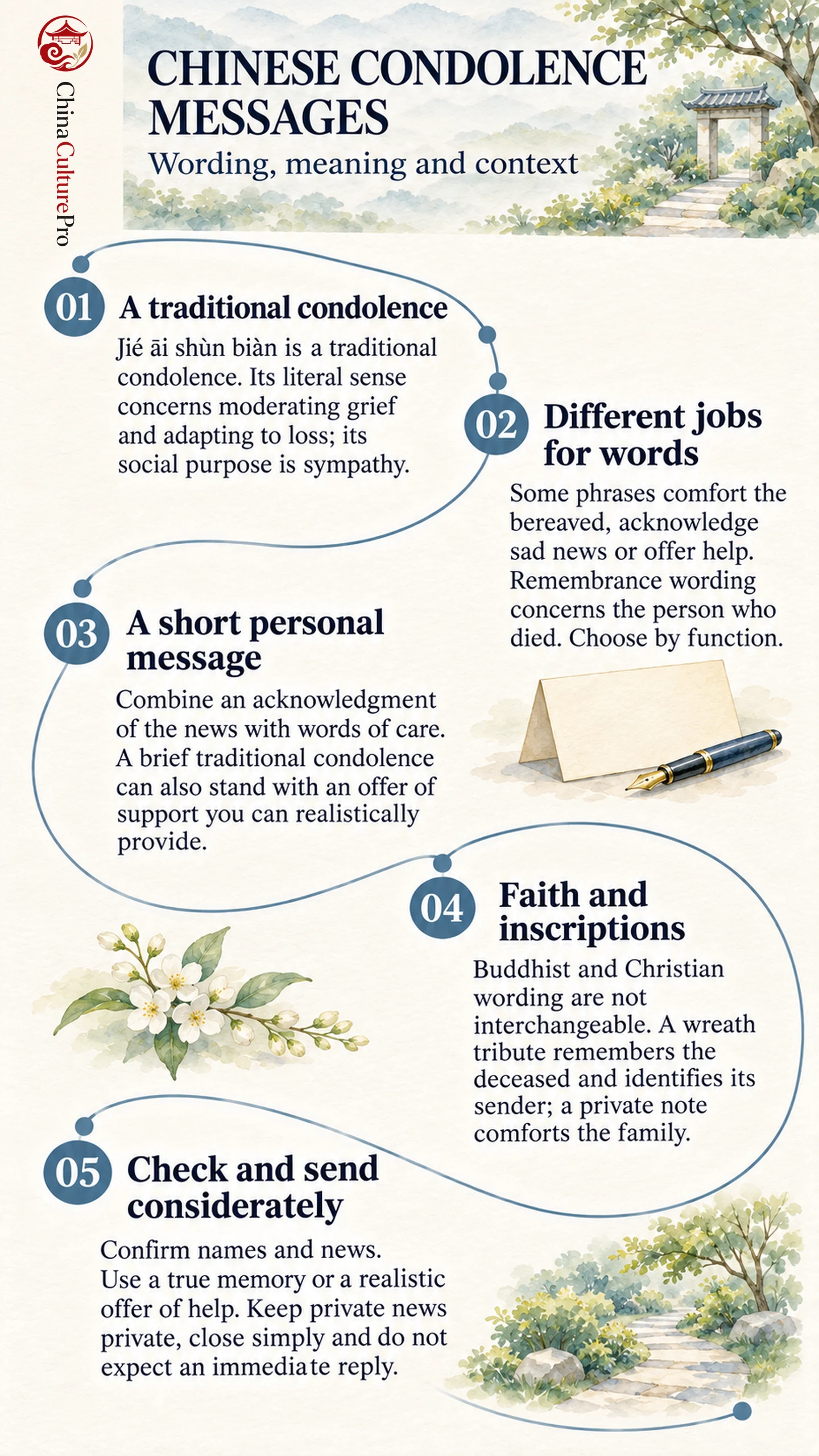
A condolence message does not need to explain a loss or resolve another person’s grief. Its immediate purpose is to acknowledge what happened and show the bereaved that you care.
The phrases below include traditional condolences, plain expressions of sadness and remembrance wording. For wider social context, see Chinese greetings and etiquette; the guide to Chinese funeral traditions explains the broader cultural setting.
What Jié Āi Shùn Biàn Means
The traditional expression has two parts: moderating sorrow and adapting to changed circumstances. Its established social use is to offer condolences or sympathy. [1] A literal gloss can sound more directive in English than a functional translation such as “please accept my condolences.” Understanding both helps you recognize what the phrase is doing.
It can be shortened in a condolence exchange, and it can be accompanied by words asking the bereaved to take care. [2] You do not need to repeat the formula several times or turn its literal meaning into an instruction about how quickly someone should recover.
If pronunciation is unfamiliar, use the tone-marked readings below alongside the guide to pinyin. The tone marks belong to the spoken Mandarin reading; simplified and traditional characters are writing choices.
Six Phrases for Sympathy, Care and Remembrance
Select a phrase by its function. The final row remembers the deceased; the care and help phrases address the living recipient.
| Expression and Mandarin pinyin | Signification | Fonction |
|---|---|---|
| 节哀顺变 (jié āi shùn biàn) | A traditional expression of condolences. | Comforts the bereaved. [1] |
| 请节哀 (qǐng jié āi) | Please accept my condolences; a shortened traditional form. | A brief traditional condolence. [2] |
| 请多保重 (qǐng duō bǎozhòng) | Please take care of yourself. | Expresses care for the bereaved. [2] |
| 听到这个消息,我很难过 (tīngdào zhège xiāoxi, wǒ hěn nánguò) | I am very sad to hear this news. | Acknowledges the news and your sadness. [3] |
| 有什么需要,请告诉我 (yǒu shénme xūyào, qǐng gàosu wǒ) | If you need anything, please tell me. | Offers help to someone you can support. [4] |
| 永远怀念 (yǒngyuǎn huáiniàn) | Forever remembered. | Remembrance wording for a card or tribute. [4] |
The last phrase is not a request that the bereaved look after themselves. Likewise, an offer of help is not a tribute to the deceased. Keeping that difference clear matters more than collecting many formal expressions.
Two Short Message Examples
These examples combine the phrases above. They are model wording, not reports of actual conversations.
For a personal note acknowledging the news:
听到这个消息,我很难过。请多保重。 (tīngdào zhège xiāoxi, wǒ hěn nánguò. qǐng duō bǎozhòng.)
“I am very sad to hear this news. Please take care of yourself.” This pairs an expression of sadness with care for the recipient. [2][3]
For a traditional condolence with an offer of support:
请节哀。有什么需要,请告诉我。 (qǐng jié āi. yǒu shénme xūyào, qǐng gàosu wǒ.)
“Please accept my condolences. If you need anything, please tell me.” Use the offer only when you are in a position to help. [2][4]
You can keep the message this short. If you know a specific way to help, describe that in your own words. Do not add a promise of unlimited availability simply because it sounds reassuring. An offer should match what you can realistically do.
Faith, Wreaths and the Words You Choose
Some remembrance formulas carry a particular religious meaning. 往生极乐 (wǎngshēng jílè) refers to rebirth in the Land of Bliss in Buddhist wording. [4] 安息主怀 (ānxī zhǔhuái), “rest in the Lord’s embrace,” is Christian wording. [5] They are not interchangeable neutral labels for every death.
If you do not know the family’s beliefs, a plain expression of sympathy or remembrance avoids making a claim about an afterlife on their behalf. You can also follow wording that the family has chosen for a public notice.
A wreath ribbon has a different job from a private message to the family. It usually carries a short tribute and identifies the sender; spelling the deceased’s name correctly is essential. [5] Ask the family’s chosen funeral provider or florist to confirm the inscription and layout rather than improvising unfamiliar ceremonial titles.
Age-specific praise of a long life may also be unsuitable when the circumstances do not fit. [4] For clothes, gifts and attendance, consult funeral guest etiquette and mourning clothing traditions.
Writing and Sending a Considerate Message
Use these three steps before sending:
- Check whom and what the message concerns: Confirm the news and the person’s name. Distinguish words addressed to the bereaved from words remembering the person who died.
- Choose one clear expression of sympathy: Use a phrase you understand. Add a true memory only if you have one, or an offer of help you can realistically provide.
- Choose a considerate channel and close simply: Use a private message when the news is private. Sign a card clearly, avoid announcing another family’s loss, and leave room for the recipient not to reply immediately.
Public condolence posts need particular care: do not reveal a death or share family photographs before the family has chosen to make that information public. [5] Avoid pressing for the cause of death or offering a cheerful explanation for why the loss happened. [6]
When a message needs a family relationship, confirm it rather than guessing from a name. The guide to Chinese family terms can help with the language, but the actual relationship still needs to be correct.
FAQs About Chinese Condolence Messages
Can I write the message in English?
Yes, when English is a language the recipient understands and uses with you. A short, sincere message is preferable to unfamiliar Chinese wording whose meaning you cannot check. [4]
What if I did not know the person who died?
Express sympathy for the bereaved without inventing a memory or personal relationship with the deceased. You can acknowledge the news and offer support without adding a tribute you cannot honestly make. [6]
Should I expect an immediate reply?
No. A condolence message does not require an immediate response. The bereaved may be occupied with arrangements or simply not ready to answer. [5]
Sources
[1] Ministry of Education, Taiwan. Concise Mandarin Chinese Dictionary: 節哀順變
[2] ChineseClass101. How to Say Congratulations and Express Condolences
[3] NetChai Chinese. My Condolences in Chinese
[4] Wah On Funeral Home. Condolences in Chinese: 節哀順變 and Other Messages
[5] The Funeral Company. Condolence Messages in Singapore
[6] Yapr. How to Say I’m So Sorry for Your Loss in Mandarin Chinese