


Quick Answer: What Do These Bathing Traditions Include?
Chinese bathing and foot-soaking culture brings together cleansing, social time, seasonal customs and traditional ideas about bodily care. Bathing (沐浴, mùyù) and foot soaking (泡脚, pàojiǎo) describe related activities, but they are not one uniform practice.
- Historical washing could express purification and respect as well as cleanliness.
- Bathhouses offered social settings beyond the private home.
- Medicinal bathing (药浴, yàoyù) adds substances selected within a particular tradition.[1]
- Modern foot soaking may be an everyday comfort, a shared activity or a commercial service.
Cultural importance does not establish a cure, and a footbath is unsuitable for some people.
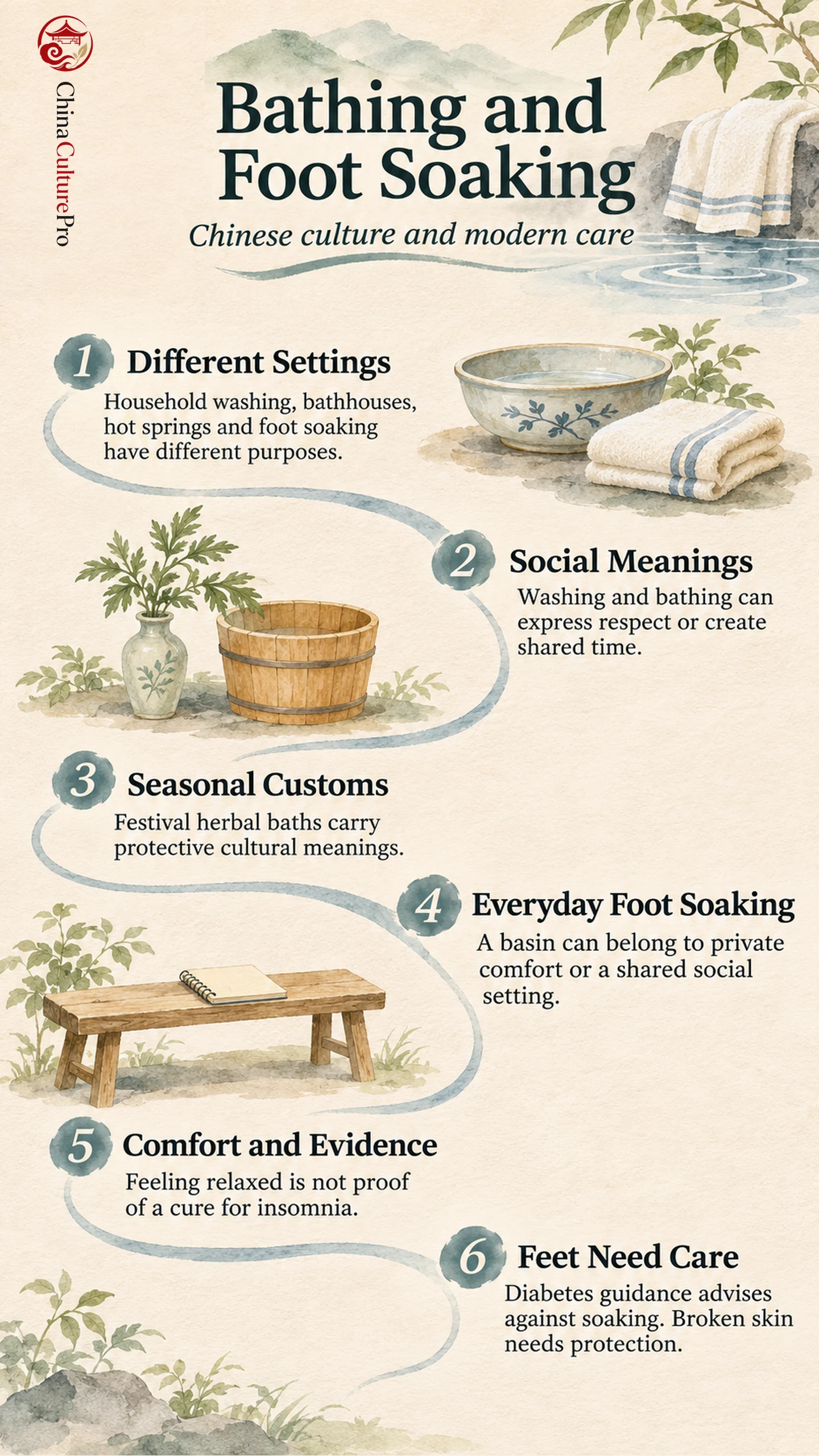
A basin, a bathhouse and a hot spring can all appear in discussions of Chinese bathing. Each has a different setting and purpose. Understanding who uses the water, where and why is more informative than treating every example as the same ancient wellness ritual.
Several Traditions, Rather Than One Unchanged Practice
The following distinctions help organize the subject. They are a reading guide, rather than an official classification of Chinese customs.
| Setting or practice | Defining feature | Question to keep separate |
|---|---|---|
| Household washing | Personal cleansing in a private setting | Is the aim washing or prolonged soaking? |
| Shared bathhouse | Bathing within a social or institutional space | What rules and relationships shape the visit? |
| Hot-spring bathing | Use of naturally heated water | How is the water managed and used? |
| Foot soaking | Immersion focused on the feet | Is this plain water, an herbal preparation or part of a service? |
Medicinal bathing can overlap with more than one setting. Adding herbs changes the preparation; it does not turn every bath or foot soak into the same treatment. Regional traditions also deserve their own context, as the separate Tibetan medicinal bathing guide explains.
Bathing as Ritual, Sociability and Seasonal Custom
Water’s historical meanings extend beyond removing dirt. A bronze ritual basin, or pan (盘, pán), from Anyang, dated approximately 1250–1150 BCE, was used for washing hands as an expression of purification and respect.[2] That object documents a particular washing practice; it is not evidence that people were using a modern-style full-body bathhouse.
During the Song period, 960–1279, temple bathhouses could be gathering places for literati-officials. Recorded activities included leisure with friends and family, encounters connected with official careers, and literary composition.[3] Bathing therefore provided a setting for relationships and cultural expression, not simply an isolated hygiene task.
Seasonal herbal bathing offers another strand. Duanwu (端午, Duānwǔ), the Dragon Boat Festival, is associated with aromatic bathing customs and wishes to ward off illness or misfortune. Mugwort and other plants appear in regional preparations.[1] Those protective meanings belong to the custom’s history; they should not be read as a demonstrated ability to prevent every disease. The Dragon Boat Festival customs guide places bathing alongside sachets, plants and other seasonal practices.
Foot Soaking in Contemporary Everyday Life
Foot soaking need not mean entering a full-body bath. Its limited physical setting allows it to become a distinct social practice. Ethnographic research in Wentang, a hot-spring town in Yichun, Jiangxi, identified public foot bathing in the town square alongside hotel bathing and private household or guest-room baths.[4]
In that public setting, people used buckets and towels, and some combined foot bathing with conversation, music or games.[4] The example shows how water, equipment and shared time work together. It does not establish that the same custom or routine is followed throughout China.
A commercial foot-care visit may combine several activities, but the names should remain clear. Soaking immerses the feet; massage involves manual manipulation. A service offering both does not make their effects identical, and the addition of herbs requires its own assessment of ingredients. The broader Chinese herbal medicine guide explains why identifying a preparation matters.
Comfort, Sleep Research and the Limits of Health Claims
Feeling comfortable is a different outcome from treating a sleep disorder. In a 2025 synthesis of 18 studies involving 950 adults aged 60 or older, warm footbaths were associated with improved subjective sleep quality. The authors also called for larger trials combining subjective and objective assessments.[5]
The distinction between outcomes matters. A 2013 crossover experiment with 25 participants compared bathing and non-bathing nights. A 40°C footbath lasting 20 minutes increased foot temperature, but produced no significant change in measured or perceived sleep quality.[6] Those numbers describe that experiment, rather than prescribe a routine for everyone.
Together, these findings support a cautious interpretation: some people may report better sleep, while results depend on the study and what is measured. They do not establish that a basin of water cures insomnia, or that any particular herbal addition supplies the benefit. Comfort can be valued without claiming more than the evidence shows.
Safety Changes the Meaning of a Harmless-Looking Basin
For people with diabetes, foot-care guidance specifically advises washing in warm water without soaking. Diabetes-related nerve damage can reduce the ability to feel heat or injury, while poor circulation can make foot wounds harder to heal.[7] A customary practice should not override an individual foot-care plan.
Shared foot spas introduce an infection question. Microorganisms can enter through broken skin, so open cuts or abrasions should not contact foot-spa water. Cleaning and disinfection between customers matter; visible clear water alone does not show that a system is properly maintained.[8]
These are concrete differences between situations. A healthy person’s private comfort ritual, a medicinal preparation, a commercial foot spa and a person with vulnerable feet cannot all be covered by one universal recommendation.
FAQs About Chinese Bathing and Foot Soaking
Is foot soaking the same as foot massage?
No. Soaking means immersing the feet in water. Massage uses manual manipulation; a commercial service may offer both.
Does a Chinese footbath always contain herbs?
No. Water-based soaking and medicinal bathing are separate descriptions. If herbs are added, the ingredients and their intended use become additional questions.
Can foot soaking cure insomnia?
Current findings do not establish a cure. Some studies report improved subjective sleep quality, while measured outcomes and individual experiments are less consistent.[5][6]
Should people with diabetes soak their feet?
Diabetes foot-care guidance advises against soaking. Daily washing and an individual care plan take priority over a customary soaking routine.[7]
Sources
[1] Beijing University of Chinese Medicine Museum. Traditional Chinese Bathing Therapies
[2] Smithsonian National Museum of Asian Art. Ritual Basin with Dragons, Fish, Tigers and Birds
[3] Choi Hae-byoul. The Bathing Culture of Literati-Officials in the Song Period
[4] Qi Liu, Alison L. Browne and Deljana Iossifova. Creating Water Demand: Bathing Practices in a Chinese Hot-Spring Town
[5] Shih-Yu Chang and colleagues. Systematic Review and Meta-Analysis of Footbath Effects on Sleep in Older Adults
[6] Wen-Chun Liao and colleagues. Warm Footbaths, Body Temperature and Sleep: An Experimental Crossover Trial
[7] CDC. Your Feet and Diabetes
[8] US EPA and CDC. Preventing Pedicure Foot-Spa Infections