

Quick Answer: What Is Beijing Ludagun?
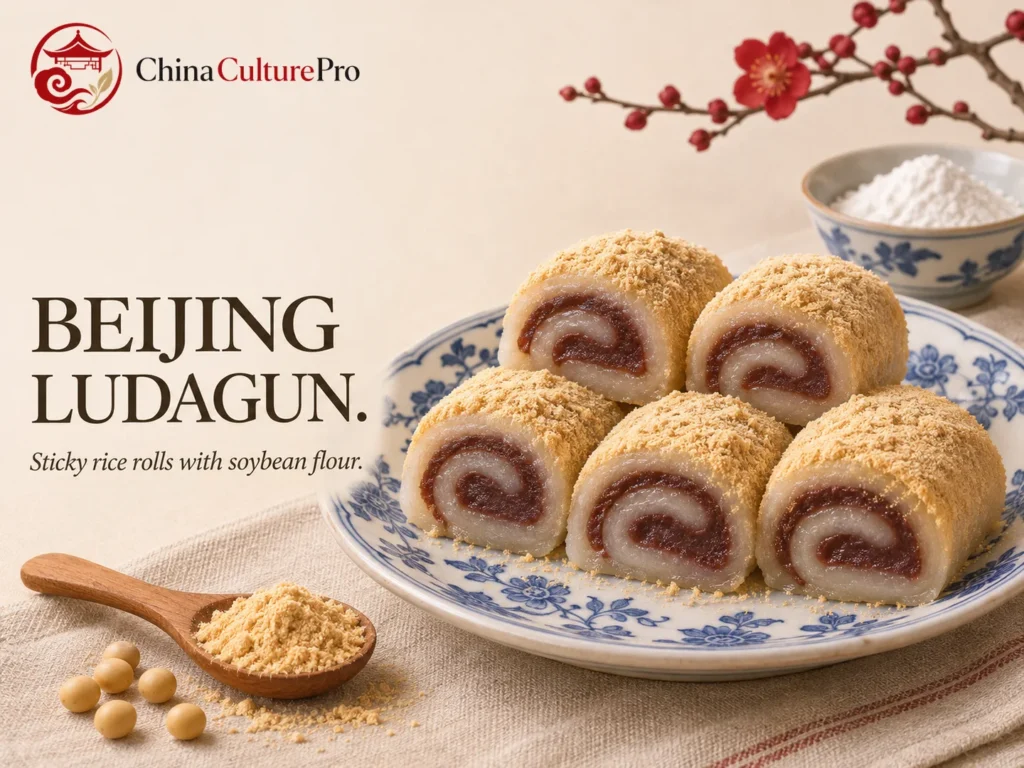
Ludagun (驴打滚; lǘ dǎgǔn) is a sweet snack of steamed sticky-grain dough rolled around a filling and coated with soybean flour. The familiar cut pieces show a pale wrapper, reddish-brown bean-paste spiral and golden, powdery exterior.[4][7]
- Wrapper: Older descriptions use sticky millet flour; many contemporary versions use glutinous rice flour.
- Filling: Sweet red bean paste is familiar, while brown sugar appears in other descriptions.
- Coating: Cooked, roasted soybean flour supplies the characteristic bean aroma and outer dusting.
- Method: Steam the dough, flatten it, spread the filling, roll it into a log and slice.[2][3][4]
The name evokes a donkey rolling in dust. It describes the appearance of the soybean-flour coating, not a meat ingredient.
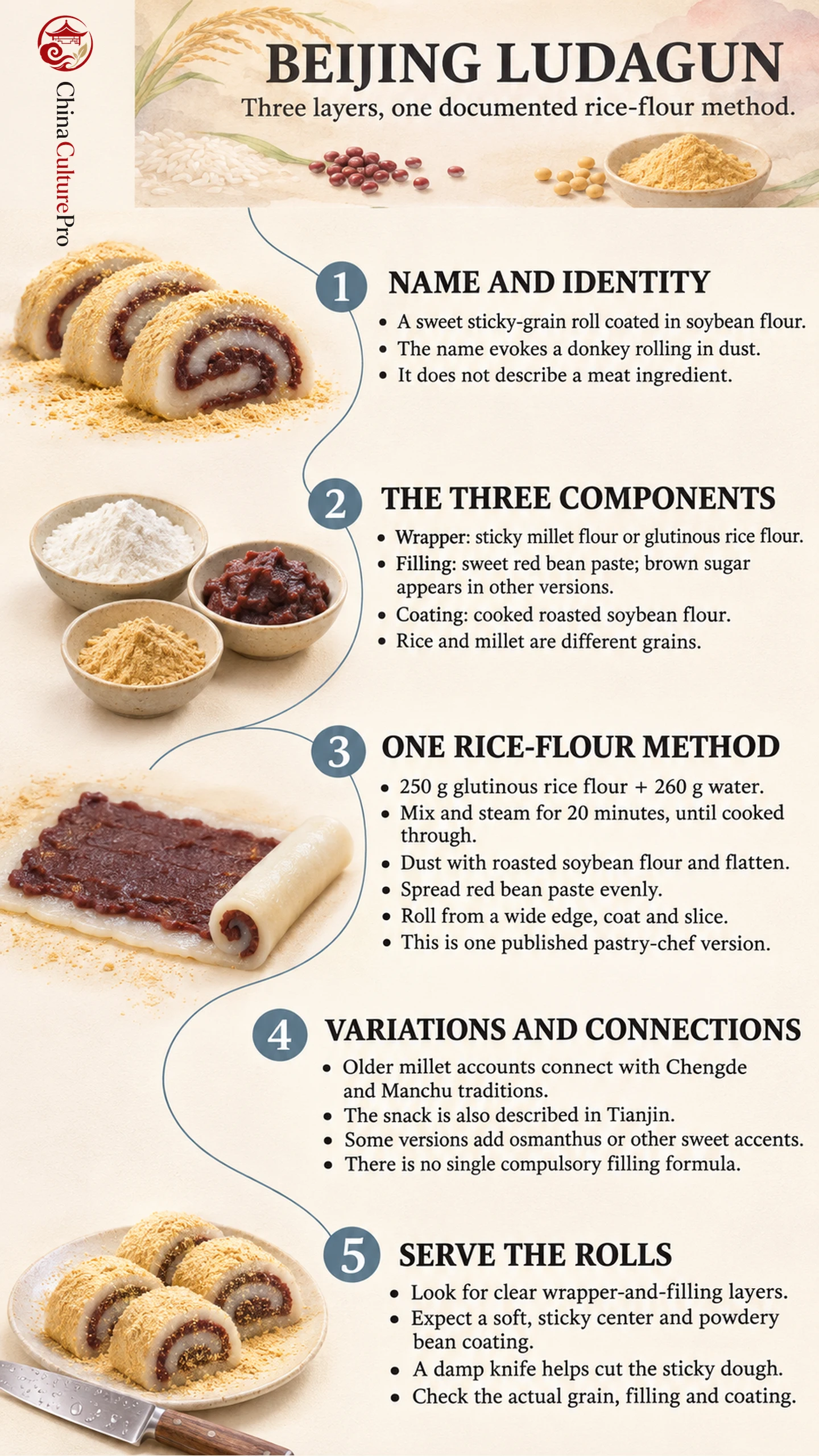
The roll’s identity comes from three contrasting layers: sticky dough, sweet filling and a dry, aromatic coating. That combination places it among the distinctive sweets of Beijing cuisine, while leaving room for changes in grain and filling. The wider traditional Chinese desserts guide provides context for other cake and pastry forms.[3][4]
Name, Shape and Beijing Roots
Another name is doumiangao (豆面糕; dòumiàngāo), referring to the soybean-flour element. The playful ludagun name likens the powdery coating to a donkey rolling in dust.[1][3]
The important visual clue is the coating. A flour-dusted roll can still have a pale rice-based wrapper underneath; the golden exterior does not prove that the dough itself was made from yellow grain. Cutting across the log reveals the filling and the layers.[3][4]
Palace-kitchen origin stories are told as legends, rather than verified invention records.[2]
Wrapper, Filling and Soybean Coating
Huangmi flour (黄米面; huángmǐ miàn) is the sticky millet flour described in older versions. Glutinous rice flour gives another documented wrapper, including the home method below. These are different grains, not two English translations for the same ingredient.[2][3]
| Élément | Common ingredient | Ce qu’il apporte |
|---|---|---|
| Enveloppe | Sticky millet flour or glutinous rice flour | A soft, cohesive layer that can enclose the filling |
| Farce | Sweet red bean paste, or brown sugar in some versions | Sweetness and a contrasting center |
| Coating | Cooked roasted soybean flour | Bean aroma, golden color and a less sticky surface |
Use soybean flour that is cooked and suitable for the final dusting. A pastry preparation cooks the flour over low heat before using it on the finished roll. The coating is applied after the wrapper is steamed, so it is not simply raw flour waiting for another cooking stage.[5]
The Chinese red bean desserts guide explains other uses of the filling. Its texture matters here: an even spread produces a more regular spiral than separate clumps of paste.
A Glutinous-Rice Version to Make at Home
A documented glutinous-rice version uses 250 g flour and 260 g water for the steamed wrapper, with sweet red bean paste and roasted soybean flour. Pastry chef Zhang Lihua publicly described this version.[1]
- Flour: 250 g glutinous rice flour
- Water: 260 g water
- Filling: Sweet red bean paste, enough for an even filling layer
- Coating: Roasted soybean flour, for the work surface and outer coating
- Mix the rice-flour batter: Stir 250 g glutinous rice flour with 260 g water until evenly mixed, then transfer the batter to a steaming tray.
- Steam the wrapper: Steam for 20 minutes, checking that the dough is cooked through.
- Dust and flatten: Dust the work surface and the cooked dough with roasted soybean flour, then roll the dough into a thin rectangle.
- Fill and roll: Spread sweet red bean paste evenly over the sheet, then roll from a wide edge into a log.
- Coat and slice: Dust the outside with more roasted soybean flour, then cut the log into short pieces and arrange them on a plate.[1]
Keep the coating within reach while handling the cooked dough: it helps prevent the sticky sheet from clinging to the work surface. Work the filling into an even layer before beginning the roll, rather than trying to correct large gaps after it has closed.[5]
Variations and Regional Connections
The older millet preparation is linked in Beijing culinary accounts with Chengde and Manchu food traditions. This is a regional connection, rather than proof that every modern rice-flour roll follows one unchanged historical recipe.[2]
The snack also appears in descriptions of Tianjin food, so its strong Beijing association should not be read as exclusivity. Within the documented versions, the main differences include the grain, the filling and extra flavorings.[6]
Red bean paste is not the only recorded center: brown sugar is another. Some ingredient lists also include osmanthus, candied shreds or melon seeds. These additions are possibilities in particular preparations, not ingredients you must add to the rice-flour method above. For the floral ingredient’s wider uses, see Chinese osmanthus desserts.[4][6]
Serving the Finished Rolls
Look at the cut ends: the wrapper and filling should form recognizable layers, with soybean flour covering the outside. The bite combines soft, sticky dough, sweet filling and a powdery bean coating. The flour is part of the taste, not packaging to brush away.[7]
A thin, even sheet and an orderly roll help give the pieces a consistent shape. One pastry method also trims the inside starting edge straight before rolling, a useful handling detail for a neater log. A clean, damp knife can help cut sticky dough without dragging the layers apart.[2][5]
Serve the pieces on a plate that catches loose flour. If choosing a packaged version, check the actual grain, filling and coating rather than assuming every product with the same name uses an identical formula. The traditional soybean coating is particularly worth distinguishing from a peanut dusting.
FAQs About Beijing Ludagun
Does ludagun contain donkey meat?
The name is a dust-rolling metaphor. The preparations described here use sticky-grain dough, sweet filling and soybean flour, rather than donkey meat.[3][4]
Is the wrapper always made from glutinous rice?
No. Sticky millet flour appears in older descriptions, while glutinous rice flour is used in documented contemporary versions.[2][3]
Is the outer coating peanut powder?
The characteristic coating is cooked soybean flour. Check a particular product’s ingredients if the distinction matters; a similar golden color does not identify the flour.[2][5]
Sources
[1] Guo Tie, The Beijing News. Ludagun: Sticky Grain Dough and Red Bean Filling
[2] Beijing Tourism official portal. Beijing Ludagun
[3] Beijing Tourism official English portal. Traditional Beijing Snack: Lv Da Gun
[4] China Daily, hosted by Beijing Municipal Government. Lvdagun: Glutinous Rice Rolls Stuffed with Red Bean Paste
[5] Haiweili. Ludagun
[6] Beijing Tourism official food catalog. Ludagun: Regional Snack Description
[7] Laura Siciliano-Rosen, Eat Your World. Sweet Rice Cakes: Ludagun and Aiwowo