


Quick Answer: What Does Wang Han’s Liangzhou Song Mean?
Song of Liangzhou (凉州词, Liáng Zhōu Cí) by Wang Han (王翰, Wáng Hàn) places the pleasures of wine and music beside the possibility of death in war. The bold speech at its end carries both defiance and unease.
- Identify it: This is the four-line poem beginning with grape wine and a luminous cup.
- Listen carefully: The instrument’s urging has more than one established interpretation.
- Read the question: The uncertainty of returning gives the toast its emotional weight.
The ending is a rhetorical question, not a numerical account of soldiers’ chances of survival.
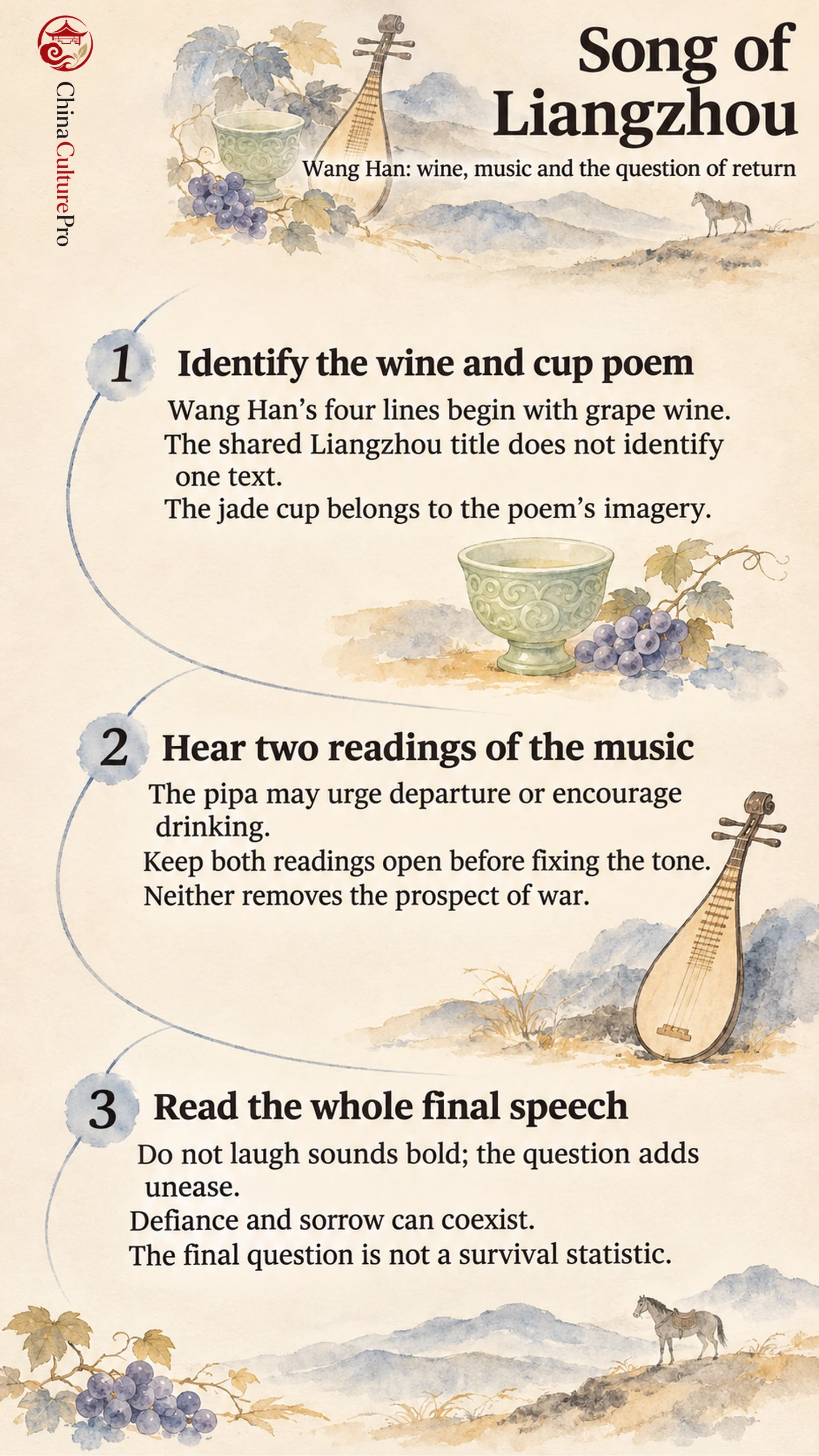
The poem’s energy depends on holding pleasure and danger together. Reading it only as a celebration of drinking loses the battlefield; reading it only as despair loses the speaker’s refusal to be laughed at.
Identify the Wine and Cup Poem and Read Its Four Lines
The pipa (琵琶, pí pá) is the plucked instrument heard in the second line. The luminous cup is traditionally glossed as a fine jade wine cup; the image combines a precious vessel with grape wine. [2]
Here is the complete quatrain, with an original, unrhymed English rendering. The second line deliberately leaves the purpose of the urging open. [1]
| Chinese line | Plain English rendering |
|---|---|
| 葡萄美酒夜光杯, | Fine grape wine in a luminous cup; [1] |
| 欲饮琵琶马上催。 | Just as we would drink, the pipa on horseback urges us on. [1] |
| 醉卧沙场君莫笑, | If I lie drunk on the battlefield, do not laugh at me; [1] |
| 古来征战几人回。 | Since ancient times, how many who went to war have returned? [1] |
Liangzhou was a musical title used by more than one Tang poet. Wang Zhihuan (王之涣, Wáng Zhī Huàn) also wrote under it, but his familiar quatrain begins with the Yellow River and clouds. Shared title does not mean identical text. [4] Compare his Liangzhou poem after this reading.
For the broader author context, see Wang Han’s major works. This page concentrates on how the wine-and-cup poem moves within its four lines.
Listen for What the Pipa Urges
The transition begins when the drinkers are about to drink. One reading hears music urging the soldiers toward departure; another hears lively playing encouraging them to drink. Both have a place in the poem’s commentary tradition. [2]
The distinction changes the pressure of the moment. In the departure reading, pleasure is threatened by the demand to depart. In the drinking reading, the music intensifies the gathering. Neither removes the battlefield and the final question from the poem.
Try reading the second line both ways without changing the other three. Does the final speech now sound like resistance to interruption, an answer to companions or both? The exercise works better than supplying an elaborate battle scene that the text never describes.
The Tang poetry guide offers context for frontier writing, while Chinese regulated verse explains the compact quatrain form.
Hear the Question beneath the Defiant Speech
The command not to laugh sounds bold, even humorous, yet the next line turns toward the uncertainty of return. The combination allows heroic feeling and sorrow to coexist rather than requiring one to cancel the other. [2]
One comparative reading describes Wang Han’s expansive language as a way of expressing lament. The force comes from grief spoken through apparent freedom and generosity, rather than through a consistently mournful register. [3]
Read the last couplet twice: once with an exuberant emphasis on the command, then with a slower pause before the question. Notice what the second line does to the first on each reading. A successful interpretation must still account for both.
When comparing English editions, check whether a translator has settled the musical ambiguity or exaggerated the ending into a categorical claim that no soldiers ever returned. The Chinese classic books guide helps evaluate explanatory notes.
FAQs About Wang Han’s Song of Liangzhou
Is this the same poem as Wang Zhihuan’s Liangzhou song?
No. They share a musical title. Wang Han’s poem begins with wine; Wang Zhihuan’s familiar poem opens with the Yellow River and clouds.
Does the last line give a historical survival rate?
No. Its question expresses the danger and uncertainty of war. It supplies no figures from which to calculate a survival rate.
Did Wang Han personally fight in the scene?
The poem does not establish that. Its vivid soldier’s voice should not automatically be treated as the poet’s own battlefield testimony.
Sources
[1] Wang Han, via Wikisource. Two Liangzhou Songs
[2] Hong Kong Education Bureau. Song of Liangzhou: Text and Reading Notes
[3] Yi Liren, National Pingtung University of Education. A Comparison of Three Frontier Poems by Wang Han, Wang Zhihuan and Wang Changling: Abstract
[4] Niigata University. Chinese Poetry Recitation Text: Wang Han’s Liangzhou Song