

Quick Answer: What Is Puju Opera?
Puju opera (蒲剧, Pújù), also called Puzhou Bangzi (蒲州梆子, Púzhōu Bāngzi), is a form of Opéra chinois from southern Shanxi. Its singing can rise sharply in pitch, and an orchestra of strings and percussion supports the performers.[1][2]
- Region: The form took shape around Puzhou, near the borders of Shanxi, Shaanxi and Henan.[1][2]
- Sound: Listen for the high bowed fiddle and the short clack of wooden percussion.[1]
- Movement: Try the excerpt with a chair and a hanging picture.[3][4][5]
Start with the picture-hanging excerpt and follow what the actor does with the chair.

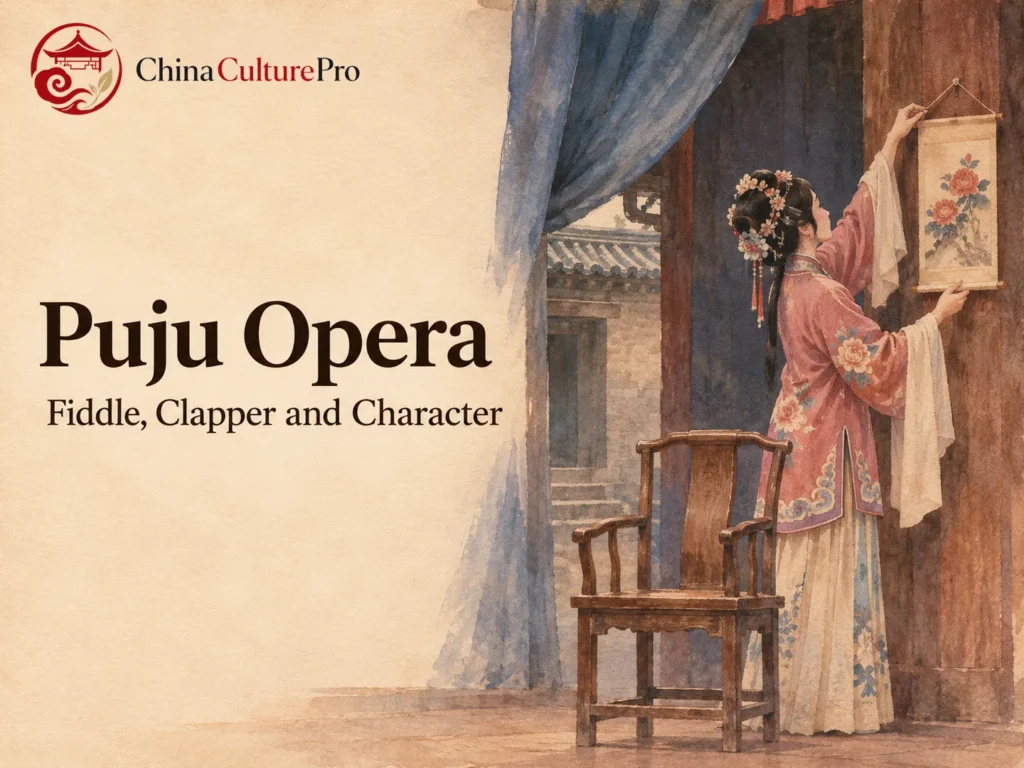
A young woman has heard that a marriage is close. In the rush to get ready, she straightens her clothes and reaches up to hang a picture. A quick reach can show eagerness, and a pause can let shyness catch up with her.
A Genre from Southern Shanxi
The heritage entries trace the genre to the late Ming and early Qing periods. Puzhou is in what is now southwestern Shanxi. Companies and audiences carried it across the borders of southern Shanxi into neighboring provinces. Today the national heritage register includes entries for both Linfen and Yuncheng.[1][2]
The historical name Puzhou Bangzi identifies the place and a family of opera music. The shorter name Puju came into use in the twentieth century.[1][2]
How the Fiddle and Clapper Shape the Voice
The banhu (板胡, bǎnhú) is the principal bowed fiddle in the melodic section. The percussion can include a wooden bangzi clapper (梆子, bāngzi), drum, gong and cymbals. Listen for the fiddle’s sustained sound against the short attacks of the percussion. The guide to Chinese musical instruments explains the wider families.[1]
The national heritage entry describes seven basic rhythmic frameworks in the main singing repertory. The singer can draw out a syllable or leap in pitch as the percussion gives the phrase a pulse or cues a movement.[1]
A Chair, a Painting and a Character
In Hanging the Painting (挂画, Guàhuà), Ren Genxin (任跟心, Rèn Gēnxīn) plays Han Yan, who is preparing for a marriage. A review of Ren’s performance describes a sequence of adjustments to clothes and appearance before the picture goes up. The plain chair gives the scene a center. Coming to it, turning beside it and looking above it all make the preparations visible.[3][4][5][6]
Watch how the performer pauses as she approaches the chair and then changes her reach. You can follow the character’s anticipation through the shifts in pace even if the words are unfamiliar.[4][5][6]
FAQs About Puju Opera
Are Puju and Puzhou Bangzi the same form?
Yes. Puzhou Bangzi is the full name used in the national heritage register. Puju is the shorter name for the same regional form.[1][2]
What other Puju work can I watch?
Try The Injustice to Dou E (窦娥冤, Dòu É Yuān) in its Puju version. Kang Xisheng arranged music for the opera film. Check the genre in the credits because the story is staged in other forms as well.[1][7]
Sources
[1] China Intangible Cultural Heritage Network. Puzhou Bangzi in Linfen
[2] China Intangible Cultural Heritage Network (Réseau chinois du patrimoine culturel immatériel). Puzhou Bangzi in Yuncheng
[3] China Intangible Cultural Heritage Network. Ren Genxin
[4] CCTV. Hanging the Painting Performed by Ren Genxin
[5] Shanxi Puju Art Academy. Puju Stage Skills
[6] People’s Daily historical archive. Young Puju Actors in Performance
[7] China Intangible Cultural Heritage Network. Kang Xisheng