


Quick Answer: Who Was Jia Yi?
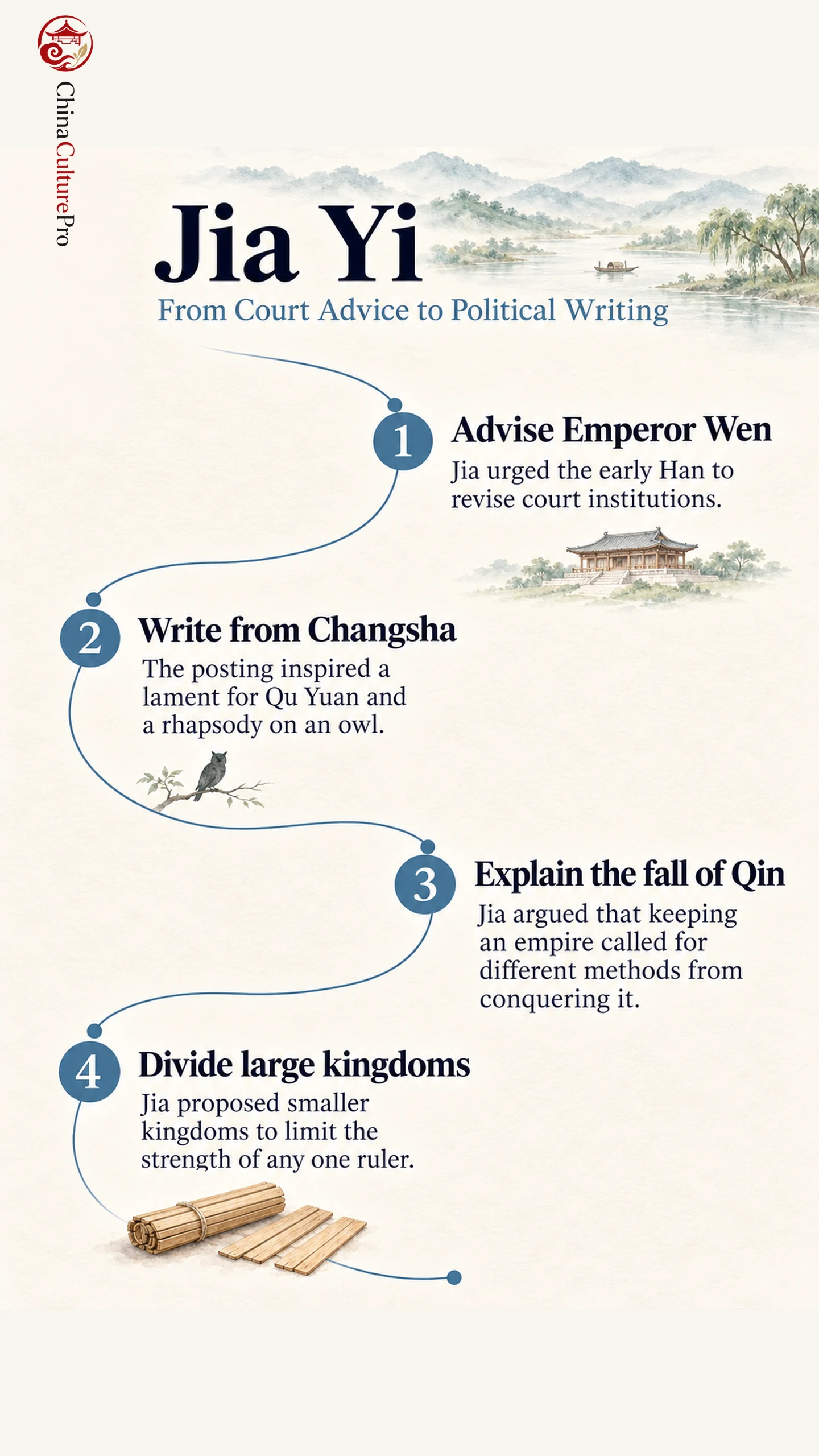
Jia Yi (贾谊, Jiǎ Yì, 200–168 BCE) was an early Western Han adviser and writer. He served under Emperor Wen (汉文帝, Hàn Wéndì) and wrote about what could keep the new dynasty in power.[1][5]
- Qin: In On the Faults of Qin (过秦论, Guò Qín Lùn), Jia argued that the qualities needed to take power differ from those needed to hold it.[3]
- Han: He urged the court to divide large regional kingdoms into smaller ones.[2]
- Literature: His posting in Changsha (长沙, Chángshā) is associated with a lament and a rhapsody about an owl.[1]
The essays and rhapsodies let readers see his response to problems of government and to his own political disappointments.
In his best-known essay, Jia asks how a state capable of conquering rival kingdoms could collapse in the face of a rebellion. He turns the fall of Qin into a problem for the Han court.
From Court Adviser to Tutor in Changsha
Jia came from Luoyang and gained a reputation for command of classical texts and skill in writing. Emperor Wen summoned and promoted him. Jia proposed that the new dynasty revise its calendar, official titles and court rituals. The Book of Han says the emperor put off the broader program, while attributing some legal changes to Jia’s advice.[2]
Sima Qian says other senior officials opposed Jia’s rise. The emperor sent him to tutor the king of Changsha.[1]
The posting gave Jia material for two works. In the Lament for Qu Yuan (吊屈原赋, Diào Qū Yuán Fù), he addresses Qu Yuan (屈原, Qū Yuán), an earlier figure remembered for losing favor. In the Rhapsody on the Owl (鵩鸟赋, Fúniǎo Fù), an unsettling visitor prompts reflection on fortune, change and mortality.[1][5]
Why Jia Yi Thought Qin Lost Its Empire
Jia’s essay first describes how generations of Qin rulers built up the strength to defeat their rivals. Then he puts the empire’s resources beside those of Chen She (陈涉, Chén Shè), a rebel who began with a small force. The contrast makes the downfall of the Qin dynasty a puzzle.[3]
Jia’s answer turns on how people were governed after conquest. A ruling house needed their cooperation, and harsh treatment made it harder to secure. Humaneness mattered to the survival of government because it gave people reasons to keep cooperating with it.[4]
In the second part of the essay, Jia imagines a different response from Qin’s second emperor. He could have eased punishments and burdens, and opened granaries to help those in need. Jia uses the measures to show what a ruler might do after inheriting an empire shaped by conquest.[3]
How Jia Yi Wanted to Stabilize the Han
In his Memorial on Order and Security (治安策, Zhì’ān Cè), preserved in the Book of Han, Jia likens the apparently settled realm to someone asleep on a pile of brushwood with fire set underneath. He identified the strength of regional rulers as a source of danger.[2]
His proposal was to partition large kingdoms and assign smaller ones among royal descendants. The royal houses could retain territory, while any one king would control fewer resources. Jia saw that arrangement as a way to reduce the danger before open conflict.[2]
FAQs About Jia Yi
Did Jia Yi return to court from Changsha?
Yes. Emperor Wen recalled him and later appointed him tutor to the king of Liang, one of the emperor’s sons. Sima Qian describes an audience in which the emperor listened to Jia discuss spirits until midnight.[1]
What is the Xinshu?
New Writings (新书, Xīnshū) is the received collection associated with Jia Yi. It contains arguments about government, historical examples and discussions of ritual. Scholars debate the transmission and authenticity of the collection.[5]
Why is Jia Yi associated with Qu Yuan?
Jia addressed a lament to Qu Yuan while traveling to his Changsha posting. Sima Qian placed both men in the same chapter of his historical work.[1]
Sources
[1] Sima Qian. Records of the Grand Historian, Qu Yuan and Jia Yi
[2] Ban Gu and others. Book of Han, Biography of Jia Yi
[3] Jia Yi. On the Faults of Qin
[4] Stanford Encyclopedia of Philosophy. Philosophy in Han Dynasty China
[5] Martin Kern. Early Chinese Literature, Beginnings through Western Han