

Quick Answer: Who Was the Tianqi Emperor?
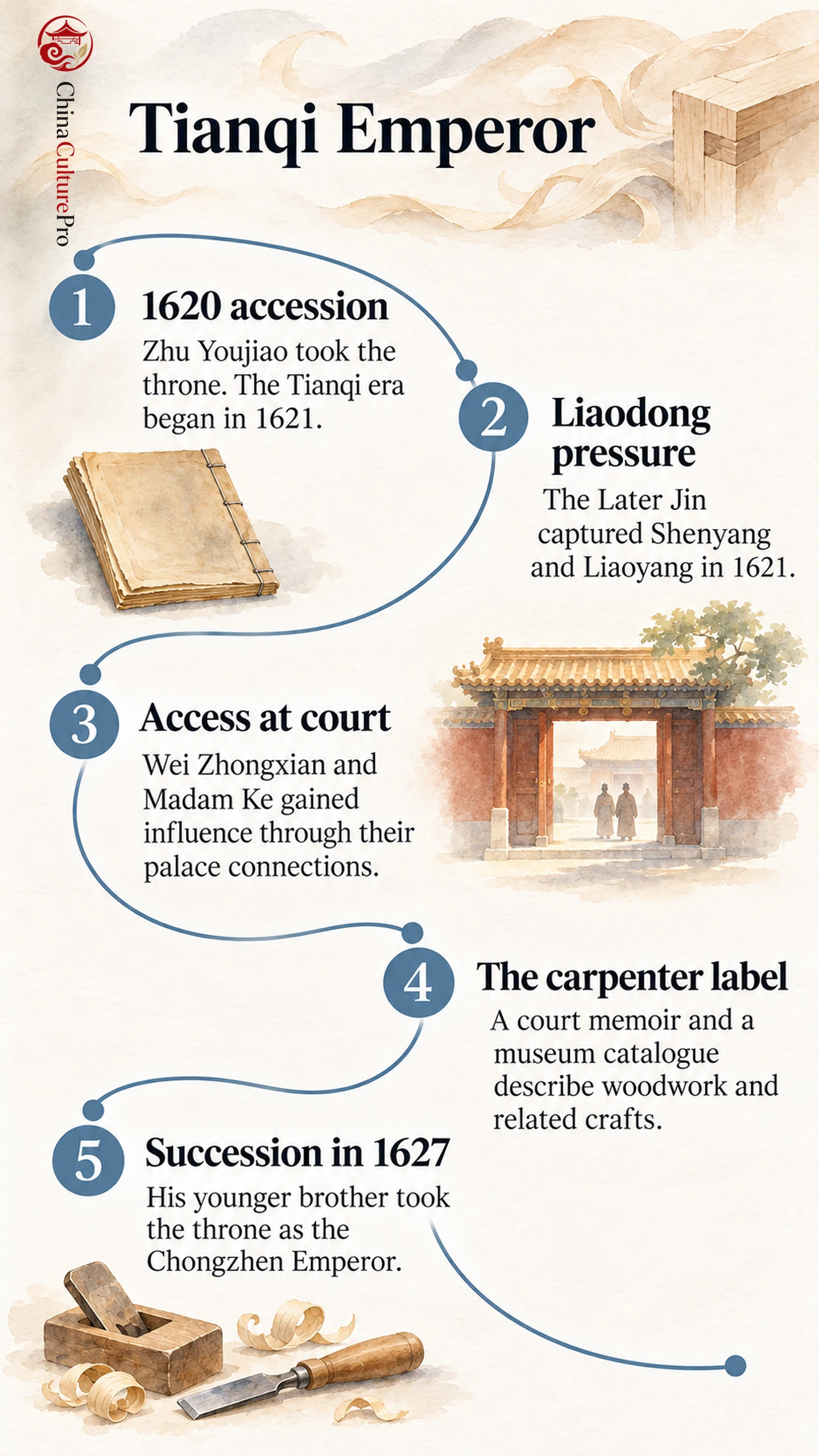
The Tianqi Emperor (天启帝, Tiānqǐ Dì) was Zhu Youjiao (朱由校, Zhū Yóujiào), a late Ming ruler who took the throne in 1620 and died in 1627. The first year designated Tianqi was 1621. He is remembered for woodworking and for a court in which the eunuch Wei Zhongxian and the emperor’s former nurse, Madam Ke, accumulated influence.[1][2][3]
- Accession: He succeeded his father, the Taichang Emperor, after a brief reign in 1620.[1][2]
- Workshop reputation: Palace accounts describe woodworking, lacquer work and an interest in construction.[3][4]
- Succession: His younger brother succeeded him in 1627 and became known as the Chongzhen Emperor.[6]
The nickname “carpenter emperor” describes an interest recorded in court accounts. It explains only part of a reign that also saw political persecution and a worsening military situation in Liaodong.[1][3][4]
The emperor remembered for working with wood ruled during a struggle over access to the throne. Accounts of his workshop habits tell us how palace observers portrayed him. The records of appointments, arrests and succession show the political stakes of his short reign.
How Zhu Youjiao Came to the Throne
Zhu was the Taichang Emperor’s eldest son. The imperial annals describe officials receiving the late emperor’s succession order and Zhu taking the throne in 1620. The new ruler ordered that the next year be counted as the first Tianqi year. That distinction accounts for references that start with 1621 while placing the accession in 1620.[1][2]
The early reign brought serious problems in Liaodong, where the Later Jin took Shenyang and Liaoyang in 1621. The court changed its senior appointments in response. The pressures were already becoming important in the final decades of the Ming dynasty.[1][2]
How Wei Zhongxian Gained Influence at Court
Wei Zhongxian’s position in the palace and Madam Ke’s connection to the young emperor gave them access to him. That access had consequences for who could hold office and who was vulnerable to prosecution. In the mid-1620s, officials associated with Donglin (东林, Dōnglín) became targets of arrests and persecution. Historical research shows that published lists helped turn Donglin into a label that Wei’s supporters could use against opponents.[1][5]
The political struggle continued after Zhu died. His brother, the Chongzhen Emperor, took the throne in 1627 and moved against Wei’s network. This succession separates Tianqi’s court from the final Ming reign.[6]
What the Woodworking Accounts Actually Show
The Palace Museum’s catalogue entry for Zhu’s portrait describes an interest in woodwork, decorative painting and building. The palace memoir of Liu Ruoyu, quoted in a later account, portrays the emperor using woodworking tools and working on objects with palace attendants. These sources explain how the nickname took hold.[3][4]
The memoir also tells a story about when attendants could bring matters before him. Its portrait of his habits is evidence about how a palace observer understood access and influence. To explain individual political decisions, read it alongside records that name officials, appointments and prosecutions.[1][2][4]
FAQs About the Tianqi Emperor
Why do some timelines start the Tianqi reign in 1621?
Zhu Youjiao took the throne in 1620. He designated the following year as the first year of the Tianqi era, so an era-name table starts at 1621.[1][2]
Was Tianqi the last Ming emperor of Beijing?
His younger brother succeeded him in 1627 and ruled as the Chongzhen Emperor. The Palace Museum places Chongzhen’s formal era in 1628–44.[6]
Fuentes
[1] Palace Museum. The Tianqi Emperor
[2] History of the Ming. Volume 22: Annals of Emperor Xizong
[3] Palace Museum. Portrait of Ming Emperor Zhu Youjiao
[4] Beijing Daily. Reading Ming Palace Life Through Liu Ruoyu’s Memoir
[5] University of Michigan Repository. Politics and Morality During the Ming–Qing Dynastic Transition
[6] Palace Museum. The Chongzhen Emperor