


Quick Answer: What Defined the Ming Dynasty?
The Ming (明, Míng) dynasty ruled from 1368 to 1644. It combined an emperor-centered government with influential artistic production, expanding commercial culture and changing connections to the wider world.[1][4]
- Rule: The dynasty began at Nanjing (南京, Nánjīng) and later established its main imperial court at Beijing (北京, Běijīng).
- Culture: Painting, porcelain, furnishings and illustrated books served court and commercial audiences.
- Connections: State voyages and later private trade linked China with overseas societies and silver supplies.
- Transition: The fall of Beijing in 1644 was followed by continued warfare and rival claims to rule.
Ming history cannot be reduced either to complete isolation or to uninterrupted openness; policies and actual exchanges changed over time.
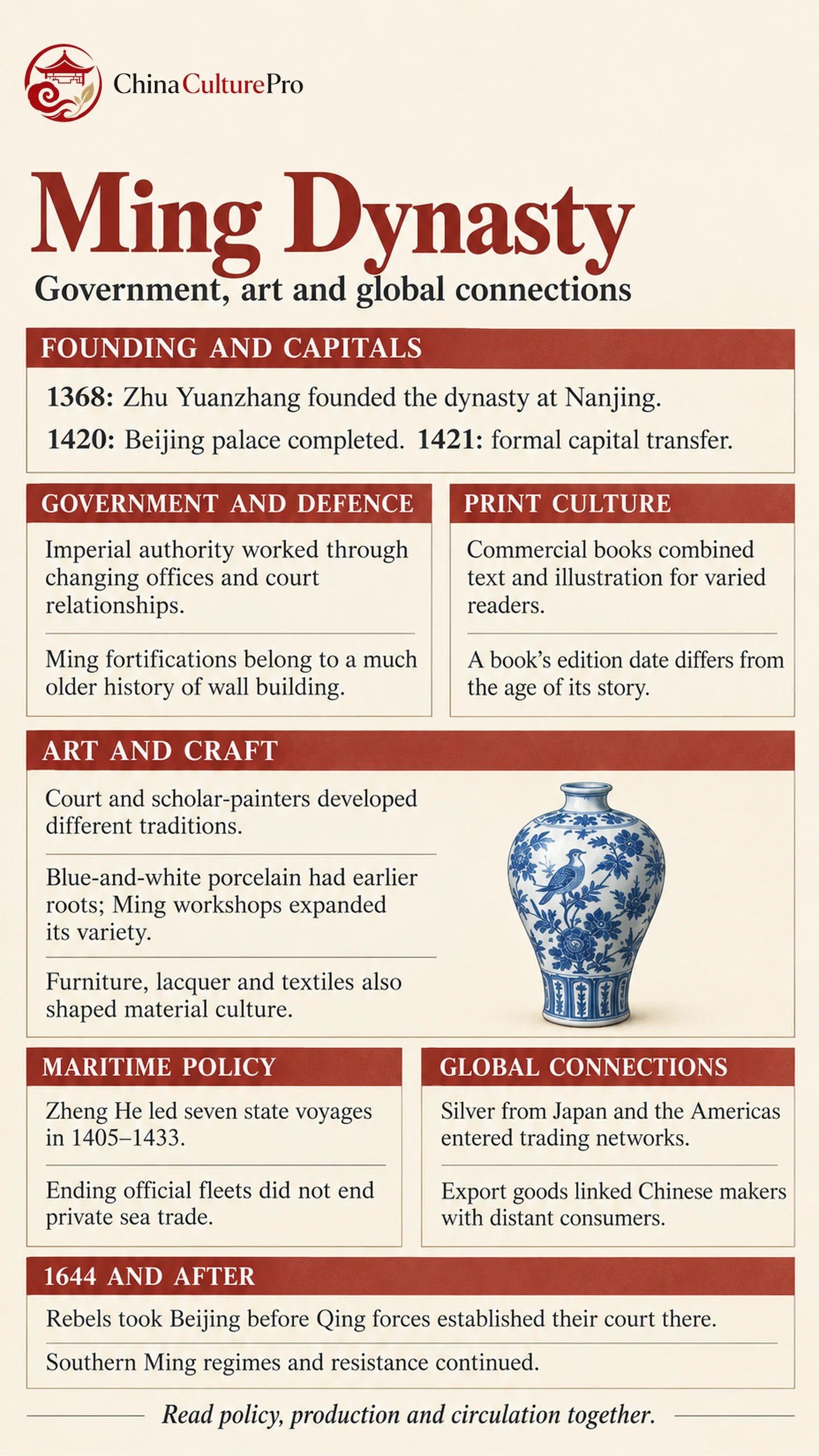
A Ming porcelain vessel could belong to an imperial service, a wealthy household or an overseas market. Understanding which setting it served helps connect its appearance with the political and commercial world that produced it.
Ships, books and buildings reveal other relationships between state power and cultural life. Use the Chinese history overview and dynasty timeline to place these developments in sequence.
From the Founding at Nanjing to the Beijing Court
The Ming emerged from rebellion and warfare against the Mongol-led Yuan dynasty (元, Yuán). Zhu Yuanzhang (朱元璋, Zhū Yuánzhāng), who ruled under the Hongwu (洪武, Hóngwǔ) era name, founded the dynasty in 1368. Nanjing was its first capital.[1][2]
The later Yongle Emperor (永乐帝, Yǒnglè Dì), whose personal name was Zhu Di (朱棣, Zhū Dì), moved the principal court to Beijing. Palace construction was completed in 1420; the formal capital transfer followed in 1421.[2]
The Forbidden City (紫禁城, Zǐjìnchéng) made imperial authority visible through ceremonial space, controlled access and the organization of court life. Its later history includes rebuilding and use by another dynasty, so surviving structures require their own dates.
Moving the political center north also linked it more closely to northern defence. Supplies and revenues from economically important southern regions remained essential, making the Grand Canal part of the larger relationship between court and countryside.[2][10]
Imperial Government, Local Society and Defence
Hongwu concentrated authority at the throne. After the abolition of the central secretariat in 1380, grand secretaries gradually developed an important advisory role between the emperor and the bureaucracy. This was a changing institutional arrangement, not proof that one ruler personally handled every local decision.[3]
Officials, military commanders and palace personnel occupied different positions around imperial power. The examination system gave classical education political value, while court relationships and conflict affected careers. Institutional continuity did not prevent sharp changes in how particular emperors and their advisers governed.[3]
Defence involved garrisons, supplies and frontier fortifications. Much of the imposing masonry associated with the Great Wall belongs to Ming construction, but the dynasty inherited a much older history of wall building.[8]
A wall was one component of a defence system. Its effectiveness depended on people, resources and strategy; a monumental structure alone could not settle the empire’s frontier problems.
Painting, Porcelain and Material Arts
Ming painting developed several earlier traditions. Court commissions could promote images of virtue and ordered government, while scholar-painters cultivated expressive brushwork and relationships with earlier masters. These approaches differed in patronage and purpose, even when they shared subjects or techniques.[4]
The guide to Chinese painting explains those longer artistic lineages. Viewing a work as personal expression does not make it independent of status, friendship or the market for cultured taste.
Ming porcelain also served varied needs. Jingdezhen (景德镇, Jǐngdézhèn) became a major production center supplying domestic and overseas consumers.[1] The history of Jingdezhen’s kilns connects workshop skill with those audiences.
Blue-and-white porcelain had important roots before the Ming, including developments under the preceding dynasty. Ming makers expanded its range, while colored enamels, monochrome glazes and other techniques also flourished. “Ming” is a period, not the name of one color scheme.[4]
Lacquer, textiles, metalwork and wooden furniture further broaden the material record.[4] Such objects reveal different skills and uses that a porcelain-only picture of the period would miss.
Printing, Fiction and Commercial Culture
Commercial publishing served readers with different interests. Illustrated stories, plays, novels and other works combined written text with images. Block cutters, publishers and sellers helped shape how these books reached their audiences.[5]
Woodblock printing supported this culture without being a Ming invention. The useful change is the relationship between established techniques, expanding markets and varied reading tastes.
Illustrations could direct attention toward a scene, reinforce a narrative or provide visual pleasure. A printed page therefore offers evidence about design and consumption as well as its literary content. Its edition date should be distinguished from the age of the story or the events it describes.
The broader Chinese literary tradition, including the classical novels, extends across several periods. A Ming publishing context does not make every later famous novel a Ming work.
Zheng He’s Voyages and Changing Maritime Policy
Zheng He (郑和, Zhèng Hé) led seven major state-sponsored voyages between 1405 and 1433. The fleets traveled through Southeast Asian and Indian Ocean routes, with missions reaching the Persian Gulf and East African coast.[6]
They carried diplomatic ambitions, imperial prestige and trade-related exchanges. Merchants and navigators already knew many of these routes. They were not the first human contact among the regions visited.[6]
The voyages also differed from later private commerce. Court decisions about costly expeditions did not determine every merchant’s activity. Maritime restrictions, licensed exchanges and unauthorized trading could coexist; a major policy relaxation in 1567 still left regulation and particular prohibitions in place.[7]
The Maritime Silk Road history follows these changing connections beyond the lifespan of the official fleets. Ending the treasure voyages did not mean that all overseas exchange ended with them.
Silver, Export Goods and Global Connections
Late Ming commerce linked Chinese demand for silver with supplies from Japan and the Americas. Silver mattered both in market exchange and in payments to the state. Trade in manufactured goods helped draw that metal toward Chinese markets.[7]
The routes were multiple. Japanese supplies moved through East Asian networks, while American silver crossed the Pacific through the Spanish colonial port of Manila and also reached Asia through other circuits. Chinese merchants participated actively in this exchange.[7]
Export porcelain makes those relationships tangible: forms and decoration could respond to distant buyers. A vessel’s later foreign mounting or ownership belongs to its history of circulation, rather than necessarily to its original manufacture.
The history of Chinese currency also explains why silver payments did not make every local exchange identical. Connections to global trade operated through regional markets, institutions and different kinds of money.
Crisis in 1644 and the Longer Transition
The final decades brought fiscal strain, crop failures, frontier warfare and internal rebellion. These problems interacted; the dynasty’s collapse cannot be explained simply by one emperor’s personality or one change in silver supply.[1][7]
In 1644, rebel forces under Li Zicheng (李自成, Lǐ Zìchéng) took Beijing, and the Chongzhen Emperor (崇祯帝, Chóngzhēn Dì) died. Manchu-led forces subsequently established the Qing dynasty (清, Qīng) in the capital. These were separate stages in the struggle for power.[3][9]
Southern Ming (南明, Nán Míng) regimes continued to claim the dynasty afterward. The conventional endpoint of 1644 marks the fall of its Beijing court, not an immediate end to all Ming resistance or a peaceful handover across the country.[3]
Ming cultural models also continued. Books, craft practices, paintings and patterns of consumption passed into later settings, where new patrons and makers adapted them. That continuing life of objects and ideas is part of the dynasty’s legacy alongside its political end.
FAQs About the Ming Dynasty
Was Ming China completely closed to overseas trade?
No. Policies varied, and restrictions did not eliminate authorized or illicit commerce. The official voyages, later private trading networks and regulated openings should be distinguished rather than combined into one timeless policy.[6][7]
Did the Ming invent blue-and-white porcelain?
No. Important developments predated it, especially under the Yuan. Ming workshops became famous for expanding production and artistic variety, but blue-and-white was neither entirely new nor the dynasty’s only ceramic tradition.[4]
Were all Zheng He’s voyages sent by the Yongle Emperor?
No. Yongle supported the earlier expeditions, but the final voyage of 1431–1433 took place under a later emperor. The seven voyages should not all be assigned to one reign.[6]
Why do histories end the Ming in 1644 if resistance continued?
The date marks the collapse of the main court at Beijing. Successor courts and other resistance continued afterward, so a broad dynasty timeline and a detailed account of the conquest can use different stopping points.[3]
Fuentes
[1] Smithsonian National Museum of Asian Art. Ming Dynasty, 1368–1644
[2] Capital Museum. 1420: From Nanjing to Beijing
[3] Cambridge University Press. The Cambridge History of China: Ming Political History
[4] Metropolitan Museum of Art. Ming Dynasty, 1368–1644
[5] Claremont Colleges Asian Library. Characterful and Illustrative: Chinese Woodblock Printed Books
[6] Columbia University, Asia for Educators. The Ming Voyages
[7] Cambridge University Press, Revista de Historia Económica. The Changing Significance of Latin American Silver in the Chinese Economy
[8] UNESCO World Heritage Centre. The Great Wall
[9] Palace Museum. The Chongzhen Emperor
[10] Columbia University, Asia for Educators. East Asia in Geographic Perspective: The Grand Canal