

Quick Answer: What Is Chinese Woodblock Printing?
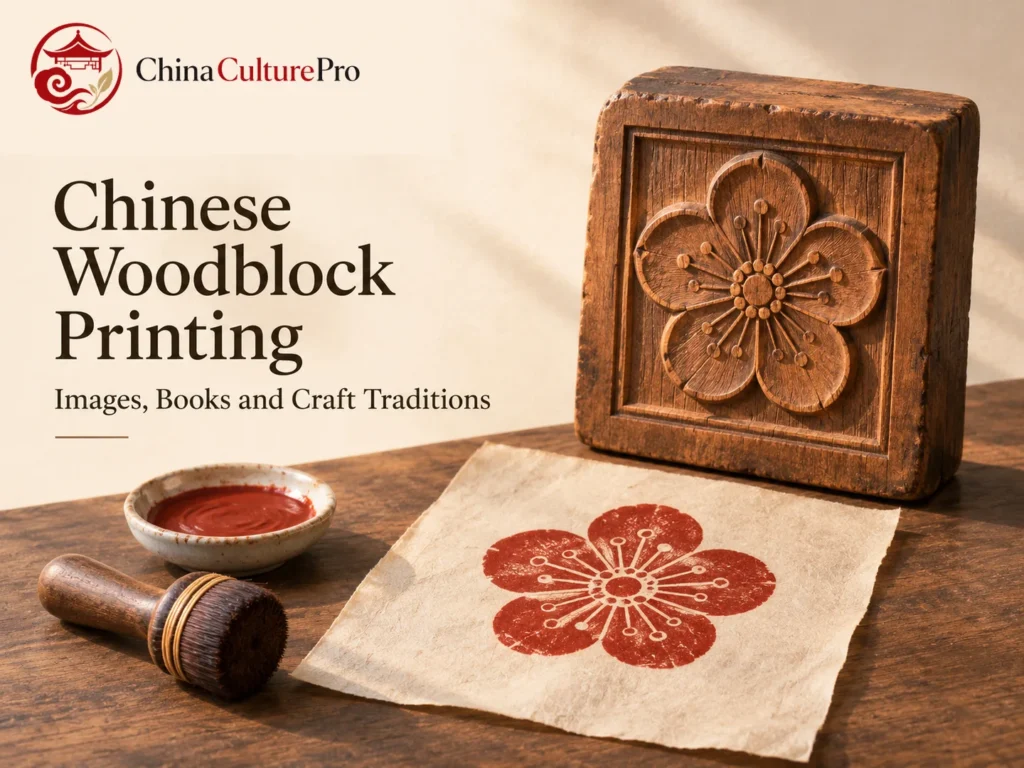
Chinese woodblock printing (雕版印刷, diāobǎn yìnshuā) transfers a design from the raised parts of a carved wooden block to paper. A block can carry characters, images or both. It can produce more than one impression.[1]
- Block: The raised lines receive ink and the cut-away areas leave spaces.
- Color: Several blocks can print different parts of a picture.
- Format: Printed sheets can become scrolls, books or individual pictures.
The surface that prints the image and the format of the finished object are separate clues.

A carved block can leave a line of text or a petal on sheet after sheet. To understand a Chinese print, start with what touched the paper, then look at how the printed sheet was colored, assembled or used.
How a Carved Block Transfers an Image
The design on a relief block is a mirror image of the impression. Paper takes ink from the raised surface, and the design appears in the intended direction when you lift the sheet. The carver leaves the printing areas raised and removes the surrounding material. A drawing or text on thin paper can guide the carver. On the finished block the black line corresponds to a raised surface that will carry ink.[1]
Before making a set of impressions, a workshop can print a proof. The proof shows how an edge or character looks on paper. It may reveal a small area that still needs correction. The block can then carry a corrected image through subsequent impressions.[1]
Printing a Book: The Diamond Sutra
The British Library’s Diamond Sutra (金刚经, Jīngāng Jīng) is a surviving dated woodblock-printed Buddhist book from 868. Its more than five-meter length comprises seven printed paper panels joined into a scroll. The frontispiece and text survive within the same object. The date tells us when this particular copy was printed. The clear lines and joined panels also show a developed technique already in use by then.[2]
Read the printing method and the assembled object independently. The panels were printed on paper and then joined into a roll. Other printed sheets could be folded or joined in book form. The guide to Chinese traditional bookbinding explains the separate decisions involved in constructing a book.[1][2]
Color Blocks and Hand-Painted Details
Multiple blocks can lay down different areas of ink. Each impression has to align with the parts already on the sheet. That alignment is called registration. A leaf from the Ten Bamboo Studio Manual of Painting and Calligraphy (十竹斋书画谱, Shízhúzhāi Shūhuà Pǔ) demonstrates the use of multiple blocks and gradual shading. The Met records that the manual’s first edition was printed in 1633 in Nanjing.[3]
The leaf comes from a manual that gathered designs of plants, birds, rocks and other subjects for painters. In the printed book, color is therefore part of the way readers encounter examples of brushwork. When you read a museum record, separate the date of the first edition from any evidence used to date the individual impression.[3]
A different workshop method combines printing and brushwork. In Yangliuqing (杨柳青, Yángliǔqīng) New Year prints, the block can supply outlines and larger color areas. A painter adds details such as facial shading. Two impressions from the same outline can differ in the brushwork added afterward.[4]
Woodblock Printing vs Wooden Movable Type
| Método | What holds the layout |
|---|---|
| Woodblock printing | A single carved block holds the fixed arrangement of lines and characters for that impression. |
| Wooden movable type | Separate carved characters are assembled for a page, then can be rearranged for another. |
In the documented wooden movable type practice of Rui’an (瑞安, Ruì’ān), Zhejiang, workshops assemble characters to print family genealogies. Both methods can print with ink from raised wood. A block keeps its layout between printings. After printing a type page, the workshop can take it apart and reuse the characters in a different arrangement.[1][5]
An impression does not always make the difference obvious. Specialists may look for shifts in alignment and other traces of type. A single uneven character gives limited evidence. The printing surface, colophon and catalogue description can help resolve what an image alone leaves uncertain.[6]
How Workshops Keep the Printing Skills in Use
The UNESCO record for engraved block printing describes several roles. Preparing the block, checking the design, carving, proofing and printing require different kinds of judgment. The finished page brings these decisions together and can obscure the separate jobs involved in traditional crafts such as printing.[1]
UNESCO inscribed the engraved block printing technique on its Representative List in 2009. Its record describes a craft in use for new books and reproductions as well as historical texts. In this case, intangible cultural heritage concerns the skills needed to keep making and teaching the work.[1]
FAQs About Chinese Woodblock Printing
Are Chinese woodblock prints always made with black ink?
A black impression is one possibility. A printer can also use colored inks, and several blocks can build up the same picture.
Why are letters carved in reverse?
The paper receives a mirror impression of the block surface. Reversed lettering on the block reads in the intended direction on the print.
Was the Diamond Sutra printed with movable type?
The surviving 868 scroll is woodblock printed. Movable type sets individual characters into a page that can later be taken apart.
Can a woodblock print also be painted by hand?
Yes. In the Yangliuqing tradition, printed lines and color areas can be combined with details painted by hand.
Fuentes
[1] UNESCO. China Engraved Block Printing Technique
[2] Agnieszka Helman-Ważny, International Dunhuang Programme. A Preliminary Study of the Paper of the Diamond Sutra (Or.8210/P.2)
[3] The Metropolitan Museum of Art. Leaf from the Ten Bamboo Studio Manual of Painting and Calligraphy
[4] China Intangible Cultural Heritage Digital Museum. The Art of Yangliuqing New Year Prints
[5] UNESCO. Wooden Movable-Type Printing of China
[6] Imre Galambos. Translating Chinese Tradition and Teaching Tangut Culture