

Quick Answer: What Was the Shang Dynasty?
The Shang dynasty (商朝, Shāng Cháo) ruled in northern China from about 1600 BCE until the mid-eleventh century BCE. It is the earliest Chinese dynasty securely documented by contemporary writing alongside excavated remains. The richest written evidence comes from its later centuries.[1][2][12]
- Oracle bones: Oracle-bone inscriptions (甲骨文, jiǎgǔwén) from Yinxu (殷墟, Yīnxū) near Anyang record questions put to diviners and, in some cases, the king’s reading and what followed.[2][4][5]
- Ritual bronzes: Skilled workshops cast vessels for food and drink used in ceremonies and burials.[1][6]
- Kingship: Royal tombs and ancestral shrines show how rulers made their authority visible. The Zhou dynasty (周朝, Zhōu Cháo) conquered the Shang court around 1046 BCE.[2][8][11]
Most surviving written evidence describes court concerns in the late Shang.
A cracked bone and a bronze steamer reveal different sides of Shang rule. One records a question about a royal birth. The other comes from the tomb of the woman named in that record.[5][9]
When and Where the Shang Ruled
The Shang took shape in the Yellow River region. Approximate dates of 1600 to 1046 BCE are useful for placing the dynasty on a timeline of Chinese dynasties. Some museum histories round the end to about 1050 BCE. Earlier dates depend heavily on archaeological sequences and later written accounts, while late Shang inscriptions make the royal chronology more detailed.[1][8][11][12]
The site at Zhengzhou in Henan has large rammed-earth walls and traces of workshops and other activity. Archaeologists associate much of the early Shang material there with Erligang (二里岗, Èrlǐgǎng), a term for an archaeological phase and its characteristic material. At Zhengzhou, walls and workshop debris show organized construction and craft production. The remains alone give no certain ancient name for the city.[3]
Yinxu, near modern Anyang, was a later Shang capital. UNESCO dates its late Shang occupation to roughly 1300–1046 BCE. More than 80 building foundations have been found in the palace and royal ancestral shrine area. Cemeteries and workshops preserve different kinds of activity. They show how burials and specialized craft production took place alongside palace and shrine life in the capital. The court left many inscriptions there, making it possible to connect what people wrote with excavated sites and artifacts. The earlier urban remains at Zhengzhou and the detailed records from Anyang come from different parts of the dynasty’s history.[1][2][3][4]
How Oracle Bones Recorded Royal Decisions
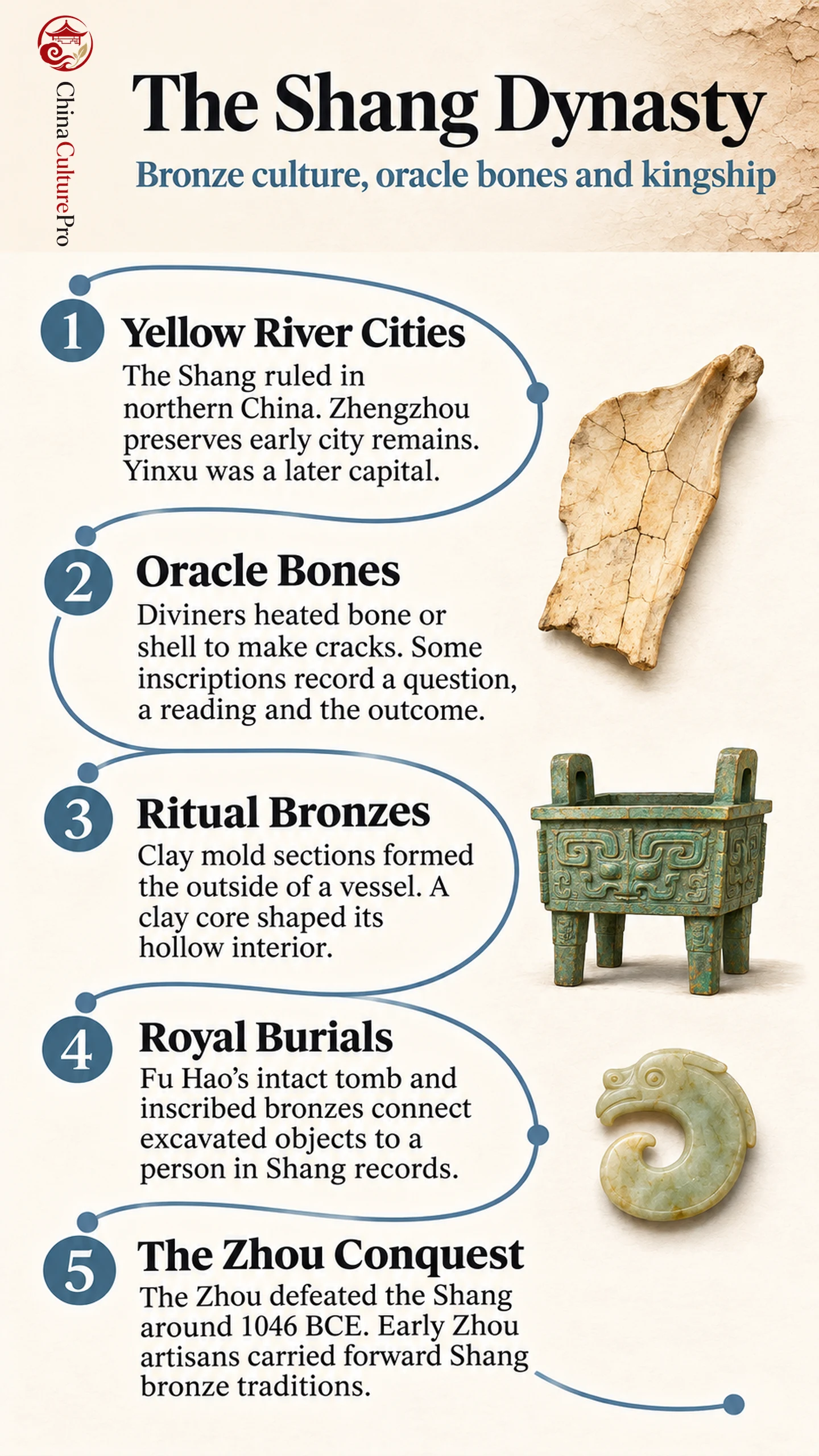
Diviners worked with cattle shoulder blades and the underside of turtle shells, among other materials. They made hollows in the material and applied heat to create cracks. A diviner or the king could interpret those cracks in response to a concern. Some inscriptions record the date, who conducted the divination and the matter under consideration. Others also record a reading of the cracks or an outcome.[4][5]
One inscription from the time of King Wu Ding (武丁, Wǔ Dīng) concerns childbirth for his consort Fu Hao (妇好, Fù Hǎo). It names the diviner Que. The king associated a favorable birth with a day bearing the sign ding in the cycle used to count days. The scribe later recorded that a girl was born on a day with a different sign and marked the outcome as unfavorable. The value judgment belongs to this royal record. The entry documents both the concern before the birth and the way someone recorded what happened afterward.[5]
Other bones concern matters such as sacrifices and royal affairs, but the archive favors the concerns that prompted divination and was selective even within court life. The guide to oracle bone script explains what this writing contributes to the history of Chinese characters.[4][5][12]
Bronze Vessels and Piece-Mold Casting
Shang metalworkers made weapons and fittings as well as containers. Many of the best-known Chinese bronze vessels held food or drink in ceremonies connected with ancestors. Shape could tell participants how a vessel was used, while its size, decoration and the amount of metal required also conveyed the resources behind a ceremony.[1][6]
A common method was piece-mold casting. Artisans made a model and took sections of a clay mold from it. Reassembling those sections around a clay core left a space for molten bronze. The outside of the cast vessel followed the mold, and the core formed the hollow interior. Artisans could carve or stamp patterns into the mold’s inner surface. Casting reproduced the details in metal, so a tool for shaping the vessel was also a way to decorate it.[6][7]
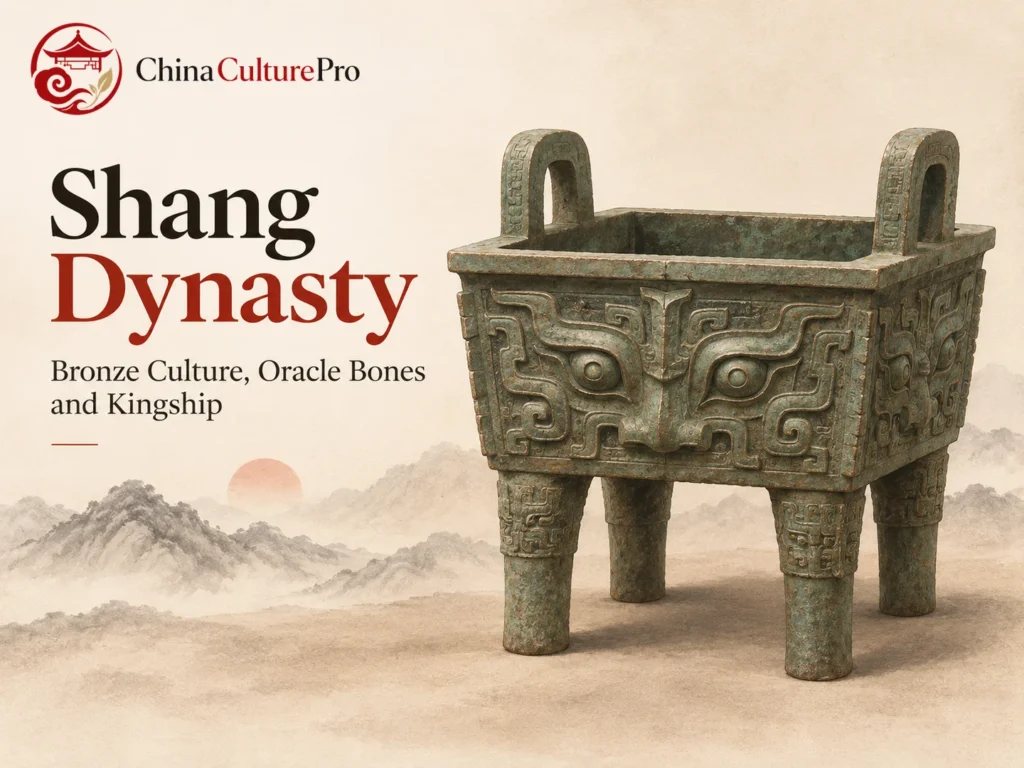
A late Shang rectangular cauldron, or fangding (方鼎, fāngdǐng), in the Metropolitan Museum of Art has a deep body, four legs and paired eyes on the surface. The stylized animal face is commonly called a taotie (饕餮, tāotiè). The eyes help a viewer recognize the motif, even where the rest of the pattern is hard to resolve into an animal. Modern names and descriptions help identify the design, but its precise meaning to Shang makers and users is uncertain.[6][7][13]
Kingship, Ancestors and the Tomb of Fu Hao
The Shang king presided over ancestral ceremonies, read divinations and drew on the labor needed to build palaces and large tombs. At Yinxu, burial grounds and shrine foundations show that the work of maintaining relationships with royal ancestors occupied space, labor and materials. The richest tombs preserve the priorities of the elite who built them. Many of the largest were robbed, which limits what can be reconstructed about their original contents.[2][8][12]
Fu Hao’s tomb offers a particularly direct comparison of writing and objects. The intact burial, excavated in 1976, held 468 bronze objects, including weapons and vessels, as well as hundreds of jades. Inscriptions on bronzes connect the burial to the royal consort, while oracle-bone texts record her participation in military and ritual affairs. The two kinds of evidence show that her court role went beyond the single childbirth inscription.[2][9][10]
One object is a bronze steamer, or yan (甗, yǎn), with three upper cooking compartments over a shared rectangular base. Each upper compartment could hold food, while the lower part held water for steaming. Fu Hao’s name appears on the vessel. A useful way to read the object is to separate what its shape shows about cooking, what the inscription says about its association and what the burial tells us about its final placement.[9]
How the Shang Ended and What the Zhou Kept
The Zhou came from farther west in the Yellow River region. King Wu of Zhou (周武王, Zhōu Wǔwáng) defeated the forces of the last Shang king, Di Xin (帝辛, Dì Xīn), at the Battle of Muye (牧野之战, Mùyě Zhī Zhàn), conventionally dated to 1046 BCE. An inscription inside an early Zhou food vessel, the Li Gui (利簋, Lì Guǐ), records King Wu’s conquest. That object provides a near-contemporary account from the victors, while the exact calendar year remains a matter of historical reconstruction.[6][8][12][14]
Early Western Zhou (西周, Xī Zhōu) bronzes carried forward Shang shapes, decoration and the use of metal vessels in ancestral ceremonies. Looking at objects on either side of the conquest helps explain why a change in rulers and a change in ritual practice have different dates. Over time Zhou bronze inscriptions grew more elaborate and could record grants, appointments or events. The Zhou dynasty guide follows the changes after the conquest.[6][11]
FAQs About the Shang Dynasty
Why is the Shang called China’s first historically verified dynasty?
Its late royal center can be identified through excavated buildings, tombs and written records produced during the dynasty itself. This is a different evidentiary situation from the earlier Xia dynasty (夏朝, Xià Cháo), whose association with a particular archaeological culture remains debated.[1][2][11][12]
Were all oracle bones made from turtle shells?
No. Diviners also used cattle shoulder blades and other bones. A turtle’s lower shell is called a plastron. The term oracle bone also covers divination shells. Some pieces bear inscriptions alongside their cracks.[4][5]
Was Sanxingdui part of the Shang dynasty?
Sanxingdui (三星堆, Sānxīngduī) in Sichuan overlapped the Shang era, but its bronze figures and masks belong to a distinct regional culture. Overlapping dates show that several metalworking centers existed at the same time. They do not establish that the court at Anyang ruled Sichuan.[11]
Fuentes
[1] Smithsonian National Museum of Asian Art. Shang Dynasty, ca. 1600–1050 BCE
[2] UNESCO World Heritage Centre. Yin Xu
[3] Early China. The Shang City at Zhengzhou and Related Problems
[4] UNESCO Memory of the World. Chinese Oracle-Bone Inscriptions
[5] Columbia University Asia for Educators. Late Shang Oracle-Bone Inscriptions on Childbearing
[6] The Metropolitan Museum of Art. Shang and Zhou Dynasties: The Bronze Age of China
[7] The Metropolitan Museum of Art. Rectangular Cauldron (Fangding)
[8] Antiquity. The Anyang Xibeigang Shang Royal Tombs Revisited
[9] National Museum of China. Fu Hao Triple Bronze Yan Steamer
[10] Smarthistory. War and Sacrifice: The Tomb of Fu Hao
[11] The Metropolitan Museum of Art. China, 2000–1000 BCE
[12] Cambridge University Press. The Shang: China’s First Historical Dynasty
[13] University of Hawai‘i Press. The Taotie Motif on Early Chinese Ritual Bronzes
[14] National Museum of China. Li Bronze Gui Food Container