

Quick Answer: What Is Geng Gong?
Geng Gong (耿恭, Gěng Gōng) was an Eastern Han officer best known for holding the Shule fortress (疏勒城, Shūlè Chéng) during a siege that began in 75 CE. His biography in the Book of the Later Han gives the episode an enduring place in accounts of the western frontier.[1][2]
- Assignment: He served in the Turfan region during Han involvement in the Western Regions.
- Siege: Ancient histories describe a small garrison enduring shortages until relief arrived.
- Reputation: The surviving biography makes the episode a story about loyalty and shared hardship.
The fortress in Geng Gong’s story and the Shule kingdom in accounts of Ban Chao are different places.
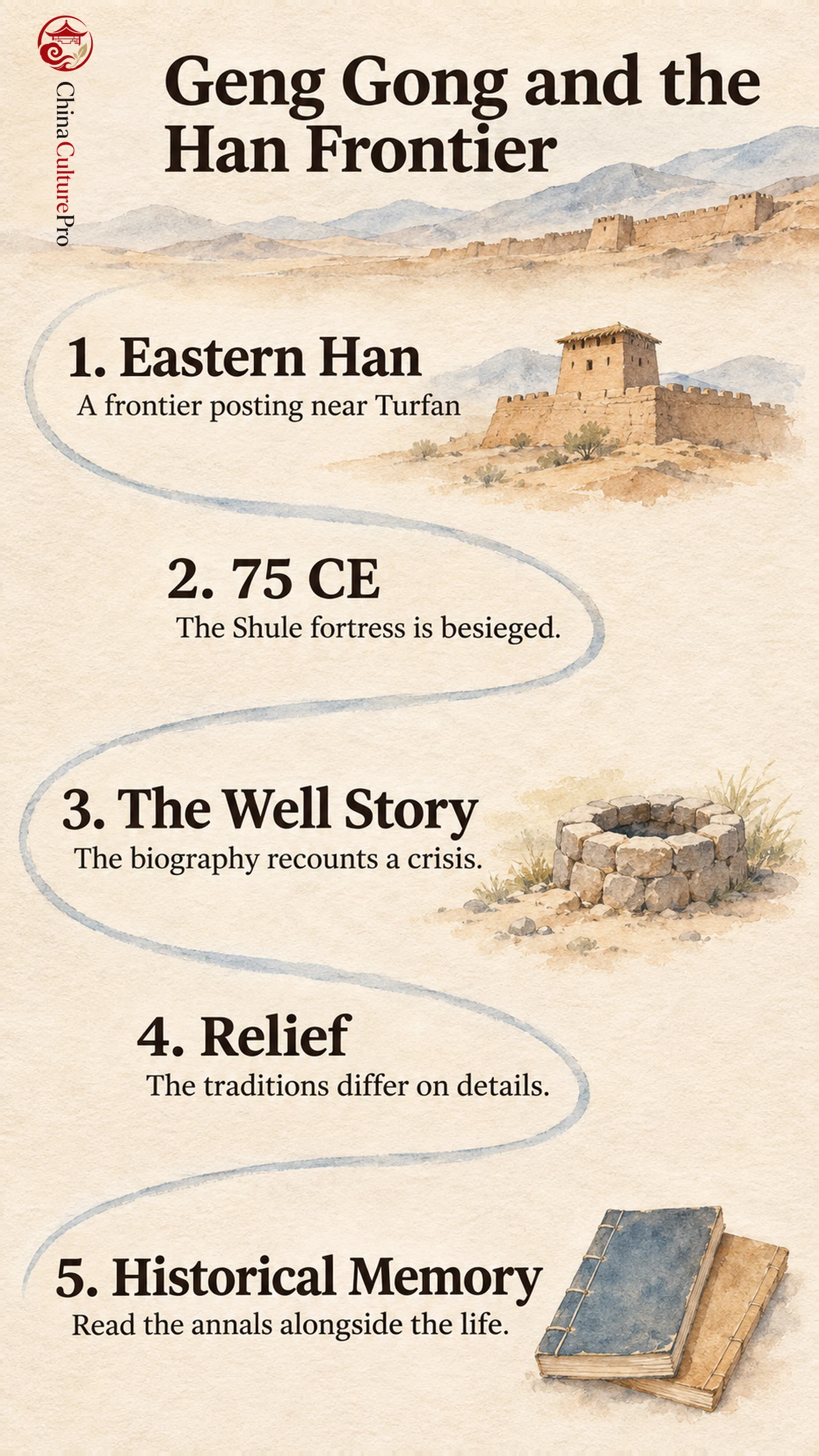
A single place name can send a reader to the wrong end of a map. In Geng Gong’s story, the name Shule refers to a fortified post in the Han frontier zone near Turfan.
An Eastern Han Frontier Posting
Geng Gong served when the Han dynasty renewed its presence in the Western Regions. The accounts place him in the area associated with the Jushi states, near the Turfan Basin, where the Han, the Xiongnu and local rulers competed for influence. The post came under siege in 75 CE.[1][2]
The career of Ban Chao offers another view of Eastern Han involvement in the west. Accounts of his work mention a different Shule, a kingdom around present-day Kashgar. These two uses of the name can easily be confused in English transliteration.[1][3]
The Siege in the Biographical Record
The biography describes the garrison suffering shortages of food and water. Its story about a well makes the appearance of water a moment of deliverance. The scene helps explain the biography’s portrait of the commander and his men, regardless of whether its dramatic details can be independently recovered.[1]
Yuan Hong’s annalistic history also gives an account of the relief, and its commentary notes a difference with the biographical tradition over which men were sent. The accounts agree that relief reached the post. Check which source you are reading when you encounter an exact tally.[2]
How the Story Made His Reputation
The biography emphasizes shared hardship and contrasts the condition of the returning men with the honours their survival brought. That literary choice focuses attention on the actions of the officer and garrison. An account of frontier administration would ask additional questions about supplies, officials and the local allies who could provide help.[1][2]
One useful reading is to compare where the annals put the event with what the biography makes its turning point. The chronology places the siege amid decisions about the western posts. The biography shows which details later readers were encouraged to remember.
FAQs About Geng Gong
Was Geng Gong a Contemporary of Ban Chao?
Yes. Both served the Eastern Han and appear in accounts of its Western Regions. Their assignments and the places called Shule in their stories differed.
How Do We Know About the Siege?
Ancient histories preserve accounts, including a biography of Geng Gong and annals of the early Eastern Han. Their differences matter when reading precise details.
Fuentes
[1] Fan Ye, Book of the Later Han. Chapter 19, Biography of Geng Gong
[2] Yuan Hong, Annals of the Later Han. Chapter 11, Annals of Emperor Zhang
[3] History of the Later Han, Supplementary Materials. Chapter 19, Accounts of Geng Gong and Ban Chao