

Quick Answer: Why Is the Han Dynasty Important?
The Han (汉, Hàn) dynasty, conventionally dated 206 BCE–220 CE, developed durable forms of imperial government and helped connect East Asia with wider networks of exchange. Its history includes an interruption and two main periods, rather than four uninterrupted centuries of identical rule.[2]
- Government: Classical learning gained importance alongside inherited administrative institutions.
- Exchange: Diplomacy, military expansion and trade strengthened connections across Eurasia.
- Culture: Historical writing, papermaking, instruments and tomb art left influential legacies.
- Chronology: Western and Eastern periods were separated by a different ruling house and restoration struggles.
Han achievements developed through many people and places; they should not all be attributed to one emperor or invention date.
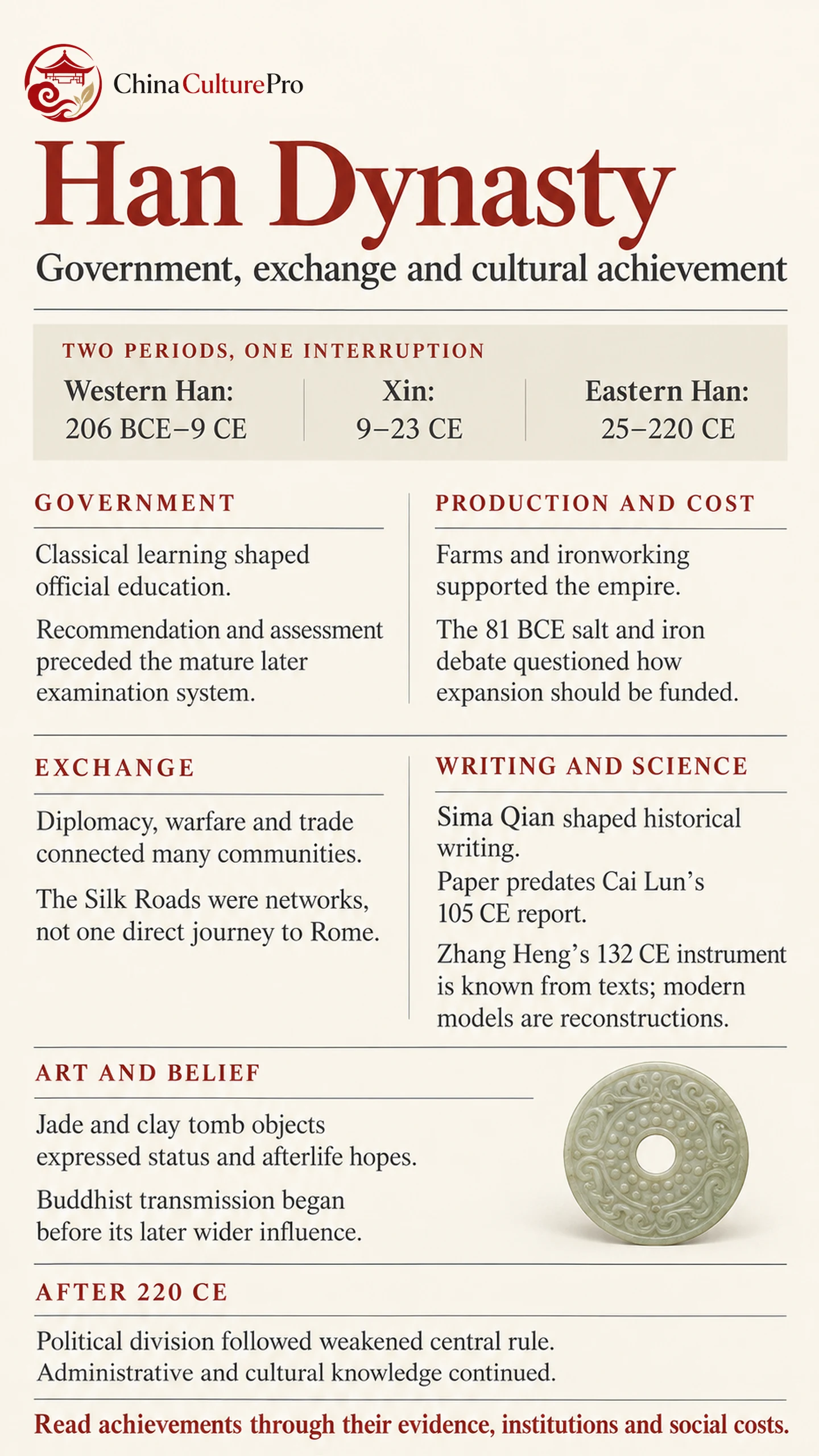
The Han dynasty is often introduced through a list of accomplishments: the Silk Road, paper and an educated bureaucracy. Those achievements become more meaningful when connected to the institutions and resources that supported them.
This guide follows government, economic life and cultural exchange through the dynasty’s changing political history. The Chinese dynasty timeline provides the wider sequence; the Chinese history overview connects these developments with later periods.
Two Han Periods and an Interrupted Dynasty
Western Han (西汉, Xī Hàn) followed the civil wars after the Qin dynasty. Its founder, Liu Bang (刘邦, Liú Bāng), emerged from that struggle and established imperial rule in 202 BCE. The conventional 206 BCE starting date refers to an earlier stage in the foundation of his power.[1][10]
The two main periods are named partly by the relative positions of their capitals. Chang’an (长安, Cháng’ān), near modern Xi’an, lay west of the later capital.[1]
| Periodo | Conventional dates | Political setting |
|---|---|---|
| Western Han | 206 BCE–9 CE | Capital at Chang’an |
| Xin (新, Xīn) | 9–23 CE | Intervening dynasty founded by Wang Mang (王莽, Wáng Mǎng) |
| Eastern Han (东汉, Dōng Hàn) | 25–220 CE | Restored ruling house, with its capital at Luoyang (洛阳, Luòyáng) |
The intervening dynasty ended in 23 CE; the restored eastern dynasty began in 25 CE. The gap matters: the interruption cannot accurately be labeled simply “Xin, 9–25.”[2]
Government, Classical Learning and Recruitment
Han rulers retained administrative foundations inherited from Qin while revising how authority was justified and exercised. Under Emperor Wu (汉武帝, Hàn Wǔdì), who reigned from 141 to 87 BCE, Confucian learning (儒学, rúxué) became increasingly important to official education and ideals of proper conduct.[1]
That development did not replace administration with philosophy. Courts still needed records, fiscal resources and officials capable of applying orders. Confucian thought supplied arguments about moral responsibility and hierarchy within that political world.
Recruitment also needs careful wording. Recommendations and imperial summons helped bring men into office; assessment and classical education could matter. This was an important predecessor of the imperial examination system, rather than the fully developed system of regular examinations familiar from much later dynasties.[3]
Nor was it equal access for everyone. Family connections, reputation and opportunities to study affected who could become visible to powerful sponsors. Calling the administration “educated” should not imply universal literacy or a modern open competition.
Farms, Workshops and the Cost of Expansion
Agriculture sustained the population and the state, while ironworking supported both farming tools and weapons. Workshops supplied objects for warfare, administration and elite consumption. Imperial expansion therefore depended on production at home as well as victories at the frontier.[5]
The costs produced disagreement. At the court debate of 81 BCE, officials and classical scholars argued about state monopolies, especially salt and iron. Defenders linked revenue to frontier expenditure; critics challenged profit-seeking government and its effects on farming and public morals.[4]
This debate offers a useful correction to the idea that Han government followed one uncontested economic doctrine. Moral language and fiscal needs could point in different directions. Successful expansion also created commitments that required continuing supplies and money.
A luxury object and an agricultural tool thus illuminate different parts of the same economy. One shows what wealth could purchase; the other helps explain the productive base beneath it.
Trade and Diplomacy across Eurasia
The routes now called the Silk Roads formed a network, rather than a single road constructed from beginning to end by one dynasty. Goods could pass through several markets and communities before reaching a distant consumer.[6]
The envoy Zhang Qian (张骞, Zhāng Qiān) traveled west on a diplomatic mission associated with the search for allies. His journeys helped enlarge the court’s knowledge and contacts. They were not simply a merchant’s expedition to sell silk directly in Rome.[6]
Military campaigns also affected access to Central Asian routes. Under Emperor Wu, the pursuit of valued horses was connected to warfare and strategic ambitions. Silk, metalwork, textiles, plants and other goods moved through these broader contacts.[1]
The history of the Silk Road explains the changing overland connections. Maritime routes also belonged to long-distance exchange. Neither network should be imagined as one permanently safe corridor under uninterrupted imperial control.[6]
Writing, Paper and Scientific Instruments
Historical writing was among the dynasty’s major intellectual achievements. Sima Qian (司马迁, Sīmǎ Qiān) assembled the Records of the Grand Historian (史记, Shǐjì), a wide-ranging work that influenced later ways of organizing the past.[1] Its accounts require interpretation as authored history, rather than being treated as an unfiltered record of every earlier event.
Papermaking has a different kind of evidence problem. Cai Lun (蔡伦, Cài Lún) is associated with a report to the throne in 105 CE, but archaeological evidence points to paper before that date. His importance concerns an influential development and its recorded attribution, not proof that no paper existed previously.[7] The history of paper separates those questions.
Zhang Heng (张衡, Zhāng Héng) is associated in later historical accounts with a seismoscope (地动仪, dìdòngyí) made in 132 CE. It indicated the direction of a seismic event; it should not be equated with a modern instrument producing a continuous waveform or predicting an earthquake beforehand. The original instrument has not survived, so familiar museum models are reconstructions.[8]
Scientific instruments also belong within the wider history of Chinese astronomy and observation. A model’s label should identify its reconstruction date, so visitors can distinguish a modern interpretation from a surviving ancient instrument.
Tomb Objects and Everyday Aspirations
Burials preserve a rich material record: pottery attendants and animals, models of buildings, vessels, decorated surfaces and luxury jade. These objects express hopes for provision, status and protection after death.[9]
They also have limits as social evidence. A lavish tomb tells us about those able to commission it. It does not show that every household possessed the same goods or shared an identical version of afterlife belief.
Jade carving reached elaborate forms, including costly burial suits. The associated cultural meanings of jade included beliefs in its preserving qualities; that belief is a historical interpretation, not a scientific guarantee.[9]
Buddhism (佛教, fójiào) also reached China through contacts with regions farther west. Its later influence would become much more extensive, but its early transmission belongs to the Han story of exchange.[2] The guide to Chinese Buddhism follows that longer development.
Why Han Rule Ended and Its Influence Continued
Court factions, struggles involving powerful families and officials, rebellion and regional military competition weakened the dynasty. The formal end in 220 CE followed a prolonged loss of effective central authority, rather than one sudden disappearance of the institutions described above.[10]
The Three Kingdoms period developed from these struggles. Political division did not erase classical learning, historical writing, craft knowledge or the usefulness of trained administrators.
Han’s importance lies in that combination of durability and change. It consolidated an imperial framework while broadening cultural and economic connections. Its surviving objects and texts reveal both accomplishment and inequality, and both state ambition and disagreement about its costs.
FAQs About the Han Dynasty
Why does Han history begin in either 206 or 202 BCE?
The dates mark different stages of foundation: Liu Bang’s establishment as a king in 206 BCE and his imperial victory in 202 BCE. Broad dynasty timelines commonly use 206 BCE; some accounts begin with the imperial accession.[1][10]
Did Han officials enter government through the later imperial exam system?
Not in its mature later form. Recommendation, summons, education and assessment contributed to recruitment. Han institutions helped prepare the way for later examination systems, but the two should not be treated as identical.[3]
Did the Han invent all Four Great Inventions?
No. Papermaking belongs to the Han achievement story, but the technologies grouped as the Four Great Inventions developed across different periods. A single Han date should not be assigned to the whole group.[2]
Does Han Chinese mean a person lived under the dynasty?
No. “Han dynasty” names a historical ruling house and period. “Han Chinese” is a later and present-day identity category with a long history of development; it does not mean a person lived between 206 BCE and 220 CE.
Fuentes
[1] Metropolitan Museum of Art. Han Dynasty, 206 BC–AD 220
[2] Bowers Museum. Windows into China’s History: Educator Resource Guide
[3] Cambridge University Press. Civil Service Recruitment, The Bureaucracy of Han Times
[4] Columbia University, Asia for Educators. A Record of the Debate on Salt and Iron
[5] Field Museum. Holding Together a Growing Empire
[6] UNESCO. About the Silk Roads
[7] University of Oxford, Cabinet. Origins of Paper
[8] Henan Museum. Zhang Heng’s Han Dynasty Seismoscope
[9] Smithsonian National Museum of Asian Art. Han Dynasty, 206 BCE–220 CE
[10] Honolulu Community College. China and East Asia to the Han Dynasty