


Quick Answer: What Are the Three Bonds and Five Constants?
The Three Bonds (三纲, sāngāng) describe hierarchical relationships between ruler and minister, father and son, and husband and wife. The Five Constants (五常, wǔcháng) are a set of virtues applied to conduct. In some later Confucian uses, the two sets appear together as an account of social order and moral character.[1][2][4]
- Bonds: The historical formulation gives one person authority within each pair.
- Constants: The virtues describe qualities of judgment, care and conduct.
- Historical use: The paired formula appears in arguments about how a household, court or wider society should be ordered.[1][2][4]
The Five Relations familiar from another classical passage are a third list with a different purpose.
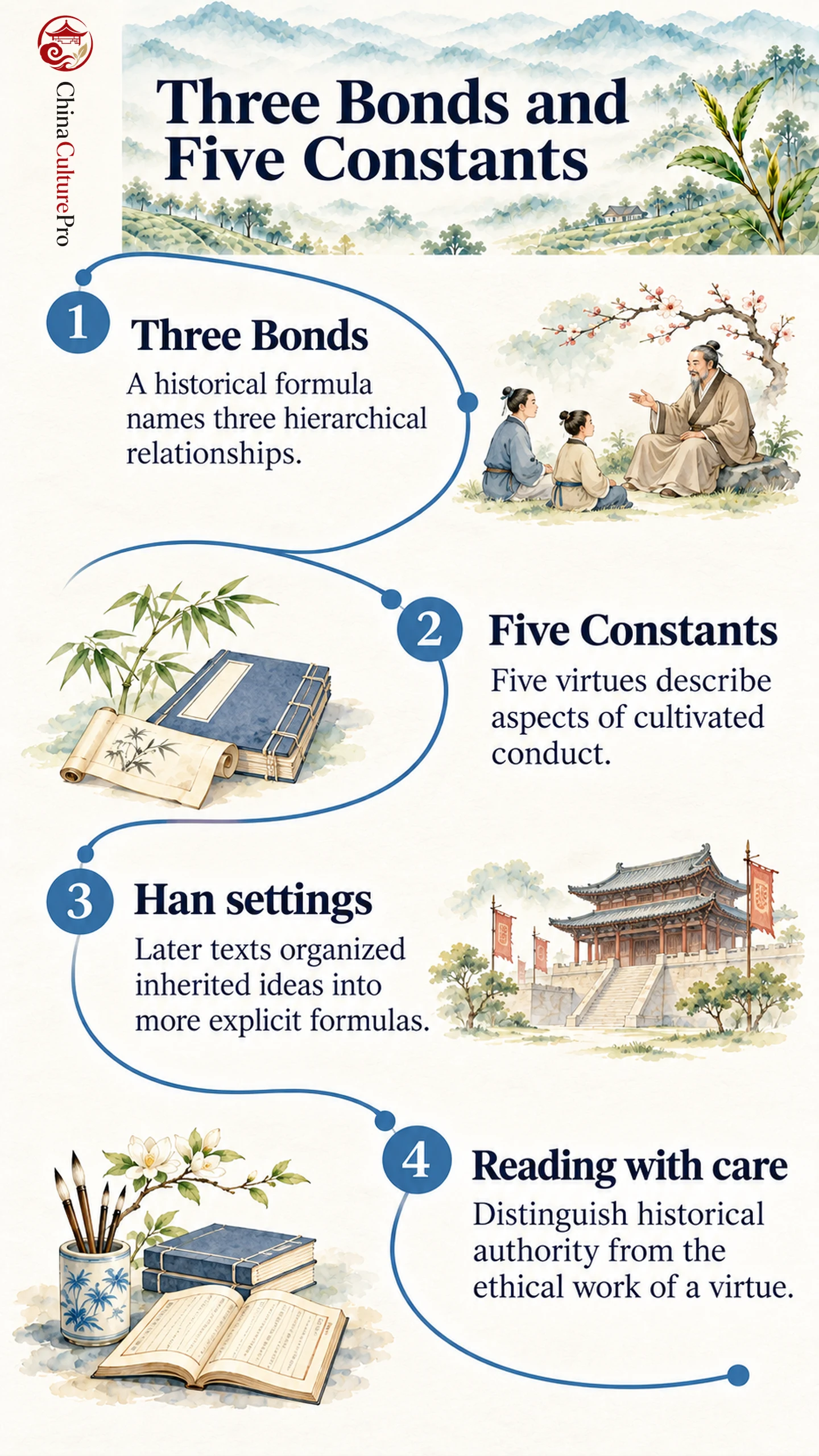
When the two expressions appear as one phrase, they can sound like a single list of requirements. Each has a different object. One describes which roles a historical writer took as fundamental. The other describes qualities by which conduct may be assessed.
The Three Bonds and Their Hierarchical Form
The Discussions of the White Tiger Hall (白虎通, Báihǔ Tōng), a work associated with Han discussions of classical learning, identifies the three pairs and quotes a formula in which ruler, father and husband guide the other member of each pair. The relationships are explicitly asymmetrical. Grouping political, parental and marital authority together gives that hierarchy a wider social reach.[1]
The passage compares the bonds to the cords by which the mesh of a net is held in order. That image conveys the claim that arrangements within several relationships can organize a larger society. The text’s own discussion also mentions advice that can keep a father from wrongdoing. That example shows why one has to read the explanations of conduct alongside the formula.[1]
The Five Constants as Virtues
The five virtues commonly appear as follows in later Confucian accounts. Each concerns what a person brings to their conduct.[2]
- Humaneness (仁, rén): Concern for other people and the ability to respond to their circumstances.
- Righteousness (义, yì): A sense of what is fitting or right in an affair.
- Ritual propriety (礼, lǐ): Regard expressed through recognizable and appropriate forms.
- Wisdom (智, zhì): Discernment about people, circumstances and what to do.
- Trustworthiness (信, xìn): Reliability or faithfulness in conduct and commitments.[2]
Several virtues may be relevant to the same action. In weighing advice, for instance, an official may need discernment to understand the situation and trustworthiness to report it accurately. A relationship tells us who holds a role. The virtues give readers a way to discuss how someone fills it.
Why Texts Put the Two Formulas Together
Later writers could use the paired formula to connect character with authority. One study of early Ming legal thought shows how the ruling elite treated the bonds and virtues as part of a larger moral and cosmic order. That is evidence for a historical use of the formula, which could give established hierarchies a philosophical and institutional justification.[4]
The combined expression therefore deserves to be read in its setting. The meaning of a virtue can be developed in a text even when a writer’s account of authority is historically specific. An example is the practice of remonstrance, which makes the form and purpose of critical advice part of the evaluation of conduct.[1][2]
FAQs About the Three Bonds and Five Constants
Are the Five Constants the same as the Five Relations?
The constants are virtues. The Five Relations in Mencius 3A.4 list parent and child, ruler and minister, husband and wife, elder and younger, and friends, with qualities appropriate to each relationship.[2][3]
Did Confucius set down the paired formula?
The formula belongs to a later history of organizing and interpreting Confucian ideas. A Han work states the bonds, and later texts show how the pair could be used together.[1][4]
Did these relationships require obedience in every case?
The bonds express real hierarchy. Some Confucian accounts also discuss responsibilities to advise or correct someone who holds authority, so the implications of hierarchy depend on the text and the role being discussed.[1][4]
Fuentes
[1] Chinese Text Project. Bai Hu Tong: Three Bonds and Six Orders
[2] Stanford Encyclopedia of Philosophy. Song-Ming Confucianism
[3] Joseph A. Adler, Kenyon College. The Modification of the Confucian Five Relations
[4] University of Washington. Early Ming Legal Cosmology