


Quick Answer: What Was the School of Names?
The School of Names (名家, míngjiā) is a label Han-era writers applied to several earlier thinkers known for argument and inquiry into language. They included Hui Shi (惠施, Huì Shī) and Gongsun Long (公孙龙, Gōngsūn Lóng). Their discussions concerned such questions as how words pick out things and when a distinction matters.[1][4]
- A historical label: A later classification grouped thinkers with some related interests.
- A set of questions: Arguments probe sameness, difference and the reach of a name.
- Surviving evidence: Later anecdotes, quoted theses and dialogues preserve different parts of the record.[1][2][3][4]
The label is helpful for finding related discussions, while the individual texts show where the thinkers’ projects diverge.
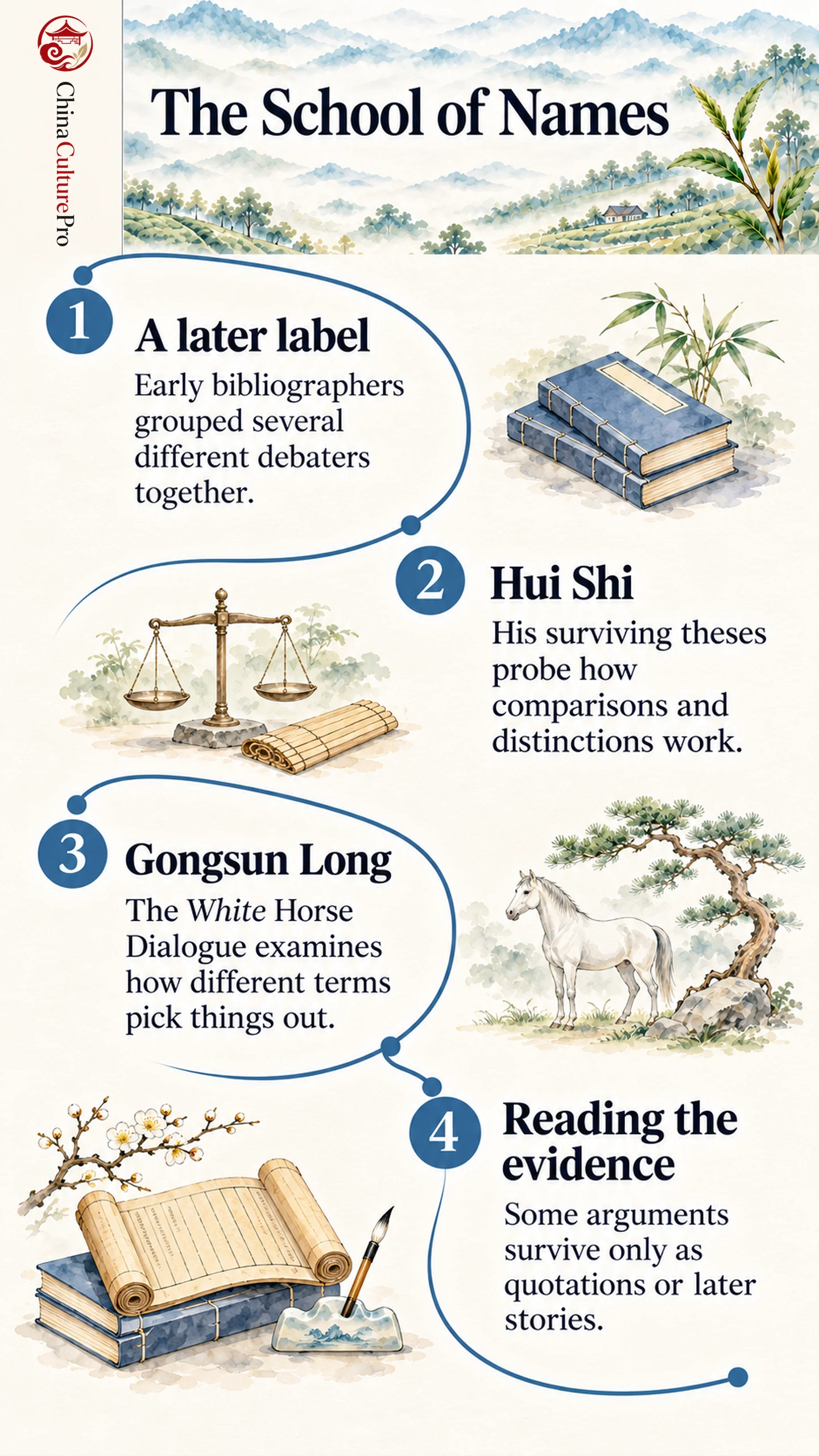
When someone asks for a horse, several colors can satisfy the request. When they ask for a white horse, the acceptable answers narrow. The consequences of that small change are among the problems readers encounter in works grouped under the School of Names.
How the Label Brings Different Debaters Together
Han bibliographers classified earlier thinkers in part by common subject matter. Those associated with the School of Names were active in different settings and periods. Earlier accounts speak of debaters, and the debates themselves are often concerned with the relation between names and the things or cases they describe. Disputation (辩, biàn) can involve defending a distinction or persuading someone that two cases should be grouped together.[1][4]
The practice crossed the boundaries of the later classification. The later Mohists also examined names, comparisons and the use of standards. Authors such as Xunzi addressed the need for words to be used consistently. A reader can follow a question across these writers without assuming that everyone interested in it belonged to the same group.[1]
Hui Shi and Gongsun Long Ask Different Questions
The final chapter of the Zhuangzi reports a group of theses associated with Hui Shi. One pair concerns the greatest, which has nothing outside it, and the smallest, which has nothing within it. These formulations prompt a reader to examine how a comparison is framed and what its limiting terms mean. The chapter gives a later account of those arguments, and its presentation helps shape the questions that survive.[1][2]
The White Horse Dialogue (白马论, Báimǎ Lùn), associated with Gongsun Long, has a different form. Its speakers test claims about the relation between horse and white horse. One argument notices that a horse of another color can satisfy a request for a horse but cannot satisfy a request for a white horse. The example invites attention to how the descriptions differ even when one and the same animal can satisfy both.[1][3]
What Survives and How to Read It
Much material credited to the thinkers in Han bibliographies does not survive as intact works. Some claims reach readers in a report by a different writer. The setting, purpose and tone of such a report matter. A striking statement quoted to characterize an opponent gives a different kind of evidence from a dialogue that shows several objections and replies.[1][2][4]
The broader setting of the Warring States period helps explain the appeal of debate. For an individual argument, the more immediate questions are who is speaking, what they need to distinguish and what would count as an adequate reply.[1][3]
FAQs About the School of Names
Did the School of Names have one doctrine?
The traditional label groups a range of thinkers. The surviving evidence supports overlapping interests in disputation and distinctions, while the arguments attributed to individuals pursue different questions.[1][4]
How does it relate to Mohist logic?
Both traditions investigate how names fit cases and which distinctions matter. The Mohist writings develop a distinct account of models and forms of comparison.[1]
Is the White Horse Dialogue merely a joke?
The wording can be provocative or playful, and scholars read the piece in different ways. Its example about a request raises a recognizable question about how a narrower description changes what counts as a suitable answer.[1][3]
Fuentes
[1] Stanford Encyclopedia of Philosophy. School of Names
[2] Chinese Text Project. Hui Shi and the Theses Preserved in the Zhuangzi
[3] Chinese Text Project. Gongsunlongzi: White Horse Discourse
[4] Chinese University of Hong Kong Press. The Mingjia and Related Texts