


Quick Answer: What Does Zhixing Heyi Mean?
Zhixing Heyi (知行合一, zhī xíng hé yī) means the unity of knowing and acting. Wang Yangming (王阳明, Wáng Yángmíng) uses it to ask what counts as genuine moral knowing. Someone may be able to state a duty, yet the way they respond can reveal how fully they understand it in practice.[1][2][3]
- Knowing: The kind of knowledge at issue has a bearing on how someone responds to an affair.
- Acting: Conduct helps reveal whether the person has brought that awareness to bear.
- Cultivation: A learner can examine how self-interest or habit comes between a familiar judgment and their response.[1][2][3][4]
The Chinese expression can also be rendered as the unity of knowledge and action. The dialogue gives a reader a reason to attend to knowing as something people do.
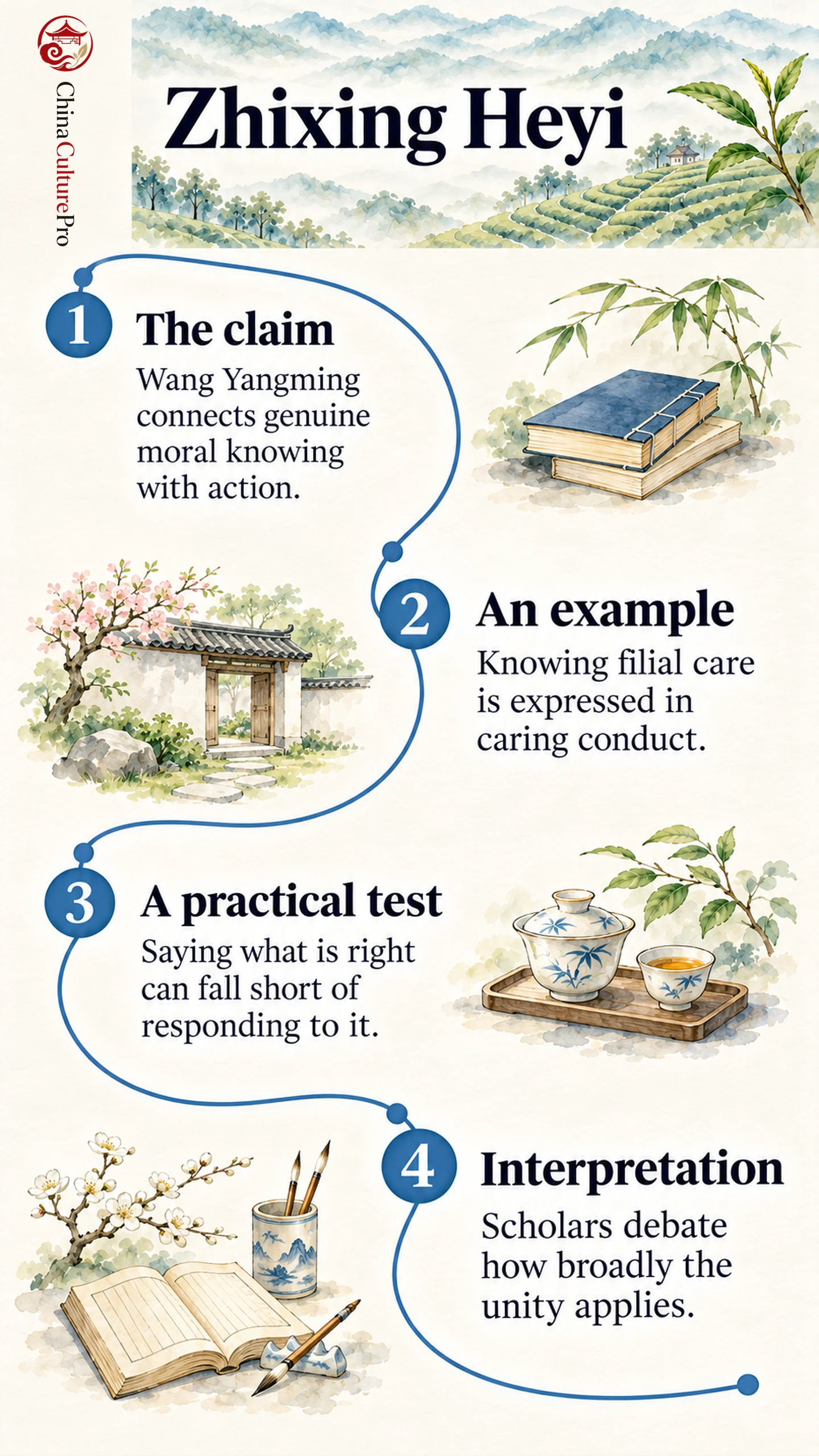
People can say that a choice would be unfair and still try to excuse it. Wang’s claim asks how to understand that gap. In the relevant dialogue, a student raises it as an objection.
Why a Student Asks About Knowing Without Acting
The Chuanxilu (传习录, Chuánxílù), often called Instructions for Practical Living, preserves a conversation about people who seem to know they should care for parents or respect elders and yet fail to do so. The example matters because it seems to offer direct evidence that knowledge and action can come apart.[1][2]
Wang’s answer shifts the discussion to what the student calls knowing. He grants the practical problem of people failing to respond appropriately and treats it as a reason to examine the quality of their understanding. The exchange is about how far the usual description of the case explains what is going on.[1][2]
What the Example of Filial Care Tests
Someone can be able to explain what filial conduct means. Wang treats the way a person actually responds to their parents as relevant to whether they know filial care in the sense he is discussing. To see the force of the distinction, consider someone who can describe a responsibility clearly yet consistently acts as though it applies only to other people. The case shows why the ability to state a principle can leave the more demanding question open.[1][2][3]
The example connects the doctrine to cultivation. A learner may have to examine how an excuse makes a familiar responsibility seem optional in their own case. In the broader School of Mind, that work concerns the way a person exercises discernment in the situation itself.[2][3]
What Kind of Knowing Is at Issue?
The distinction is especially important when a translation uses “knowledge.” A person may know a date without being called upon to do anything in particular. Wang’s examples concern a form of moral understanding that shows itself in how someone attends and responds. His account of innate moral knowing gives that form of understanding a place in his wider philosophy.[1][2][3]
Scholars differ over how to characterize the unity and how to identify genuine knowing. They ask, for example, whether the claim is about what counts as knowing, the role action plays in understanding, or how to interpret apparent weakness of will. Those questions explain why the doctrine can receive different readings even when its examples are familiar.[2][3][4]
FAQs About Zhixing Heyi
Is the unity a rule to act immediately?
The doctrine concerns the relation between moral knowing and response. Its examples give a reason to examine how one understands a responsibility, including where careful judgment is needed.[1][2]
How does it relate to innate moral knowing?
Innate moral knowing names a capacity for discernment. The unity describes the connection between a genuine exercise of that knowing and conduct.[2][3][4]
Do scholars agree on what unity means?
They agree that the relation between knowing and acting is central. They offer different accounts of what makes knowledge genuine and what kind of unity follows.[2][3][4]
Fuentes
[1] Columbia University, Asia for Educators. Wang Yangming on the Unity of Knowing and Acting
[2] Stanford Encyclopedia of Philosophy. Wang Yangming
[3] Harvey Lederman. The Introspective Model of Genuine Knowledge in Wang Yangming
[4] Harvey Lederman. What Is the Unity in the Unity of Knowledge and Action?