


Quick Answer: How Do Chinese Tea and Food Pairings Work?
Chinese tea and food pairing combines established dining settings with flexible choices about flavor, aroma and texture.
- Cultural setting: Cantonese dim sum(点心,diǎnxīn)brings sweet and savory small dishes together with tea.[3]
- Intensity: Delicate teas can accompany gentle flavors; fuller teas can stand alongside richer dishes.[1]
- Similarity: Nutty or toasted notes can echo flavors in the food.[4]
- Contrast: A floral oolong is another option alongside spice, rather than a compulsory dark tea.[2]
Treat the combinations below as starting points to taste, not one fixed national menu or a ranking of correct pairings.
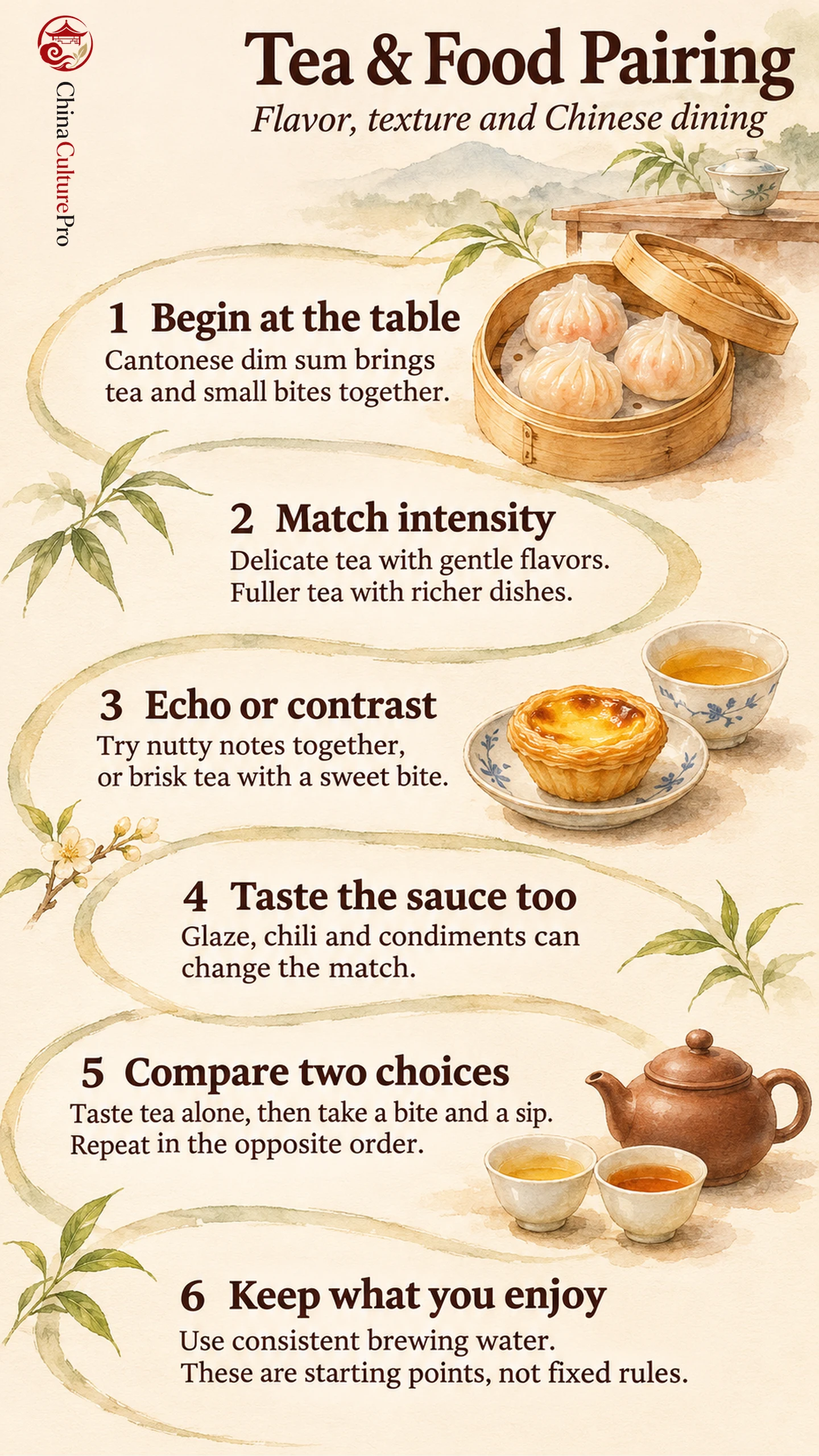
A steamed dumpling and a sweet-glazed roast ask different things of the cup. Begin with the dish on the plate.
Tea at the Table: Culture and Contemporary Pairings
In the Cantonese dim sum meal, tea accompanies an assortment of sweet and savory bites. The shared setting matters: tea belongs to the meal’s rhythm rather than requiring a formal matching exercise for each dumpling.[3]
Present-day vegetarian teahouses also serve a broad selection of teas alongside freshly made dim sum. Meat and seafood are therefore only part of the pairing landscape; tea can accompany a vegetable-centered spread too.[5]
Contemporary restaurant pairings add another approach. A Beijing tea sommelier proposes white tea with scallops and woody ripe Pu Erh with a richly sauced dish: specific combinations chosen for that menu.[1]
Match the Dish’s Intensity, Aroma and Texture
Start with the dish’s strongest feature: delicate seafood, a sweet glaze or a pronounced roast. Match its overall intensity before choosing by the main ingredient alone.[1]
Then decide whether to echo a flavor or contrast it. A nutty green tea with roasted nuts emphasizes similarity; a brisk black tea beside a rich custard pastry introduces contrast. Neither approach guarantees that everyone will prefer the result.[4]
Finally, consider texture as well as aroma: the tea’s roundness, briskness or drying feel sits beside the food’s softness, richness and chew. A fragrant tea that disappears after one bite may need a different partner.[1]
Tea and Food Combinations to Try
This table offers sensory starting points drawn from published dining recommendations. It is not a complete classification of every tea or dish.
| Tea profile | Food to try | Qué observar |
|---|---|---|
| Delicate green or white tea | Light seafood or steamed dumplings | Whether the tea remains noticeable without covering the filling’s gentle flavor.[2] |
| Mellow yellow tea | Light egg dishes or a gentle savory broth | How its softer profile sits beside a relatively mild dish.[4] |
| Floral oolong | Seafood or a mildly spicy dish | Whether floral sweetness complements the food’s aroma rather than competing with it.[2] |
| Roasted oolong | Pato de Pekín or beef with black-bean sauce | A more assertive tea alongside roast, sauce and richness.[1][2] |
| Malty or brisk black tea | Char siu barbecue pork, chocolate or a baked pastry | Shared roasted sweetness, or a brisk contrast to a sweet, dense bite.[4] |
| Woody ripe Pu Erh | A rich braised dish with a concentrated sauce | The tea’s depth beside the sauce and the food’s texture.[1] |
An oolong’s roast matters. Tieguanyin roasting levels offer a useful next comparison when one packet tastes floral and another emphasizes toasted notes.
Sauces, Sweets and Chili Can Change the Match
Look beyond the ingredient name. Plain cheung fun and a generously sauced portion need not taste equally delicate. Compare a bite with the condiment you actually intend to eat before deciding that a tea is too strong or too light.
With sweets, test the tea after the bite as well as before it. A pairing suited to a lightly sweet biscuit may not suit an intensely sweet glaze.[4]
With chili, consider the tea’s fragrance and smoothness as alternatives to simply making a stronger brew. Floral oolong appears among practitioners’ suggestions for spicy food. This is an option to explore, not a promise that tea removes chili heat.[2]
How to Compare Two Pairings at Home
Use a simple side-by-side comparison rather than changing the food, tea and brewing method all at once.
- Choose one familiar dish and two contrasting teas, such as a floral and a roasted style.
- Prepare each tea using its own complete packet method. Keep the food and condiments the same.
- Taste each tea alone, then take a bite followed by a sip. Notice aroma, sweetness, drying feel and aftertaste.
- Repeat in the opposite order. Keep the pairing you prefer, and note what changed.
Keep brewing water consistent and avoid mistaking an over-strong infusion for a problem with the whole tea family.
FAQs About Tea and Food Pairing in Chinese Culture
Does Every Dim Sum Dish Need a Different Tea?
No. Some teas work across several dishes. Changing tea by course is an optional tasting approach rather than a requirement.[2]
Can Chinese Tea Be Served with Desserts?
Yes. Published suggestions include black tea with chocolate and baked sweets. Start with the dessert’s actual sweetness and richness.[4]
Must Spicy Food Be Paired with Pu Erh?
No. Floral oolong is another suggested partner. Choose for the particular dish and your preferred contrast.[2]
Do Tea and Food Have to Come from the Same Region?
No. Regional combinations offer ideas, but matching flavor and texture is more useful than treating a shared province as compulsory.[1]
Fuentes
[1] MICHELIN Guide. The Art of Food and Tea Pairing: Exploring Balance of Flavours with Tea Master GI Na
[2] Tao Group Hospitality. Tea and Dim Sum Pairing
[3] Hong Kong Tourism Board. 6 Unmissable Hong Kong Dim Sum Restaurants
[4] Silk Road. Chinese Tea Pairing Guide: Flavors, Food & Traditions
[5] LockCha. Hong Kong Park Flagship Teahouse