
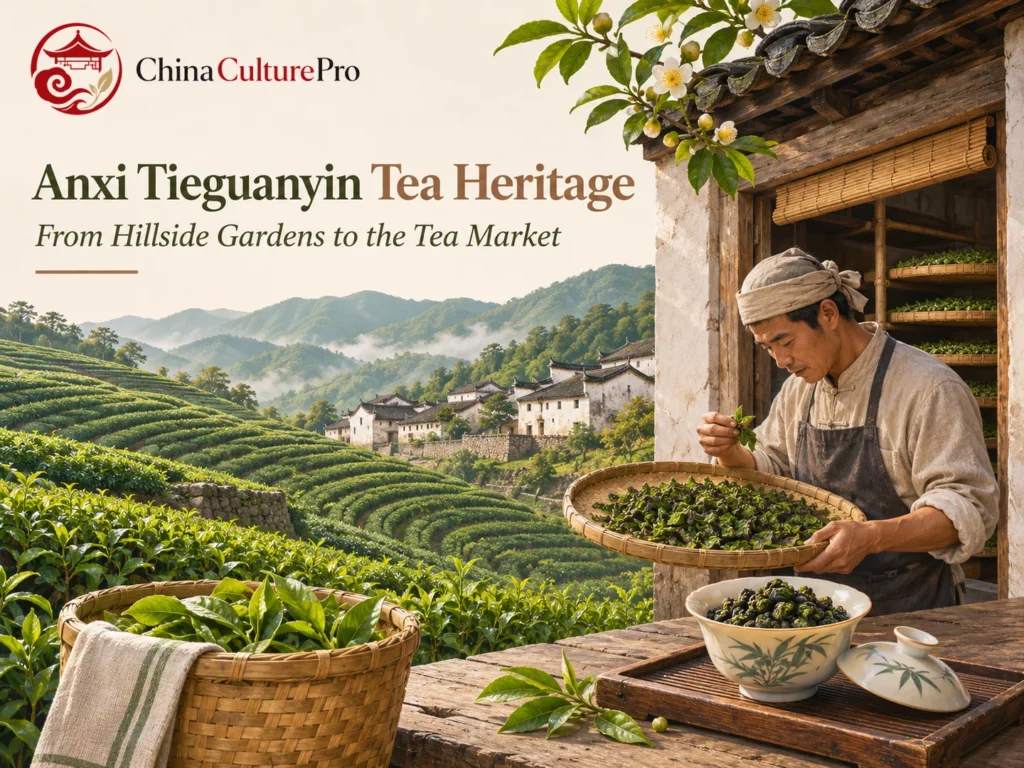

Quick Answer: What Is Anxi’s Tieguanyin Tea Heritage?
Anxi’s Tieguanyin tea heritage is a farming and workshop tradition in southeastern Fujian. Tieguanyin (铁观音, tiěguānyīn) is both a tea cultivar and the name of the oolong made from it. In 2022, the FAO designated the Anxi Tieguanyin Tea Culture System as a Globally Important Agricultural Heritage System. [1]
- Villages: Growers raise tea on slopes, manage their gardens and judge when shoots are ready to pick.
- Workshops: Tea makers adjust leaf handling and rest by watching how a batch changes.
- Markets: Producers and buyers compare finished lots, connecting the choices made in workshops with the tea people drink. [1][2][3]
The designation recognizes a living agricultural system and the people who tend and process its tea.

A bag of Anxi oolong brings together decisions made in a garden, a processing room and a market. To see what makes this a regional heritage, start in the villages where the crop and the craft meet.
How Anxi Villages Keep the Tea Going
Xiping, Lutian and Huqiu are among the towns in the agricultural heritage area. Xiping is closely associated with the cultivar’s early history. For growers, keeping a valued plant in production takes more than saving its seed. Propagation by cuttings lets farmers start new bushes from selected plants and carry forward their characteristics. Anxi growers have also maintained other tea varieties suitable for oolong. [1][3][4]
Slope planting makes water and soil management part of the grower’s work. The FAO describes measures such as terracing and maintaining vegetation in and around gardens. Those practices help protect the land the bushes depend on. In nearby Fuzhou’s jasmine tea system, the agricultural landscape serves a different craft. There, growers supply a second crop, fresh jasmine, for scenting processed tea. [1]
What Tea Makers Look For in the Workshop
After picking, makers wither the leaves and alternate shaking or tossing them with periods of rest. The shaking bruises the edges, and careful handling allows partial oxidation to develop. The leaf’s smell and feel help a maker decide when to advance the batch. Heating then slows the oxidation, and rolling and drying give the tea its finished shape and make it suitable for storage. Sorting, blending or roasting can follow during refinement. [1][2]
Two makers working from the same cultivar can produce noticeably different lots, even when they start with leaves of similar maturity. A greener, floral cup and a roast-forward cup reflect processing choices as well as the starting leaf. The Tie Guan Yin tea guide covers those styles from the drinker’s perspective.
From Garden to Local Market
Anxi’s tea competitions give producers a reason to compare finished lots and discuss their methods. In commercial trade, buyers also evaluate a batch before deciding whether and how to sell it. One leaf lot can pass through different hands for growing, initial processing, refinement and marketing. That chain helps explain why the FAO designation describes livelihoods and knowledge alongside tea bushes. [1][3]
Three Places That Shape Anxi Tieguanyin
| Lugar | What happens there | Qué observar |
|---|---|---|
| Hillside garden | Growers manage the site and pick suitable shoots | The condition of the bushes and the maturity of the leaf |
| Village workshop | Makers wither, shake, rest, heat and roll the leaf | The changing aroma and the bruising along leaf edges |
| Market or tasting table | Producers and buyers compare finished lots | Differences in fragrance, roast and finish |
The Anxi designation covers the local farming system. The broader UNESCO inscription for traditional tea making and social practices covers knowledge and customs shared across China. Both help place Anxi within Chinese tea culture, where a leaf’s place of origin and the way it is served tell different parts of its story. [1][5]
FAQs About Anxi Tieguanyin Tea Heritage
Where is Anxi’s Tieguanyin heritage area?
It is in Anxi County, which is administered by Quanzhou in Fujian. The agricultural heritage area includes Xiping, Lutian and Huqiu. [3]
Why do makers shake the tea leaves?
Shaking bruises the leaf edges and helps the maker manage how oxidation develops during periods of rest. Timing and intensity depend on the condition of the batch. [1][2]
What does Anxi’s FAO designation cover?
It covers the agricultural system behind the tea, including plant varieties, garden management, processing knowledge and the livelihoods that sustain those practices. [1]
Fuentes
[1] Food and Agriculture Organization. Anxi Tieguanyin Tea Culture System
[2] Fujian Provincial People’s Government. National ICH: Oolong Tea Processing Technique
[3] PubMed Central. Livelihood and Food Security in the Context of Sustainable Agriculture
[4] Centre for Sustainable Agricultural Mechanization. Sci-Tech Empowering Rural Transformation
[5] UNESCO. Traditional Tea Processing Techniques and Associated Social Practices in China