
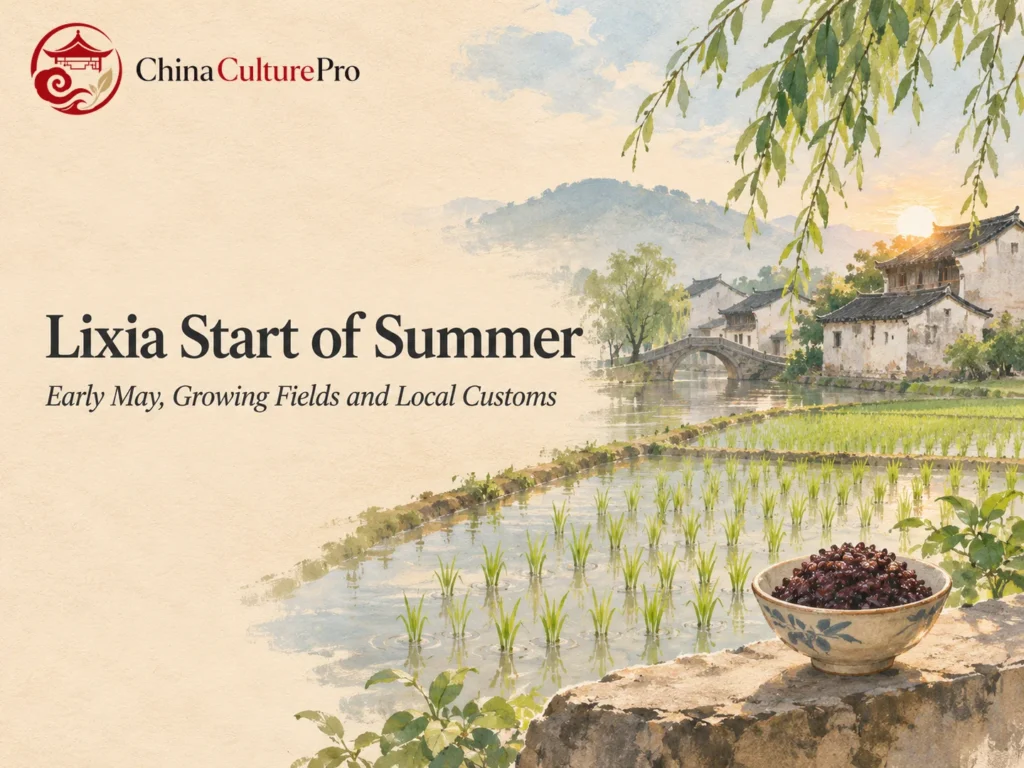

Quick Answer: When Is Lixia?
Lixia (立夏, Lìxià), or Start of Summer, is the seventh of the 24 solar terms. It begins when the Sun’s apparent longitude reaches 45 degrees, usually on May 5 or 6. Hong Kong Observatory tables place it on May 5 in 2026 and May 6 in 2027. [1][2][3][4]
- Calendar meaning: Lixia opens the traditional sequence of summer solar terms. [1][4]
- In the fields: Around this time, early rice can be transplanted while winter wheat is already flowering or filling grain. [5][6]
- Local customs: Some communities mark the season with egg games, weighing and seasonal meals. [7][8]
Lixia marks a solar position. The timing of warm weather and farm work varies by region.

In Hangzhou’s Banshan area, a bowl of dark glutinous rice (乌米饭, wūmǐfàn) and a turn on a scale can be part of welcoming summer. The local observance developed in an area where families grew rice and raised silkworms. The local heritage account still includes a seasonal market for farming and silk products. [7][8][9]
The Solar Date and the Start of Warm Weather
The Hong Kong Observatory calls Lixia Summer Commences. Its place among the 24 solar terms is between Grain Rain at 30 degrees and Grain Full at 60 degrees. In 2026, Lixia corresponded to day 19 of the third lunar month. In 2027, it corresponds to day two of the fourth month. [1][2][3]
The word summer also has a meteorological meaning. China Weather Network notes that in early May parts of northeastern China can still be experiencing spring weather as summer conditions spread northward from warmer regions. The term marks a point on the traditional calendar that people can share across different climates. [5][10]
Rice Seedlings and Wheat Grain
In Jiangnan and farther south, a China Weather Network guide describes Lixia as a time when early rice seedlings can be transplanted. The same account notes that increasing spring rains affect field conditions. In northern wheat areas, farmers may be tending crops already well into their growing cycle. A separate seasonal guide describes winter wheat flowering and filling grain around this period. [5][6]
The two crops illustrate how the same date can mark different stages of growth within the broader sequence of summer solar terms. [4][5][6]
Egg Games, Weighing and Seasonal Foods
In the egg-tapping game (斗蛋, dòudàn), children compare hard-boiled eggs by tapping them against one another. A cultural account from Hubei also describes weighing people (称人, chēngrén), sometimes accompanied by wishes for a good summer. In Banshan, visitors took part in both customs at a public event reported by Hangzhou’s local cultural portal. [7][9]
Banshan’s customs also include eating dark glutinous rice and broad beans. The national heritage entry describes the area’s history of rice cultivation and sericulture and records a seasonal market for farm and silk products. Banshan’s local customs entered China’s national intangible cultural heritage list in 2021. In Jiangsu, the Lixia custom of tasting three fresh foods can give neighboring cities different menus. The Hubei heritage feature records cherries, green plums and wheat in Suzhou, while its Nanjing example includes fish with the fruit. [7][8][9]
FAQs About Lixia
¿Lixia es lo mismo que el solsticio de verano?
Lixia begins the traditional summer sequence at 45 degrees. The summer solstice comes later, at 90 degrees. [1]
Do people eat the same foods for Lixia everywhere?
Banshan’s dark glutinous rice and Suzhou’s fresh-food selection are examples from different local traditions. The dishes associated with the solar term vary by place. [7][8]
Fuentes
[1] Hong Kong Observatory. The 24 Solar Terms
[2] Hong Kong Observatory. 2026 Gregorian–Lunar Calendar Conversion Table
[3] Hong Kong Observatory. 2027 Gregorian–Lunar Calendar Conversion Table
[4] China Agricultural Museum. Social Functions and Cultural Meanings of the Solar Terms
[5] China Weather Network. Regional Weather and Fieldwork Around Lixia
[6] China Weather Network. Weather and Farm Activities at Lixia
[7] Hubei Intangible Cultural Heritage Network. Lixia Seasonal Foods and Customs
[8] China Intangible Cultural Heritage Digital Museum. Banshan Lixia Customs
[9] Hangzhou Civilization Network. Welcoming Summer by the Grand Canal
[10] China Weather Network. The Solar Term and Meteorological Summer