

Quick Answer: What Is China National Day?
China National Day (国庆节, Guóqìng Jié) falls on October 1. It marks the proclamation of the People’s Republic of China (PRC) at Tiananmen Square (天安门广场, Tiān’ānmén Guǎngchǎng) on October 1, 1949. The leadership formally designated the date as National Day two months later. [1]
- Anniversary: October 1 is the date commemorated each year. [1]
- Public ceremony: The national flag-raising at Tiananmen Square is a prominent part of the observance. [4]
- October break: In mainland China, the public holiday period can extend beyond October 1. [6]
October 1 stays fixed, while the length of the break and the public program vary by year.
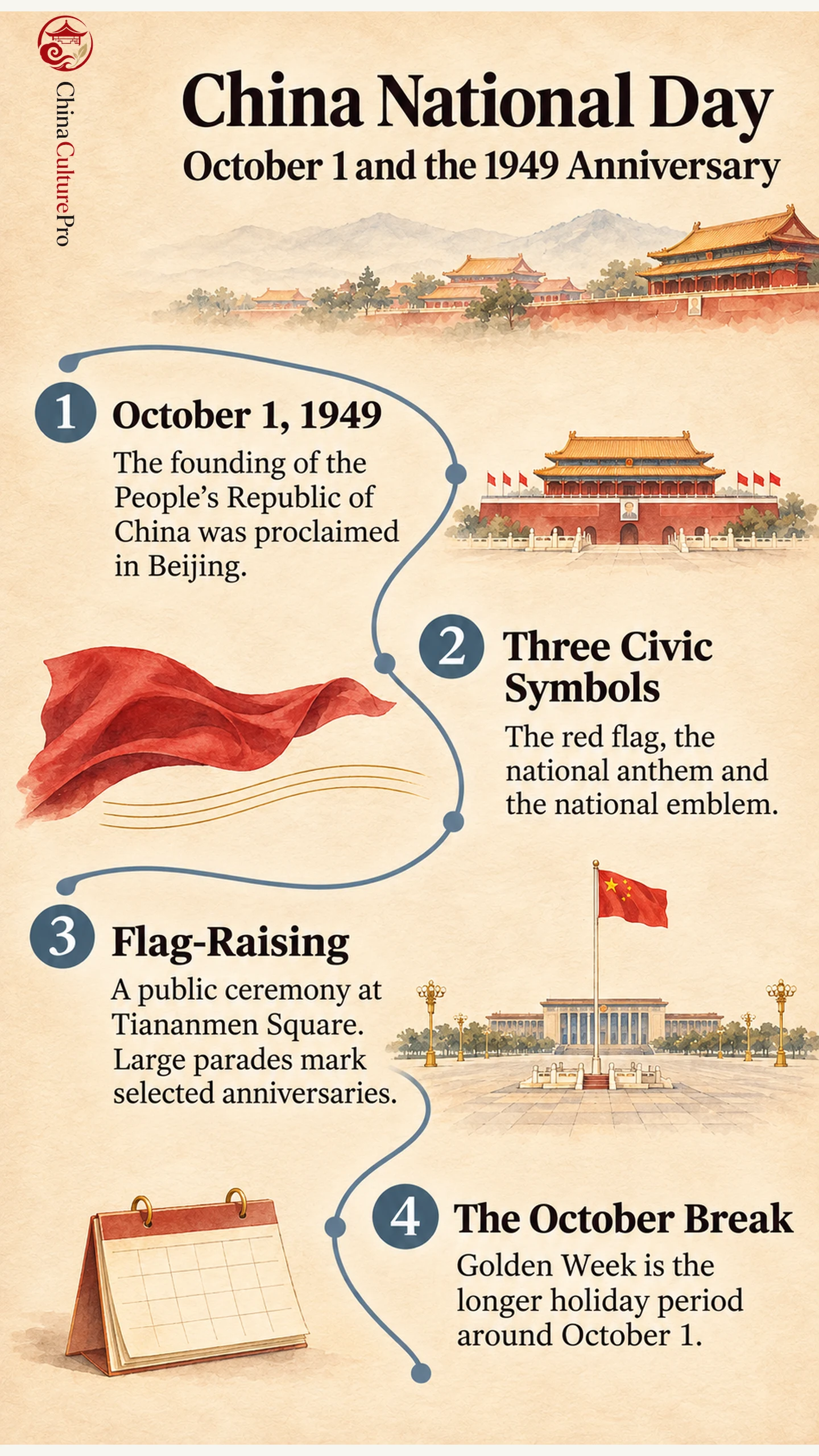
An October holiday notice, a picture of flags outside a school, and footage of a parade can all carry the label China National Day. They tell you different things about the occasion. The holiday notice sets out time off, the flags mark an anniversary, and the parade footage may come from a particular milestone year. [2][4][5][6]
Why China Marks National Day on October 1
On October 1, 1949, Mao Zedong proclaimed the founding of the People’s Republic of China at a ceremony in Tiananmen Square in Beijing. That public event supplies the date for the anniversary. Within a broader timeline of Chinese history, National Day commemorates the founding of the modern PRC. [1]
On December 2, 1949, the Central People’s Government passed a resolution designating October 1 as National Day. The December resolution turned the date of the October ceremony into the anniversary observed each year. In 2026, the observance marked 77 years. [1][4]
Tiananmen Gate and Tiananmen Square are adjacent parts of the setting. The gate stands on the north side of the square. It served as an imperial ceremonial entrance long before 1949, when it became the setting for the proclamation. Looking at the Beijing Central Axis helps place the gate in the older design of the capital. It also explains why the gate is recognizable when the emblem reduces it to an outline. [1][3][7]
What the Flag, Anthem, and Emblem Represent
China’s Constitution identifies the five-star red flag, the March of the Volunteers, and the national emblem. The red flag is the most visible object in many October 1 ceremonies. The National Flag Law sets out where it must be flown, including requirements for specified institutions and public venues on National Day. Those rules help explain why the flag appears far beyond the central ceremony in Beijing. [2][3]
The anthem belongs to the ceremony as music, while the emblem identifies the state in a different visual form. The Constitution describes the emblem as Tiananmen under five stars, surrounded by ears of grain and a cogwheel. If you are identifying objects in photographs, look for the gate and grain border to identify the emblem, or the five stars in the upper corner to identify the flag. The guide to Chinese national symbols explains the designs in more detail. [3]
What National Day Celebrations Look Like
A National Day flag-raising took place at Tiananmen Square on October 1, 2026. The photographs show the flags, the ceremony, and people gathered to watch. Outside the capital, flags at government buildings, schools and other venues can mark the day on a local scale. Readers familiar with Chinese holidays and observances may notice how prominently National Day displays the flag. [2][4]
The large military parade and civilian pageantry held in Beijing on October 1, 2019, marked the 70th anniversary. If you see footage of a huge parade presented as a typical National Day scene, check the year in the caption. The 2019 pageant and the documented 2026 flag-raising are examples of different events with different scales and purposes. [4][5]
How National Day Relates to Golden Week
In mainland China, October 1–3 are statutory days for National Day. An annual notice can arrange a longer break with ordinary or rescheduled rest days. The October period is commonly called Golden Week in China. Someone can be traveling during Golden Week several days after the anniversary ceremony itself has taken place. [6]
For time off, date ranges, and any weekends designated as workdays, use the calendar of China’s public holidays. For a ceremony or exhibition, check the organizer’s announcement for that year. A calendar entry can tell you when the holiday falls, while an event listing tells you what happens at a particular place. [4][5][6]
FAQs About China National Day
Does China National Day follow the lunar calendar?
It falls on October 1 of the Gregorian calendar every year. [1]
What does Guoqing mean in Chinese?
Guóqìng is commonly used in reference to National Day. The full holiday name is Guóqìng Jié. [1]
Does China hold a major National Day parade every year?
A major parade is associated with particular commemorations, such as the 70th anniversary in 2019. The 2026 anniversary reporting documents a flag-raising ceremony. Check the program for the year you are asking about. [4][5]
Fuentes
[1] State Council English Portal. Día Nacional
[2] State Administration for Market Regulation. Law of the People’s Republic of China on the National Flag
[3] State Council English Portal. Constitution of the People’s Republic of China, Chapter IV
[4] Xinhua. InPics: Flag-raising ceremony held to mark National Day
[5] State Council English Portal. Over 100,000 participants gather in Beijing for National Day parade, pageantry
[6] State Council of the People’s Republic of China. Regulation on Public Holidays for National Festivals and Memorial Days
[7] Beijing Municipal Culture and Tourism Portal. Tiananmen Gate