

Quick Answer: What Are the Dragons and Fish on Chinese Roofs?
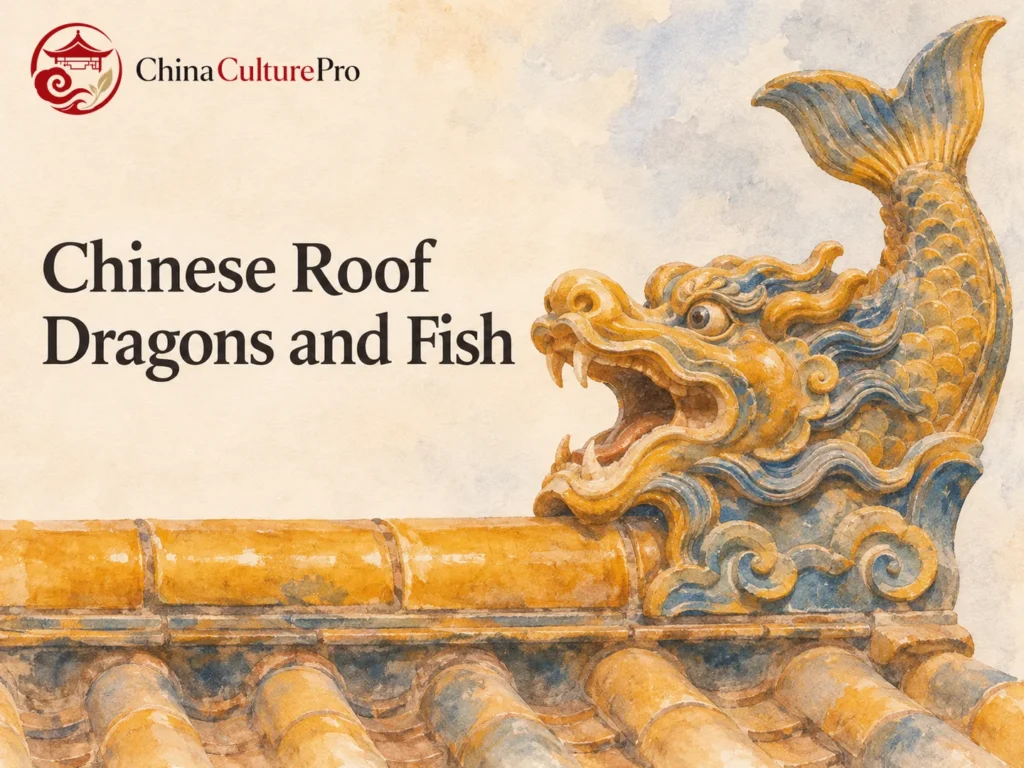
A large dragon or fish-like ornament at the end of a traditional Chinese roof’s main ridge is often called a chiwen (鸱吻, chīwěn). Some pieces have a dragon head, an open mouth and a curved fish body or tail. The fitted ornament covers a roof joint and carries a protective image.[1][2][3]
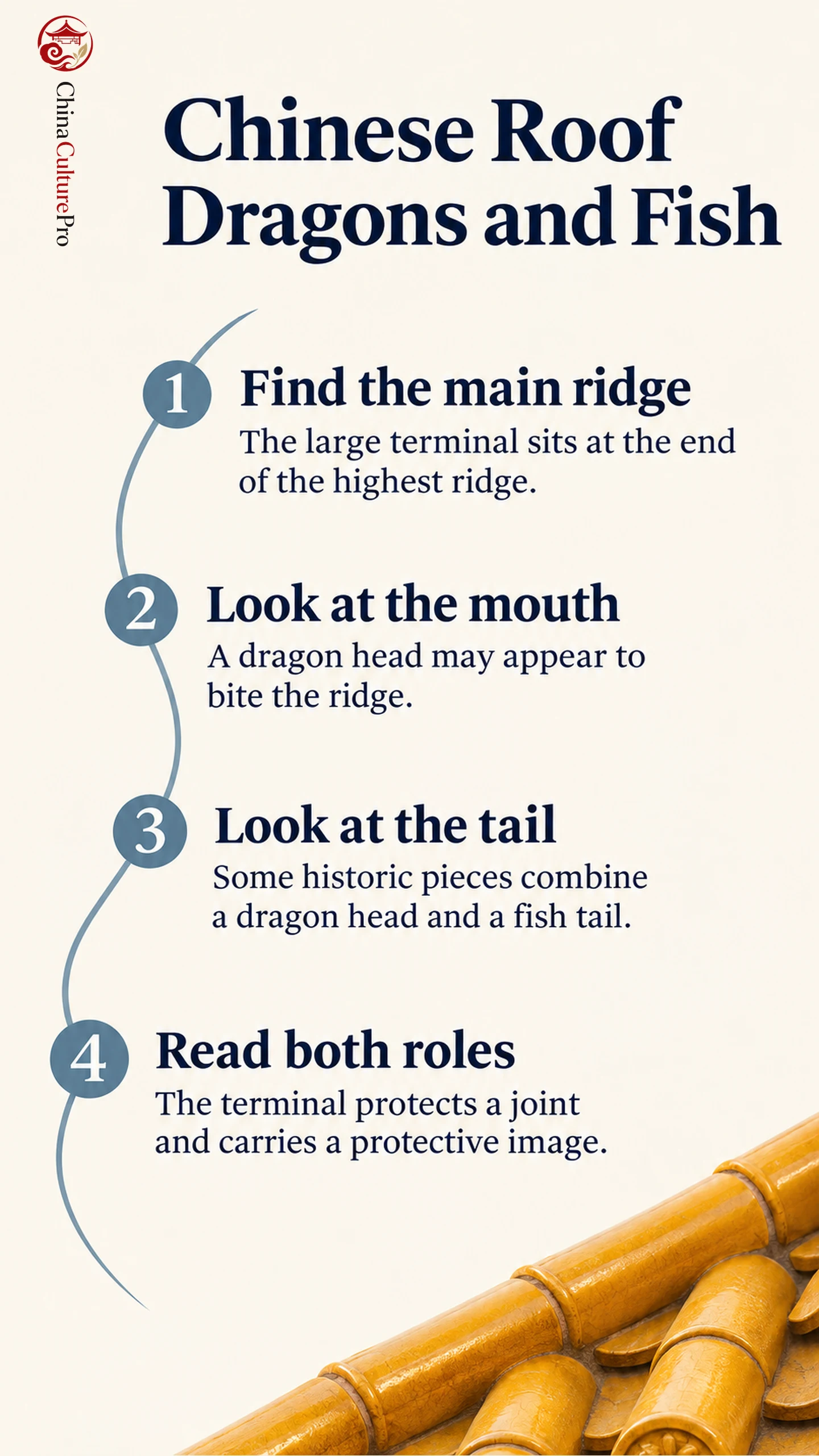
- Position: Look for it at either end of the highest horizontal ridge.[1][2]
- Shape: The mouth often faces inward and appears to bite the ridge.[2][3]
- Role: The fitting helps protect a roof junction from water. The creature was traditionally associated with protection from fire.[1][7]
Identify the position first. A roof can have several kinds of animal ornaments on different ridges.[1][4]
From the courtyard, the jaws make the terminal look like a creature in motion. From close up, the opening is also the place where the ornament meets the roof.[1][3]
Where the Ridge-End Ornament Sits
Find the main ridge, the horizontal crest where the principal roof slopes meet. At its ends, some roofs have a pair of large ornaments facing one another. In the Palace Museum’s terminology the main-ridge terminal is called a zhengwen (正吻, zhèngwěn), also known as a dragon terminal or large terminal. Rows of smaller animals sit on sloping ridges nearer the corners.[1][4]
Viewed from an angle, the line of small figures runs toward the eaves. The large terminal meets the horizontal crest at its upper end.[1][4]
How Fish and Dragon Features Appear Together
The National Museum of China catalogues a green-glazed Western Xia example with scales, a dragon head and a fish body. Its head and body were fired separately. Another piece in the same museum’s collection has yellow and green glazes and a fish tail with clearly defined fins. The museum records that the head and tail were fired separately and fitted together.[2][3]
The National Museum uses the older name chiwei (鸱尾, chīwěi) when discussing earlier tail-like forms. Its Western Xia example shows the combination already present in a single object. Look for surviving features such as fins, scales or an open jaw when identifying an individual piece.[2][3]
How the Ornament Protects the Roof
In Chinese architecture, the ridge end can bring several tiled roof surfaces together. The terminal caps the exposed junction. The Palace Museum describes it as a fitting that helps keep rainwater out at the meeting of the roof slopes.[1][5]
The Hall of Supreme Harmony offers an unusually large documented example. During its 2006 conservation work, the Palace Museum recorded a height of 3.4 metres and a weight of about 4.3 metric tons for the terminal, which consisted of thirteen yellow-glazed ridge pieces. The assembled silhouette can look continuous from the courtyard even though it is made from separate ceramic parts.[5]
Why the Ridge Creature Was Linked with Fire Protection
The Palace Museum cites the Ming writer Li Dongyang’s account of the dragon’s nine sons. In that version it enjoys swallowing, which explains the image of a creature gripping the ridge. Other accounts link the creature with water and the idea of swallowing flames. The image expresses a wish to protect the building from fire, while the ceramic fitting itself protects an exposed roof joint from rain.[1][4][6][7]
FAQs About Chinese Roof Dragons and Fish
Are chiwen and the small ridge animals the same?
The large terminal sits at an end of the main ridge. The smaller animals run down sloping ridges toward the roof corners.[1][4]
Were these ornaments always yellow?
The Hall of Supreme Harmony uses yellow glaze. A green-glazed Western Xia piece and a yellow-and-green example are held by the National Museum of China.[2][3][5]
Why does the dragon face inward?
Facing inward places the open mouth around the end of the ridge. This gives the creature the appearance of biting or swallowing it.[1][4]
Fuentes
[1] Palace Museum. Architectural Glossary: Main-Ridge Terminal
[2] National Museum of China. Green-Glazed Chiwen
[3] National Museum of China. Dragon-Head and Fish-Tail Chiwen
[4] Prince Kung’s Palace Museum. Small Animals and Ridge Ornaments on Palace Roofs
[5] Palace Museum. Conservation Record: Hall of Supreme Harmony Ridge Terminals
[6] Palace Museum. Ridge Creatures and Their Traditional Names
[7] Beijing Municipal Government. Beijing Magazine: Chinese Roof Ridge Ornaments