
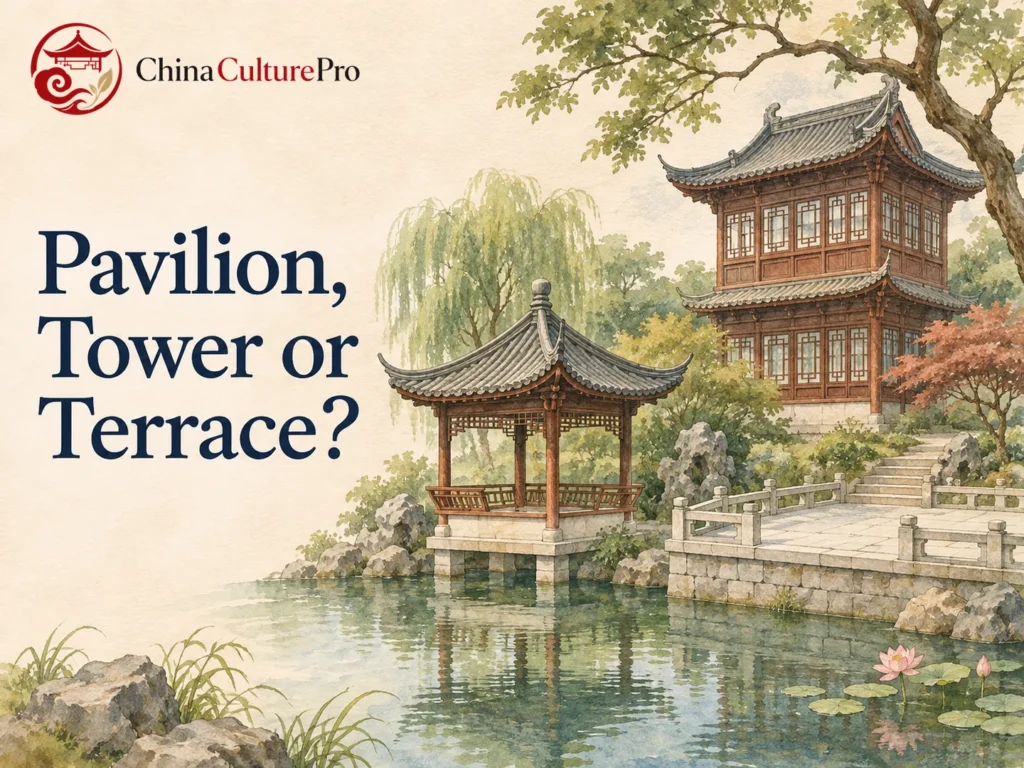

Quick Answer: What Is the Difference Between a Pavilion, Tower and Terrace?
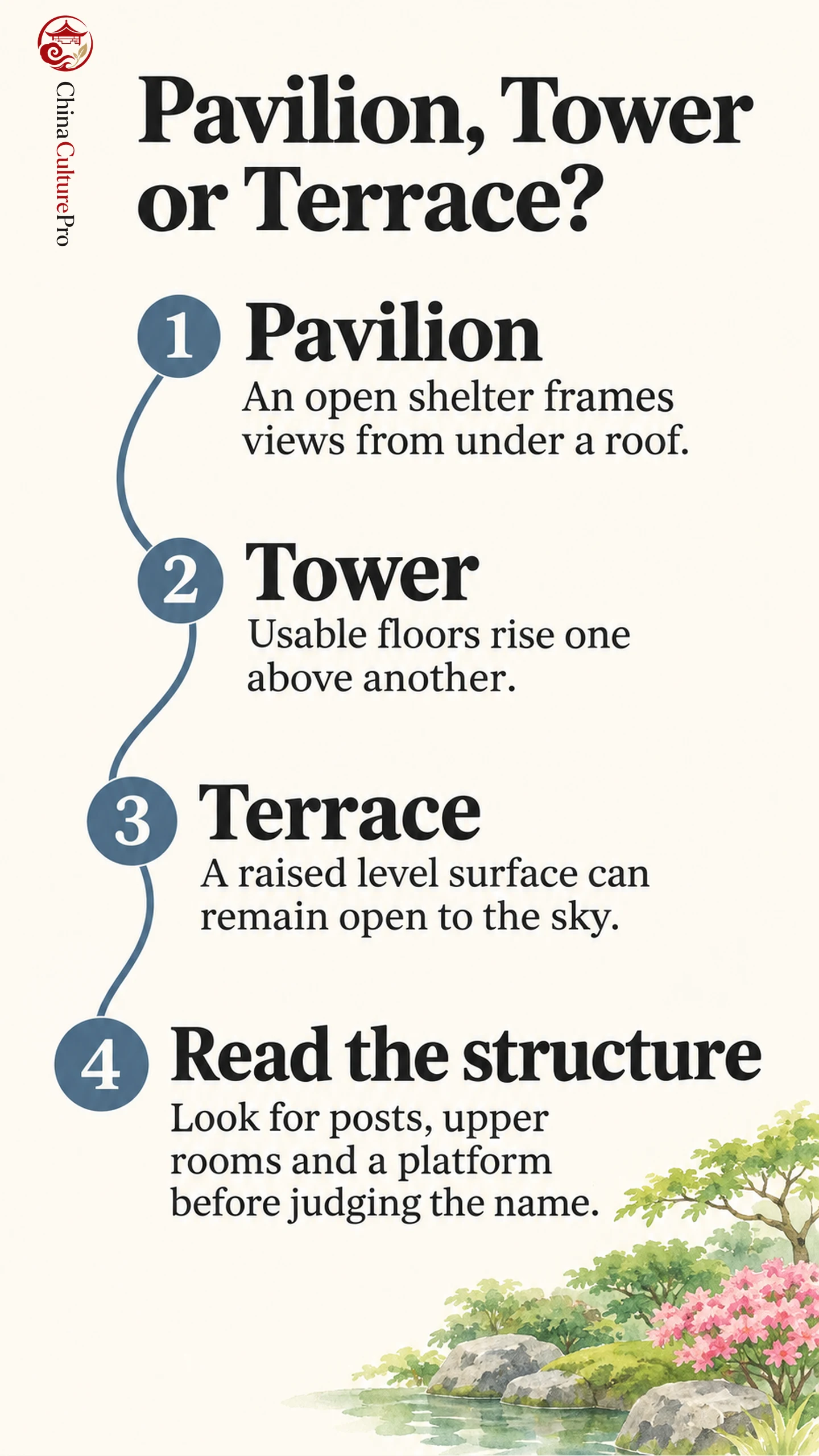
In a Chinese garden, you can distinguish these three forms by the kind of space each one creates.[1][2]
- Pavilion (亭, tíng): A small roofed shelter, often open between its posts.[1]
- Tower (楼, lóu): A building with an upper storey. The word also applies to ordinary multi-storey buildings.[1]
- Terrace (台, tái): A raised level platform that can serve as a place to stand, look out or hold a ceremony.[1][2][5]
Look for the surface you stand on, the rooms you can enter and the roof above them.[1][2]
The three forms can appear close together in a garden. From a path, look for open posts, the windows of an upper room and the raised surface beneath or beside the roof.[1][2]
Three Forms You Can Identify on Site
| Forma | Qué buscar | Ejemplo documentado |
|---|---|---|
| Pavilion | A roof on posts with an open place to pause beneath it | Biluo Pavilion in the Forbidden City |
| Tower | An upper level with usable space, often visible through a row of windows or a balcony | Yunguang Tower in the Forbidden City |
| Terrace | A level top raised by masonry, earth, stone or timber | The Circular Mound at Beijing’s Temple of Heaven, a ritual platform |
A Chinese pavilion may stand on a rockery or a base. A tower may sit on a raised platform too. Describe the structure above and the platform separately when both are visible.[1][2][3][4][5]
How the Three Forms Shape a View
Biluo Pavilion stands on the main rockery peak in the Qianlong Garden. Its five-petalled plan recalls a plum blossom, and its roof has two tiers of eaves. The rockery supplies the height of the viewing position and the roof provides shelter for the person standing beneath it.[3]
Yunguang Tower stands nearby. The Palace Museum records two storeys and a stone bridge linking the northern side of the upper level to the rockery. The bridge connects two sources of height in the garden, one built into the tower and one formed by the rockwork.[4]
At the Temple of Heaven, the Circular Mound is a raised, open-air platform in three concentric tiers. The Beijing Cultural Heritage Bureau identifies it as the place where the emperor performed the winter solstice sacrifice to Heaven. In this case, the raised surface gave the ceremony a distinct place within the temple complex.[5]
Why English Building Names Can Overlap
The English words pavilion and tower can reflect a building’s name or role as well as its form. The Huntington calls one of the structures in its Chinese Garden the Stargazing Tower and describes it as a pavilion. The building occupies the garden’s highest point. Its elevation comes from the site, and its name evokes the view toward Mount Wilson Observatory.[6]
If a sign uses an unexpected name, look at the Chinese name and the description of the building together. A literal translation may preserve a place name, while a description of the structure explains how the space works.[1][6]
FAQs About Chinese Pavilions, Towers and Terraces
Does a pavilion have to stand at ground level?
A pavilion can stand on elevated ground or on a platform. Biluo Pavilion sits on a rockery peak.[3]
Do two roofs make a tower?
Two visible roof edges can belong to one shelter. Look for a usable upper storey before classifying the building from its eaves.[3][4]
Can a terrace have more than one tier?
Yes. The Circular Mound at Beijing’s Temple of Heaven has three circular tiers and remains open to the sky.[5]
Fuentes
[1] The Metropolitan Museum of Art. A Chinese Garden Court
[2] Shelly Bryant, Hong Kong University Press. The Classical Gardens of Shanghai, excerpt
[3] Palace Museum. Biluo Pavilion
[4] Palace Museum. Yunguang Tower
[5] Beijing Municipal Cultural Heritage Bureau. Architectural Study of the Circular Mound Altar
[6] The Huntington Library, Art Museum, and Botanical Gardens. Chinese Garden and Stargazing Tower