


Quick Answer: What Are Chinese Diaspora Temples?
Chinese diaspora temples are places of worship founded by Chinese communities outside China. Their histories often reflect how people arrived, where they settled and which networks helped them build a life. In Singapore, seaborne migrants gave thanks to Mazu (妈祖, Māzǔ) at Thian Hock Keng (天福宫, Tiānfú Gōng). In California, Chinese residents rebuilt a place of worship after a fire. In Sydney, migrants from Sze Yup (四邑, Sìyì) in Guangdong funded a temple tied to their home region. [1][2][3][4]
- Worship: Identify the principal deity and the local name used for the place. [1][4][5]
- Founders: Look for the people or association that paid for the building and cared for it. [1][3][4]
- Community role: A temple could also give migrants a meeting place or preserve links with people from their home district. [1][4][6]
Start with a temple’s own records and the relevant heritage register.
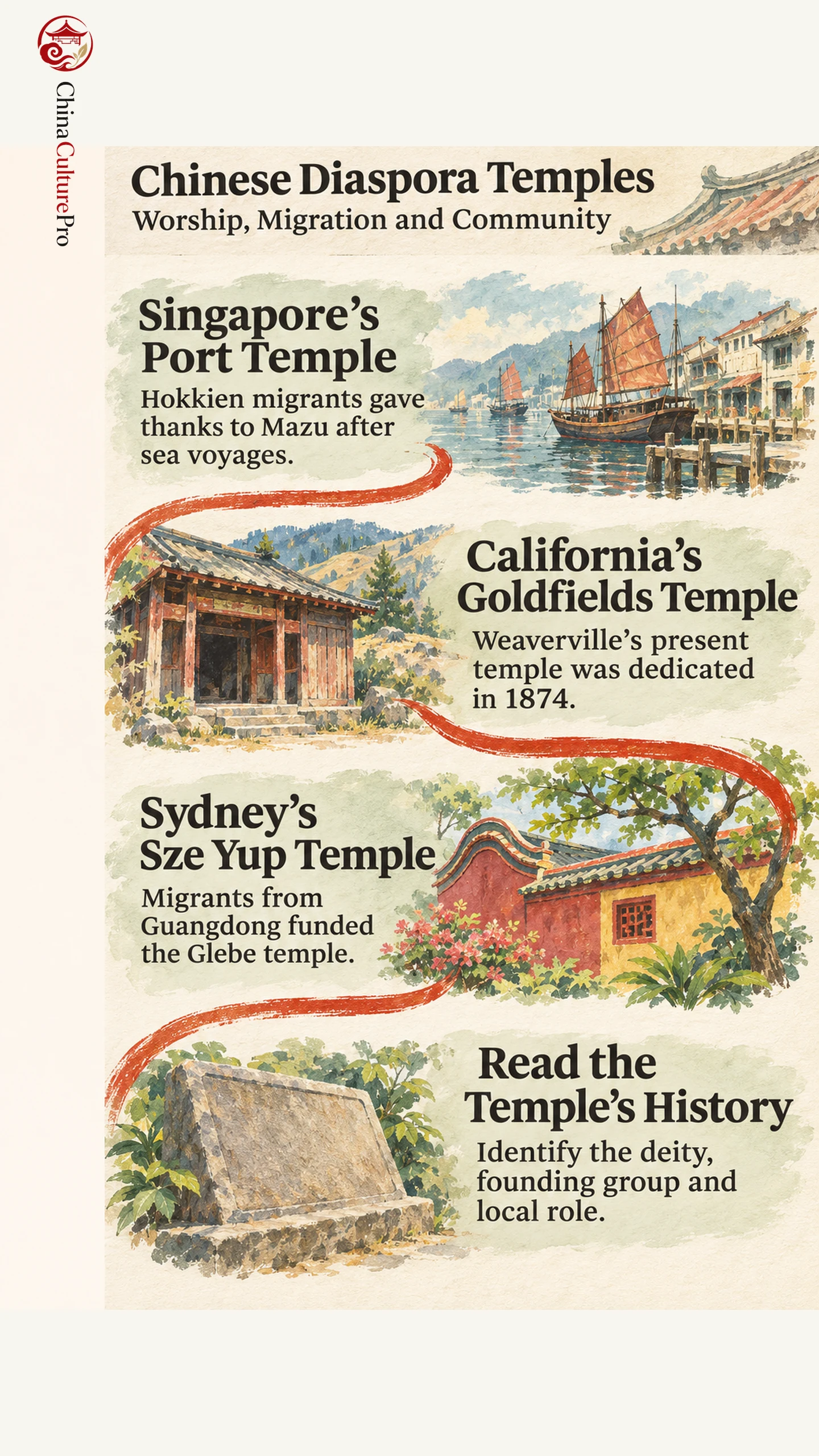
A temple beside a former port and a wooden shrine in a California mining town answer different questions about migration. In Singapore, worshippers remembered journeys across the sea. In Weaverville, the people who rebuilt a burned temple left a record of the money they raised. Their histories show what a temple can tell you about the people who built it. [1][2][3]
Singapore: A Port Temple for Hokkien Migrants
Thian Hock Keng stands on Telok Ayer Street near the former waterfront. The temple traces its beginnings to immigrants who gave thanks to the sea goddess after a safe voyage. It credits Hokkien leaders Tan Tock Seng and Si Hoo Keh with the building work that began in 1839. The story of Mazu explains why the goddess became important to communities whose journeys depended on the sea. [1][2]
The temple also housed the clan’s office and gave members a place to meet. Its operator identifies the Singapore Hokkien Huay Kuan as its present manager. This pairing of religious and association work helps explain why a historic place of worship can turn up in accounts of migrants’ social lives. Other Singapore temples served different speech communities. The guide to diaspora dialect associations explains those ties. [1][6]
A later event shows that maritime devotion remained visible after the waterfront changed. Singapore’s National Library Board documented a 2024 Mazu procession that began at the temple. The procession documents how worshippers used the site in 2024. The steles record earlier events at the temple. [1][2]
California: Rebuilding a Temple in the Goldfields
Chinese miners arrived in the Weaverville area in the 1850s. California State Parks records that fire destroyed an earlier place of worship in 1873. Chinese residents helped fund the replacement. The present wooden temple was dedicated on April 18, 1874. Its English name is the Temple of the Forest Beneath the Clouds. The parks department notes that the donors’ names were recorded in Chinese. [3][7]
California State Parks also calls the building the Weaverville Joss House. In this historical setting, joss house is an English term used for a Chinese place of worship. Search under that historic label to find the state record. The local building history gives more detail about the people who maintained the temple. [3][5]
Sydney: A Temple Tied to Four Counties in Guangdong
Sydney’s Sze Yup Temple in Glebe was funded by migrants from the four Guangdong counties known collectively as Sze Yup. The City of Sydney Archives dates the building to 1898 and identifies its site as a former market garden. The temple takes its name from the founders’ home region. [4][5]
The Glebe Society describes the main dedication as being to Kwung Ti, its spelling for the deified Guan Yu (关羽, Guān Yǔ). Its account describes memorial spaces and says that remains were at times kept at the site before being returned to China. That history shows why one temple complex can appear in sources about worship and in accounts of Chinese diaspora funeral traditions. [5]
How to Read a Diaspora Temple’s History
Read the deity and the founding group as separate clues. Mazu identifies a focus of devotion at Thian Hock Keng. The Hokkien association helps explain who supported it. At Glebe the regional name Sze Yup tells you about the founding community, while Kwung Ti identifies the temple’s main dedication. [1][2][4][5]
A plaque or donor list can add another layer. The temple in Singapore describes stone steles recording its history, while the California park describes a list of donors to the rebuilding. An inscription may name a sponsor, an episode of restoration or the building itself. The guide to reading Chinese temple inscriptions explains which clues to look for. For other migration institutions, see the Chinese diaspora culture guide. [1][3]
FAQs About Chinese Diaspora Temples
What is a joss house?
Joss house is a historical English name for a Chinese place of worship, as in the name of the California state historic park at Weaverville. A particular site can also have a Chinese name and a distinct principal dedication. [3][5]
Did Chinese migrants build temples only to Mazu?
Mazu is associated with seafaring and is central at Thian Hock Keng. The Sze Yup Temple in Sydney honors a different figure, Kwung Ti, the deified Guan Yu. [1][2][5]
Were temples and clan associations the same institution?
Their roles could overlap. A clan association could fund or manage a temple, and a temple could provide meeting space. The founder, manager and main dedication each answer a different question about the site. [1][6]
Fuentes
[1] Thian Hock Keng. About Us
[2] National Library Board, Singapore. Mazu Worship in Singapore
[3] California State Parks. Weaverville Joss House State Historic Park
[4] City of Sydney Archives. Sze Yup Temple and Joss House, Glebe
[5] The Glebe Society. Sze Yup Temple
[6] Singapore Chinese Cultural Centre. The Functions of Chinese Temples and Clan Associations in Singapore
[7] California Office of Historic Preservation. Weaverville Joss House