
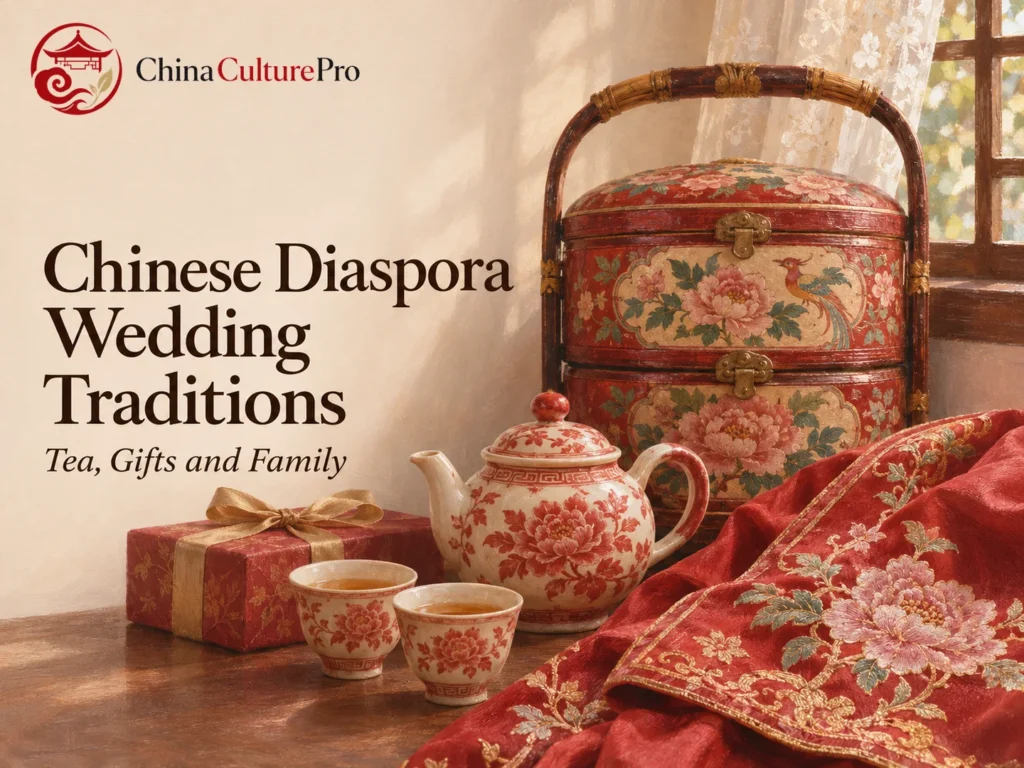

Quick Answer: What Are Chinese Diaspora Wedding Traditions?
A Chinese diaspora wedding may include a wedding tea ceremony (敬茶, jìngchá), betrothal gifts and a banquet. These customs serve different purposes. Tea pays respect to family elders. Gifts may be exchanged between families before the wedding. The timing, clothing and participants depend on the couple and their families. Historical examples from Singapore and Canada show how families have combined customs in different ways. [1][2][3][5]
- Tea: Ask when the tea will be served and which relatives will take part. [1][5]
- Gifts: Betrothal gifts exchanged by the families are a separate custom from a gift brought by a guest. [2][4]
- Local practice: An object such as a Peranakan wedding basket belongs to a specific community and historical ceremony. [3][4]
If you are attending a wedding, the hosts’ invitation or family contact is the best guide to your role.

A wedding teacup, a set of gold jewelry and a tiered basket can all appear in accounts of Chinese diaspora weddings. They belong to different parts of the occasion. Knowing who gives or receives each object helps you understand the relationships a wedding recognizes, and how the same family may observe several traditions in one celebration. [1][2][3][4]
Serving Tea to Family Elders
In Singapore’s National Heritage Board account, a couple serves tea to parents and elders as a sign of respect. A wedding may include a tea ceremony for each side of the family, with the relatives and order arranged by the hosts. Some couples wear traditional wedding clothes for this part of the day. The gesture to watch is the couple offering a cup to the elders they wish to honor. [1]
If you are a guest, check the program or ask a family contact whether you are invited to watch, take part or join the celebration afterward. A tea ceremony may involve a smaller group than a banquet. The Chinese wedding tea ceremony guide covers the ceremony in more detail, including which parts families can arrange for themselves. [1]
The clan federation describes one arrangement in which the couple serves tea to the bride’s elders before leaving her family home, then serves the groom’s elders at his family home. It is an example of how the order of a ceremony can follow the geography of the wedding day. In a single venue, a family can still recognize both sides. [1][2]
Betrothal Gifts in Singapore
The Singapore Federation of Chinese Clan Associations records jewelry as one part of some families’ betrothal gifts. It describes the Teochew set known as four pieces of gold (四点金, sìdiǎnjīn): a necklace, ring, bangle and pair of earrings. The federation distinguishes practices among speech communities, so the Teochew example tells you about one recorded custom rather than a universal gift list. [2]
The purpose of the betrothal gift exchange is distinct from a guest bringing a present to the wedding. A family planning the former can discuss what both households want to exchange. A guest looking for a suitable present can check the couple’s own directions and use the Chinese wedding gifts guide for context. [2]
The federation describes the jewelry in this Teochew example as a gift from the groom’s mother to the bride. That detail explains why it belongs to the negotiations and exchanges between households. A guest has a different relationship to the exchange. [2]
What a Peranakan Wedding Basket Tells Us
The National Museum of Singapore catalog describes a four-tier Peranakan wedding basket called a bakul siah. The museum connects the basket with the exchange that the National Archives of Singapore calls lap chai. The basket matters because it identifies an event involving both families. Its use at a historic wedding says more than its appearance alone. [3][4]
Archival notes accompanying footage of a Peranakan bride in 1940 describe a traditional twelve-day wedding sequence. It could include a hair-combing ceremony and a day for paying respect to elders and ancestors. Singapore Chinese Cultural Centre records similarities with other Chinese wedding customs, including tea, alongside locally distinct roles and performances. The archive describes the full sequence as a historical form. An individual rite may still appear in a shorter celebration. [3][6]
How Chinese Canadian Families Combined Wedding Customs
A Canadian Museum of History collection note describes Chinese Canadian marriages that combined Chinese and Western customs. It mentions tea offered to parents and relatives among practices some couples retained. An individual celebration may put that family ceremony alongside a different style of wedding clothes or a reception planned with other customs in mind. The collection note illustrates how customs can coexist in a single celebration. [5]
When a program includes more than one tradition, the schedule and hosts can tell you what each part is for. The tea ceremony names particular family relationships. The reception can include friends and guests who have no role in the tea ceremony. The broader guide to Chinese wedding traditions gives context for other rites, and the Chinese diaspora culture guide explains how local communities adapted practices over time. [1][5][6]
FAQs About Chinese Diaspora Wedding Traditions
Does everyone at a Chinese diaspora wedding take part in the tea ceremony?
Usually the hosts identify the relatives they want to honor. Other guests may watch if invited or join the couple later. Follow the invitation or ask a family contact. [1]
Are betrothal gifts and guest gifts the same custom?
Betrothal gifts belong to a family exchange before or around the wedding. A wedding guest brings a gift according to the couple’s preferences or local practice. [2][4]
Do Peranakan weddings still last twelve days?
The twelve-day sequence describes an elaborate historical form documented in Singapore. The National Archives describes those long weddings as a practice of the past. Present-day couples can retain individual elements. [3][6]
Fuentes
[1] Singapore National Heritage Board. Chinese Weddings
[2] Singapore Federation of Chinese Clan Associations. Traditional Wedding Rituals
[3] National Archives of Singapore (Archivos Nacionales de Singapur). Footage of a Peranakan Chinese Bride, 1940 (Imágenes de una novia china peranakan, 1940)
[4] National Museum of Singapore. Peranakan Chinese Wedding Basket
[5] Canadian Museum of History. Chinese Vase Collection Record and Wedding Context
[6] Singapore Chinese Cultural Centre. The Peranakan Chinese in Singapore