


Quick Answer: What Are Chinese Diaspora Dialect Associations?
Chinese diaspora dialect associations grew around shared speech and regional origins. A huiguan (會館, huìguǎn) can mean a community association or the hall it uses. Many halls served people from particular places within a wider language community. [1][2][3]
- Membership. A name can point to a language, district, surname or trade. [1][3][6]
- Support. Associations helped some newcomers find work or lodging and provided aid to members in need. [1][2]
- Representation. Several associations could join together to advocate for a broader community. [1]
To understand an association, look at whom it served and the place or group named in its records.
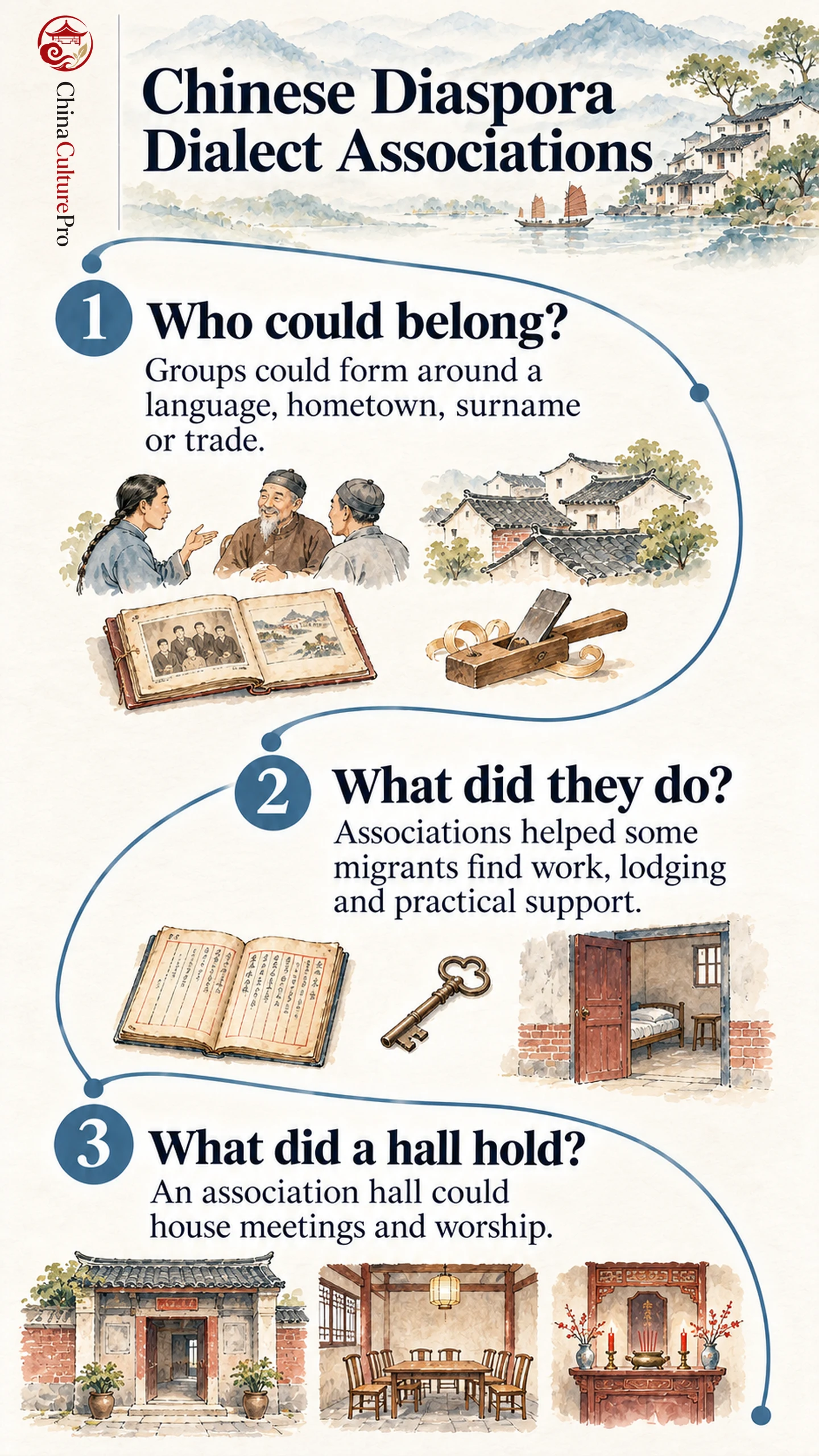
An association sign can hold a clue to someone’s place of origin. Two organizations in the same neighborhood may have spoken a related variety of Chinese while admitting people from different districts.
Language, Hometown and Surname
A language name identifies a wider speech community. A district association can serve people from a much smaller area, sometimes within that same community. The San Francisco Ning Yeung association, for example, served people from the district commonly called Taishan. Its members belonged to wider Cantonese diaspora networks. [1]
Surname organizations connect people through a family name, while trade associations organize around an occupation. The categories can overlap in a person’s life. Someone could have a connection to one group through a hometown and to another through work. The association name can help distinguish an overseas institution from the emigrant hometown it refers to. [3][6]
What Associations Did for Members
In the United States, district associations helped immigrants find work, cared for people in need and sometimes arranged to return the remains of deceased migrants to their home region. These services mattered where migrants had little access to other institutions. [1][2]
In San Francisco, the Chinese Consolidated Benevolent Association brought district organizations together. Known as the Six Companies, it represented common interests across districts. The federation could act on issues that extended beyond one association’s membership, including discrimination during the Chinese exclusion era. [1][2]
Three Examples From Singapore, Kolkata and Manila
In Singapore, Ngee Ann Kongsi represents a broad Teochew (潮州, Cháozhōu) connection. Other Teochew associations served particular districts, such as the Huilai Countrymen Association. One language community could sustain several organizations with different origins. [3][4]
In Kolkata’s Chinese community, migrants from Sihui founded Huining Huiguan, which housed an association and temple. Among Chinese communities in the Philippines, native-place, surname and trade groups all helped sustain social and economic ties. The same kind of hall could be a meeting space, a place of worship or a base for organizing work and trade. [5][6]
FAQs About Chinese Diaspora Dialect Associations
Is a dialect association the same as a surname association?
A dialect association draws on a shared speech or regional background. A surname association organizes around a family name. People can have connections to both. [3][6]
Were the Six Companies a single hometown association?
The Six Companies brought together several San Francisco district associations. Each district group had its own constituency, while the federation could advocate on behalf of a broader community. [1]
Fuentes
[1] Library of Congress. Community Bonds: The Early History of the Chinese Six Companies
[2] Library of Congress. Taking Care of Our Own
[3] National University of Singapore Libraries. Index of locality-based Chinese clan associations
[4] Singapore Chinese Cultural Centre. Teochew clan associations in Singapore
[5] Mint. Kolkata’s Chinese community and the Cheenapara Heritage Gallery
[6] Cambridge University Press. China and the Philippines: Nationalisms of the Founders