


Quick Answer: What Shapes Chinese Culture in the Philippines?
Chinese Filipino culture grew through trade, settlement and exchanges with other Philippine communities. Binondo, established in Manila in 1594, became a center of commerce. Tsinoy is a name used for Chinese Filipinos, whose language histories include Hokkien (福建話, Fújiànhuà), Tagalog and English. [1][3][4]
- Settlement. Binondo and the Parián had different functions in colonial Manila. [1][2]
- Language. Philippine Hokkien reflects long contact with other languages. [3]
- Heritage. Bahay Tsinoy preserves records and objects concerning Chinese life in the Philippines. [4]
The Manila district is an entry point into histories of Chinese Filipino families and institutions across the country.
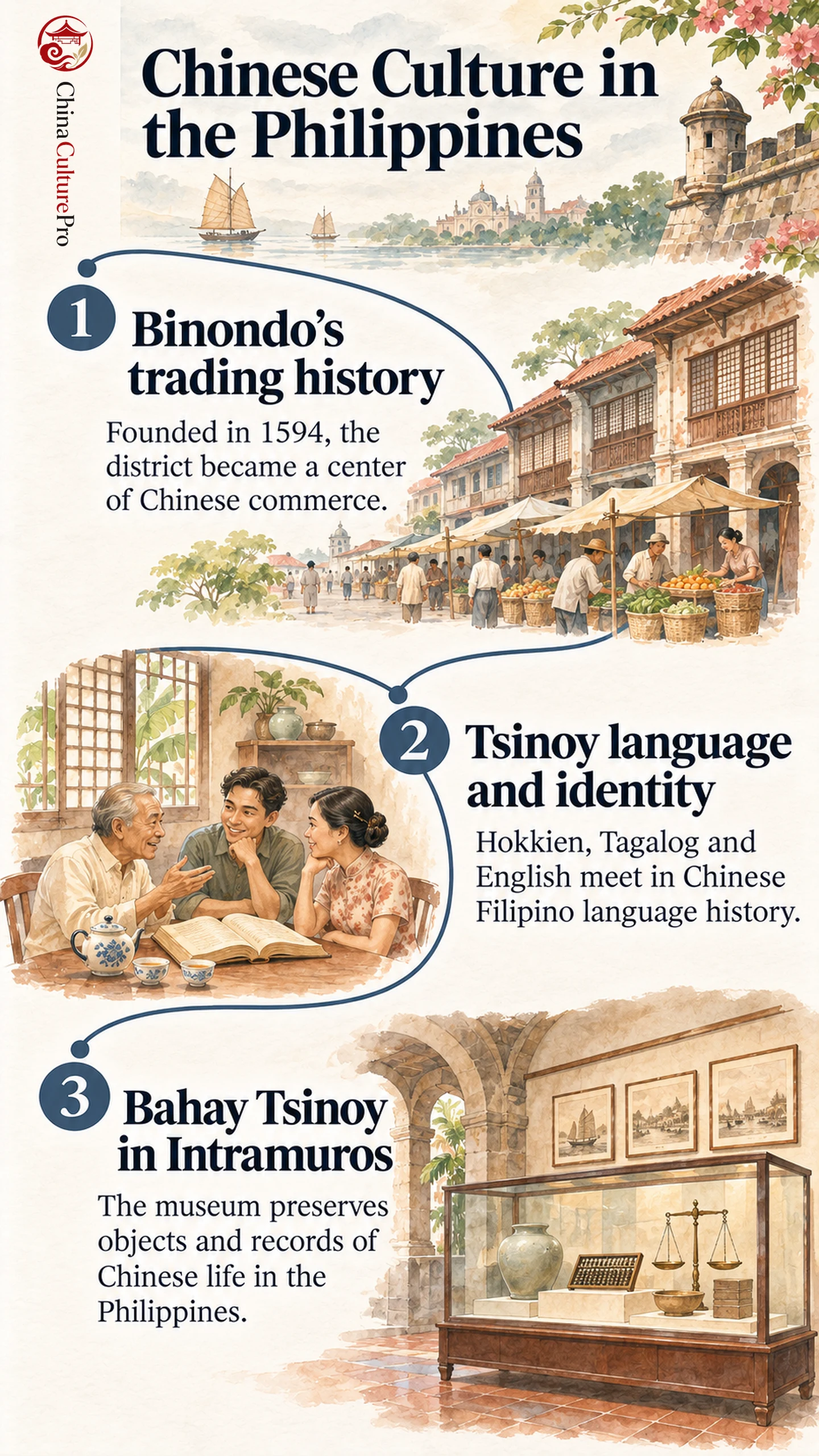
A church, a commercial street and a museum tell different parts of Chinese Filipino history. Binondo preserves traces of settlement, while nearby Intramuros houses collections that extend the story beyond Manila’s Chinatown.
Manila’s Binondo and the Parián
Founded in 1594, Binondo is often described as the world’s oldest Chinatown. In the same colonial city, the Parián was a walled Chinese settlement that moved and was rebuilt several times. The walled settlement and the commercial district occupied different places in Manila’s colonial geography. [1][2]
Binondo’s church became a parish in 1596. Its location at Plaza San Lorenzo Ruiz gives a specific setting for the community’s Catholic history. The same square has hosted public celebrations around Chinese New Year. [1][5]
Tsinoy Identity and Philippine Hokkien
Tsinoy names a Chinese Filipino identity. Language can form part of it, but people’s daily speech reflects family, schooling and wider social life. Research documents contact among Hokkien, Tagalog and English, including a variety described as Philippine Hybrid Hokkien. The Philippine example illustrates how Chinese diaspora languages developed through local contact. [3][4]
How Manila Preserves Chinese Filipino History
Bahay Tsinoy, in Intramuros, preserves records and artifacts that show Chinese participation in Philippine society. Its exhibits give context to the settlements, exchanges and family lives behind Chinatown culture. [4]
FAQs About Chinese Culture in the Philippines
When was Binondo established?
Binondo was established in 1594. It became a center for Chinese commerce and migration in Manila. [1]
What does Tsinoy mean?
Tsinoy refers to a Chinese Filipino. It can describe a person or community whose history and cultural life have ties to both Chinese and Filipino traditions. [4]
Fuentes
[1] Philippine Information Agency. Binondo turns 430
[2] National Historical Commission of the Philippines. El Parian historical marker
[3] Language Ecology. Language contact in the Philippines
[4] Kaisa Para Sa Kaunlaran. Bahay Tsinoy: Museum of Chinese in Philippine life
[5] National Historical Commission of the Philippines. Simbahan ng Binondo