


Quick Answer: What Shapes Chinese Culture in New Zealand?
One chapter of Chinese New Zealand history began in the Otago goldfields. The earliest mining communities grew from recruitment in the 1860s. Their homes and shops, the restrictions they faced and later public memorials tell different parts of the story. [1][2][3][4]
- Mining settlements. Arrowtown and Lawrence preserve evidence of homes and businesses. [1][2]
- Immigration restrictions. New Zealand imposed a poll tax on Chinese immigrants in 1881. [3]
- Public heritage. Dunedin’s Chinese garden commemorates settlers and their contributions to the city. [4]
These Otago sites trace a regional history that became part of New Zealand’s national record.
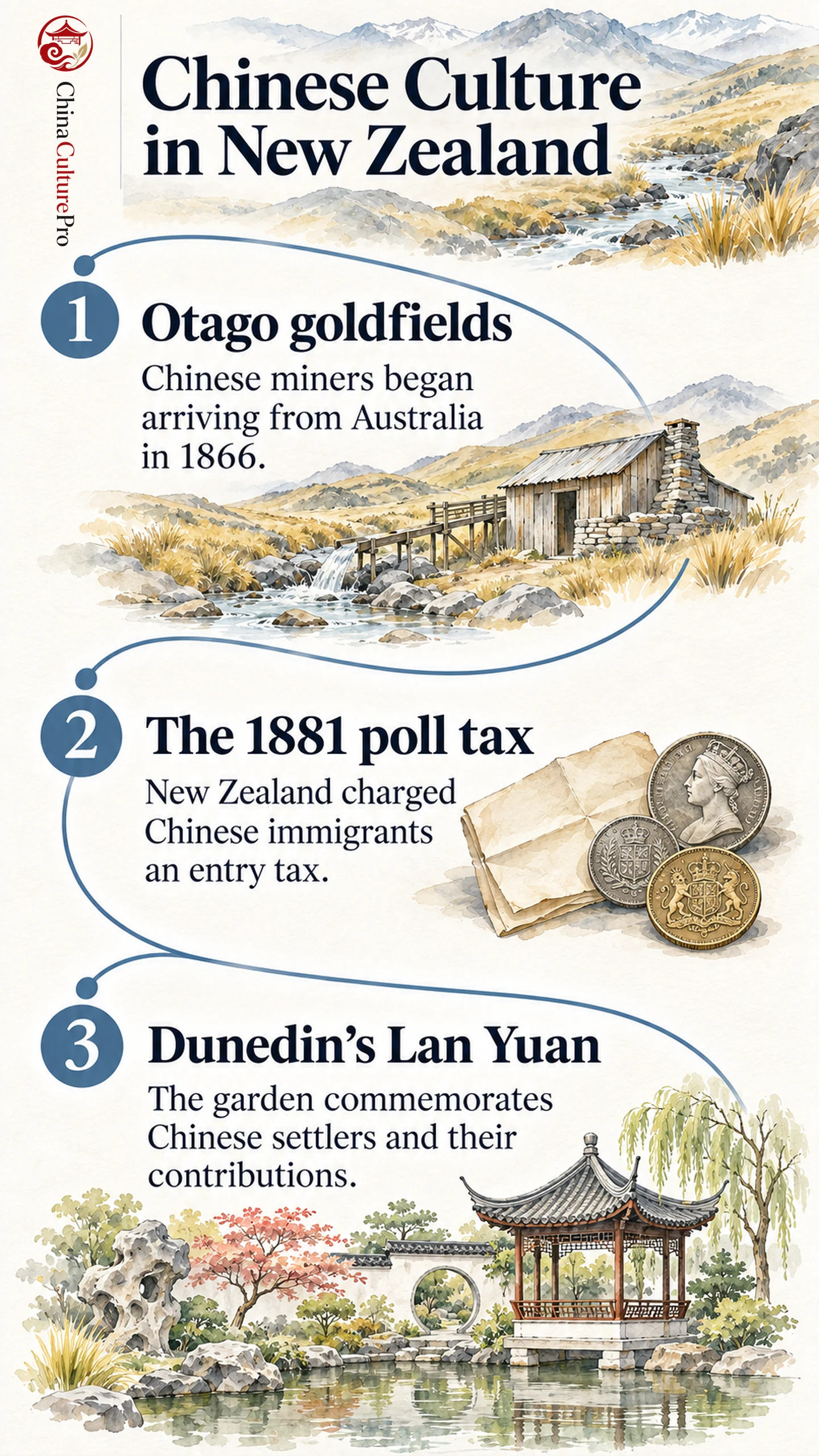
An old mining hut shows how workers lived. A merchant’s store and a modern garden show how trade and civic recognition followed settlement.
From Victoria to the Otago Goldfields
When miners left Otago for new West Coast goldfields in 1865, the provincial council invited Chinese miners from Victoria. They began arriving in Otago from 1866, extending a migration route already established in Australia’s goldfields. [1]
Arrowtown preserves a settlement near the gold workings, with small dwellings that illustrate everyday living conditions. The Chinese camp at Lawrence also became a commercial center. Its documented businesses included a general store run by Chau Mong and Chow Tie. [1][2]
The Poll Tax and Its Legacy
In 1881, the government imposed a £10 entry tax on Chinese immigrants. The charge rose to £100 in 1896. The experience offers a comparison with Chinese settlement in South Africa, where separate restrictions also constrained migration and settlement. Because the tax specifically targeted Chinese arrivals, it placed a financial barrier in the way of Chinese migration. In 2002, the government formally apologized to the Chinese community for the poll tax and related immigration restrictions. [3]
Remembering Settlement in Dunedin
Lan Yuan, the Dunedin Chinese Garden, opened in 2008 with support from Dunedin and Shanghai. The local trust wanted to recognize Chinese settlers who stayed after the gold rush and helped establish businesses. The garden gives that history a permanent public setting near the city’s railway station and settlers’ museum. [4]
FAQs About Chinese Culture in New Zealand
When did Chinese miners arrive in Otago?
They began arriving in 1866, following recruitment from Australia after workers left Otago’s goldfields. [1]
What was the Chinese poll tax?
It was a charge on Chinese immigrants entering New Zealand. Introduced at £10 in 1881, it increased to £100 in 1896. [3]
Fuentes
[1] Heritage New Zealand Pouhere Taonga. Arrowtown Chinese Settlement
[2] Heritage New Zealand Pouhere Taonga. Lawrence Chinese Camp
[3] Manatū Taonga – Ministry for Culture and Heritage. Poll tax imposed on Chinese
[4] Dunedin Chinese Garden. About the Garden