


Quick Answer: What Shapes Chinese Culture in South Africa?
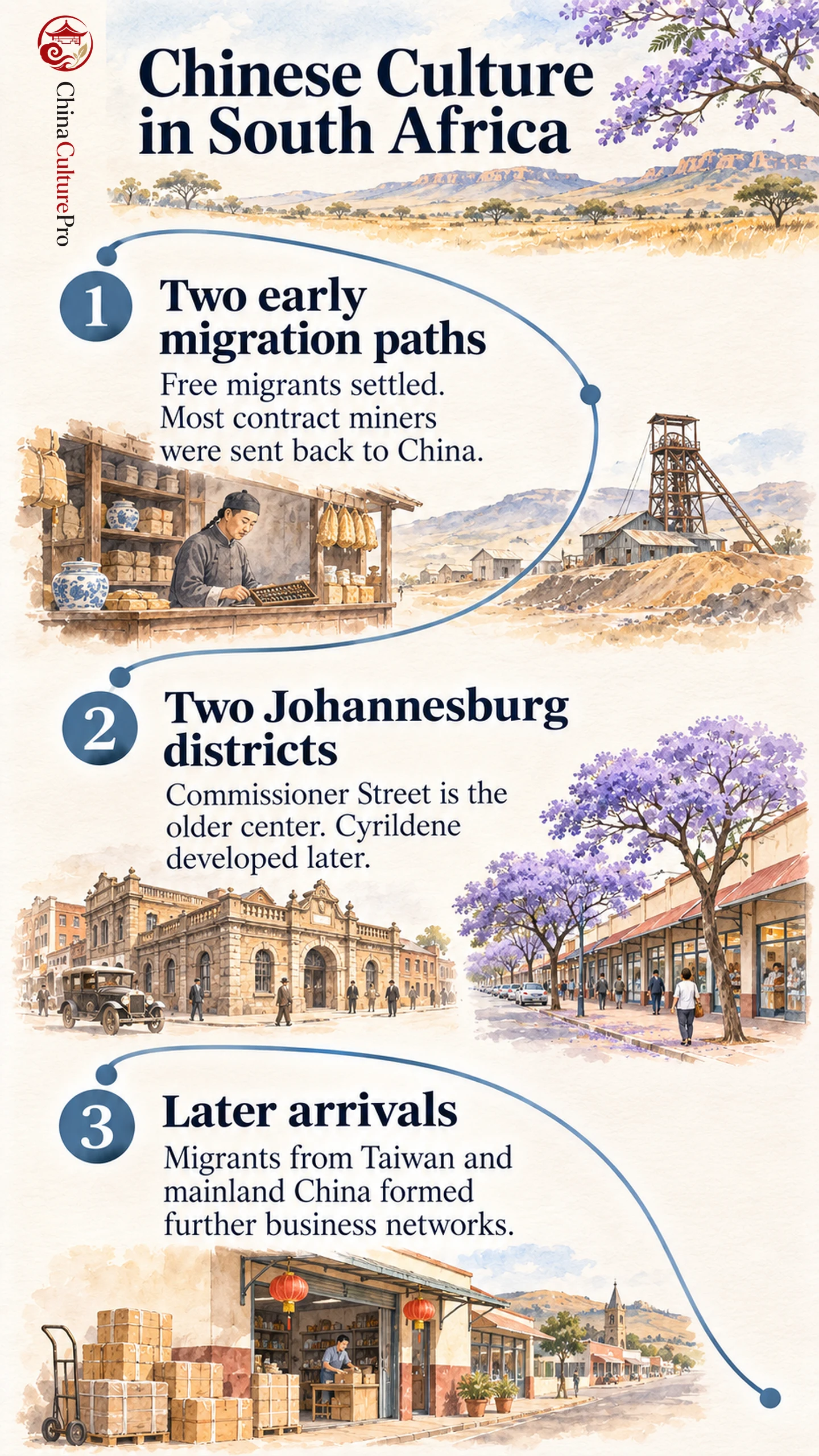
Chinese communities in South Africa formed through several migration streams. Free migrants from Guangdong established families and businesses from the late 1870s. Contract miners recruited to the Witwatersrand in the early twentieth century followed a separate path, and most were sent back to China. [1]
- Established families. Guangdong migrants formed a settled community despite discriminatory restrictions. [1]
- Urban centers. Johannesburg’s historic Chinatown developed on Commissioner Street. A newer one grew in Cyrildene. [2][3]
- Later migration. People from Taiwan and mainland China added other business and family networks. [1][3]
The distinction between temporary mining labor and long-term settlement explains why the communities developed differently.
A plaque on Commissioner Street records a community institution. The history behind it includes families who built lives in Johannesburg while facing immigration and residential restrictions.
Free Migration and Contract Labor
Free migrants from southern China began settling in greater numbers in the late nineteenth century. Some opened businesses and established families. Laws and practices that discriminated against Chinese residents made settlement and further migration harder. [1]
Recruitment for the Witwatersrand mines between 1904 and 1910 brought a separate group of contract workers. Most were repatriated. This history sits alongside other examples of labor migration, such as the Chinese Canadian railway experience, while the industries and local restrictions differed. [1]
Johannesburg’s Two Chinatown Histories
Commissioner Street was the older center. Heritage plaques mark places such as the Transvaal Chinese United Club and the Chinese Association of Gauteng headquarters. These buildings show how community associations maintained dedicated premises in the city. [2]
A newer Chinese commercial district grew in Cyrildene, particularly around Derrick Avenue. The two areas preserve different periods of Chinatown culture in Johannesburg. [3]
Later Migration From Taiwan and Mainland China
Later arrivals included Taiwanese business owners who came through industrial investment and other opportunities. Migration from mainland China expanded in a later period, including traders who established shops outside the largest cities. A family with generations of ties to Commissioner Street may therefore have a different migration history from a newer shop owner. [1][3]
FAQs About Chinese Culture in South Africa
Did Chinese contract miners establish the main settled community?
Most contract miners were repatriated to China. The long-established Chinese South African community traces many of its roots to separate free migration from Guangdong. [1]
Where were Johannesburg’s two Chinatowns established?
The historic quarter developed on Commissioner Street in the central city. A newer Chinese commercial district developed in Cyrildene. [2][3]
Fuentes
[1] Revue européenne des migrations internationales. Recent Chinese migrants in small towns of post-apartheid South Africa
[2] City of Johannesburg. Chinese New Year lights up Jozi skies
[3] Urban Forum. Enclaves on edge: Immigrant business spaces of Johannesburg