


Quick Answer: What Shapes Chinese Culture in Myanmar?
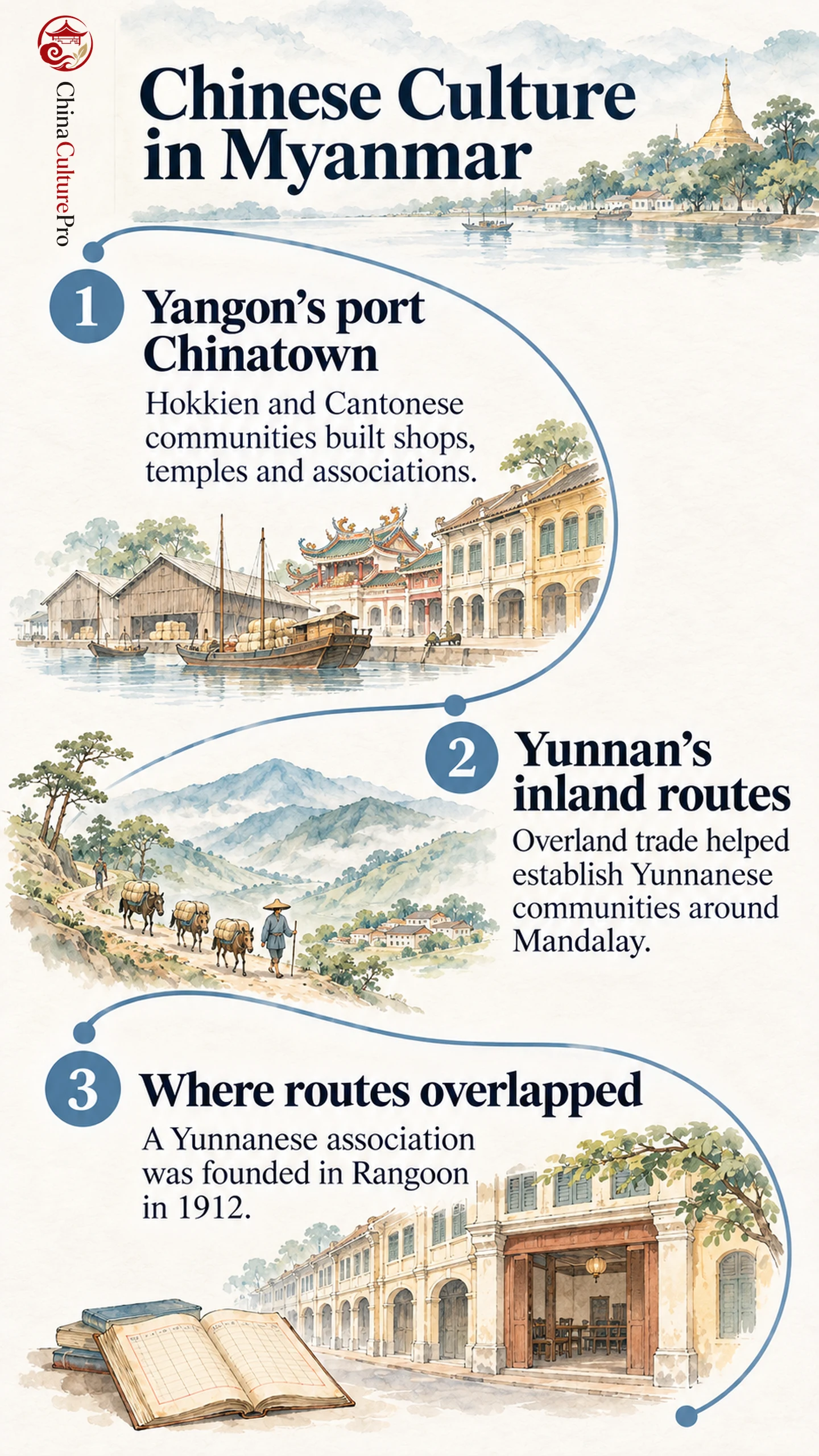
Two migration histories help explain Chinese culture in Myanmar. Yangon’s port district attracted migrants from coastal southern China, including Hokkien (福建話, Fújiànhuà) and Cantonese speakers. Overland trade linked communities in northern Myanmar to Yunnan. [1]
- Yangon. Shops, temples and regional associations developed in the historic Chinatown. [1]
- Mandalay. The city became a center for migrants connected to Yunnan through inland trade. [1]
- Across both routes. Yunnanese merchants also established a community association in Yangon. [1]
These routes overlapped when migrants moved between inland towns and the port.
A temple and an association hall can stand near each other and represent different migrant histories. That was the case in colonial Rangoon, now Yangon, where southern coastal and inland networks met.
Yangon: A Port Chinatown With Several Communities
Colonial Rangoon’s Chinatown lay west of the city center. Hokkien institutions clustered mainly in the southern part of the district, and Cantonese institutions in the northern part. Shops and residences stood alongside temples and associations, making the neighborhood a place where families lived, worked and organized community activities. [1]
The Yunnanese association was formally established in 1912. Its early premises on Latter Street stood close to both Hokkien and Cantonese institutions. The address shows how different Chinese diaspora associations could share a neighborhood while serving distinct networks. [1]
Mandalay and the Overland Routes From Yunnan
The Mandalay area had long-standing trade connections with Yunnan. Overland migrants settled in northern hill communities and towns. In later decades some moved farther south, including to Yangon from the late 1980s. These routes can be compared with the Yunnan connections in northern Laos. [1]
Yunnanese origins also encompassed different religious communities. Mandalay was home to Panthay, a historical name used in Myanmar for Chinese Muslims associated with Yunnan. Their history adds a religious dimension to a story often told through regional origins and commerce. [2]
FAQs About Chinese Culture in Myanmar
What is the difference between Yangon and Mandalay’s Chinese migration histories?
Yangon’s port encouraged coastal migration, while Mandalay was tied to overland networks from Yunnan. Yunnanese families and institutions also reached Yangon, where those networks overlapped. [1]
Who are the Panthay?
Panthay is a historical name used in Myanmar for Chinese Muslims with links to Yunnan. It describes a specific community within the wider migration history. [2]
Fuentes
[1] ISEAS – Yusof Ishak Institute. The Yunnanese Chinese in Myanmar
[2] Journal of Southeast Asian History. The Panthay of Burma and Yunnan