


Quick Answer: What Is Ben Shan Oolong?
Ben Shan(本山,Běnshān)is an Anxi tea cultivar used to make oolong. The International Camellia Register records it as Camellia sinensis ‘Benshan’, native to the Xiping area of Anxi County, Fujian.[1]
- Origin: Anxi in southern Fujian is its home context.
- Identity: A named cultivar with its own record.
- Cup: Processing, harvest and preparation help determine the finished tea’s character.
A compact, green-looking oolong should not be classified by color alone. Likewise, a comparison with another Anxi tea does not replace the cultivar name. Read the actual product’s growing information and manufacture alongside its tasting description.
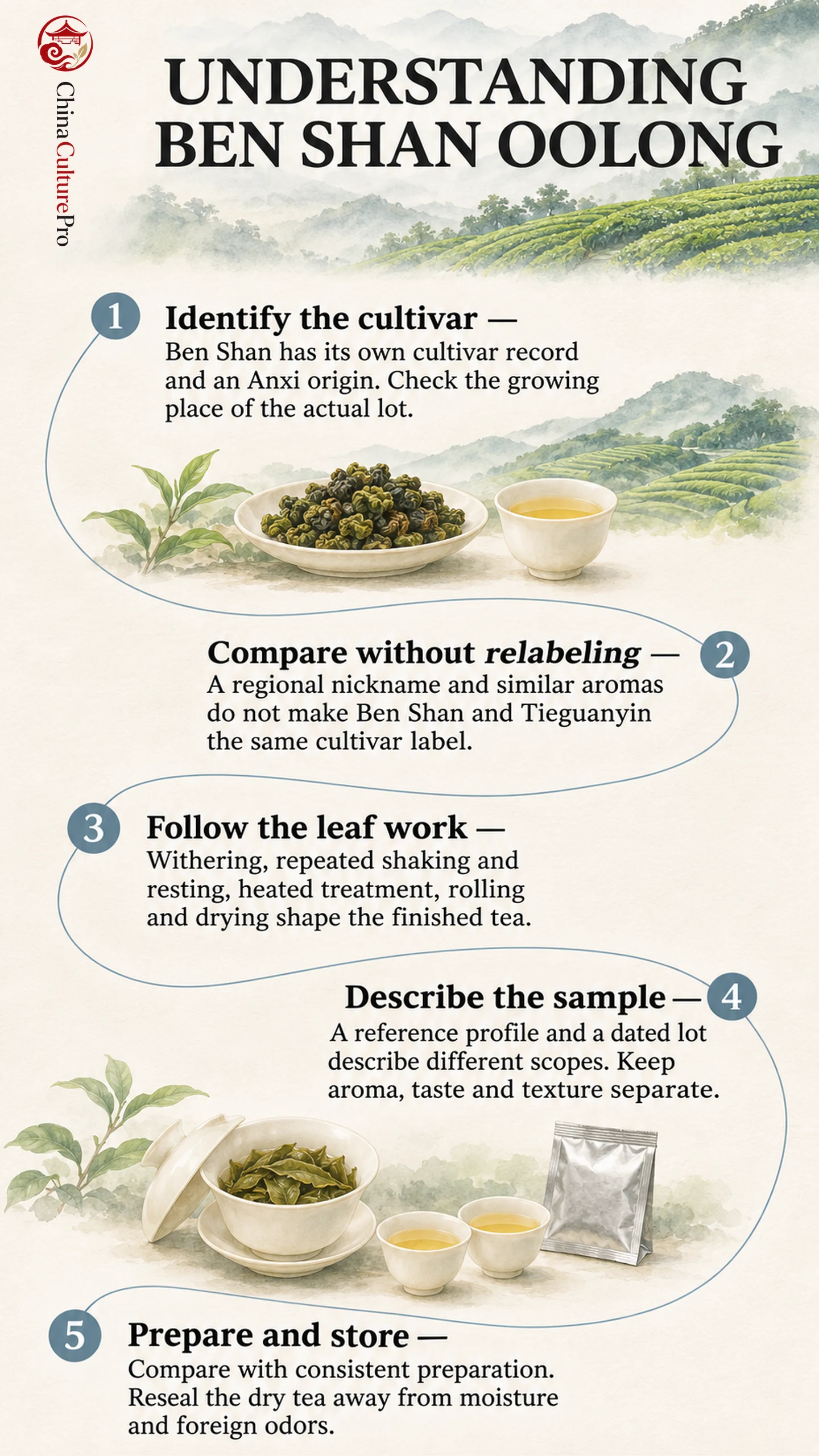
Compact greenish-brown leaves unfold in the vessel, giving a fragrant cup that invites comparison with other Anxi oolongs. Ben Shan has a recognizable place in that regional family. Its own cultivar record, the maker’s leaf-working choices and the character of an individual harvest explain more than a general promise of floral sweetness.
Ben Shan’s Anxi Origin and Cultivar Record
The cultivar register places Ben Shan’s origin at Yaoyang Nanyan in Xiping Town, Anxi. It records national recognition under a 1985 variety number and a later 2018 registration.[1] These are administrative records for a named plant variety, not dates establishing when tea growing began in the district.
An official Ministry of Culture and Tourism guide presents Ben Shan alongside Tieguanyin(铁观音,Tiěguānyīn), Huangjingui and Maoxie as four familiar Anxi teas.[2] This provides a regional context for meeting the name on a tea menu. It is not a worldwide ranking of quality or a requirement to prefer one cultivar.
Keep three details distinct when reading a packet: the cultivar, the growing location and the finished-product style. Knowing that Ben Shan originated in Anxi does not establish which garden supplied a particular harvest. A producer’s growing and manufacturing information fills in details that the cultivar name leaves open.
The Tieguanyin Comparison in Context
Ben Shan is often introduced through a comparison with Tieguanyin. The register notes that good Ben Shan oolong can resemble Tieguanyin’s aroma and taste characteristics.[1] Similarity is a useful reason to taste them alongside each other; the names remain distinct cultivar labels.
The ministry’s regional guide uses the nickname Little Guanyin(小观音,Xiǎo Guānyīn)for Ben Shan and describes its fragrant, mellow-sweet character.[2] A nickname expresses an association. It does not establish that Ben Shan is a grade of Tieguanyin, or that every lot must be judged as its lesser substitute.
For a comparison, choose products with clearly described harvest and roast information. Otherwise, differences between two cups may involve finishing choices as well as cultivar. Describe each actual cup before judging its quality from the cultivar name.
Leaf Working and the Rounded Oolong Style
The Chinese Tea Society’s account of oolong processing places withering before zuoqing(做青,zuòqīng), pan-firing(炒青,chǎoqīng), rolling and drying. Zuoqing involves repeated alternation between shaking and resting, managing moisture changes and enzymatic oxidation. The account explicitly notes differences with region and cultivar.[3]
This is substantial leaf work, even when the final product looks green.
A 2025 study specifically investigated Ben Shan using two mechanical approaches to shaking the leaves. Its published abstract reports higher sensory scores for one water-sieve rotary treatment than for the conventional drum treatment in that comparison.[4] The reported comparison illustrates why processing information matters alongside a cultivar name. It does not require all makers to reproduce one experimental setting.
Rolling and shaping also affect its presentation: compact, semi-ball-rolled Ben Shan is one documented market form.[5] The dry shape and the plant’s cultivar identity are separate pieces of information.
For the terminology behind these transformations, see tea oxidation versus fermentation.
Flavor References and Individual Harvests
The cultivar reference describes Ben Shan oolong with tightly formed, brownish-green leaves, a rich, lasting fragrance compared with osmanthus, and a mellow, fresh taste.[1] That is a useful reference profile, not a checklist every cup must satisfy exactly.
A documented autumn 2017 lot offers a different level of detail. Its account describes floral sweetness, crisp pear-like and vegetal impressions, and an elusive milky aromatic quality.[5] Those observations belong to that product; they do not establish a compulsory Ben Shan flavor or an added-milk ingredient.
When tasting, keep the observations separate:
- Fragrance: Note the aroma above the liquor and in the emptied vessel.
- Taste: Distinguish sweetness and bitterness from a flower comparison.
- Texture: Describe fullness, smoothness and any drying sensation.
- Finish: Record what remains and how it changes between infusions.
Use Chinese tea aroma vocabulary to make your notes clearer. If added flowers, flavoring or dairy matter to you, check the product information rather than inferring ingredients from a sensory metaphor.
Brewing and Storing Ben Shan
Begin with the actual product’s directions. A gaiwan o tetera should give the compact leaves room to open and allow you to drain the liquor. Keep the leaf amount, actual water and contact time together when adjusting strength.
For comparisons, keep preparation consistent. Record the producer, growing location, harvest and roast beside the tasting notes. Change one brewing variable at a time so that the next cup tells you something useful about the adjustment.
Keep the remaining dry tea well sealed and away from moisture and foreign odors. The Tea and Beverage Research Station explains that tea readily absorbs both and that its aroma components can change during storage.[6] Follow the packet’s storage conditions rather than borrowing one refrigeration rule or shelf life from another oolong. Our guide to storing Chinese tea covers routine handling.
FAQs About Ben Shan Oolong
Is Ben Shan the same tea as Tieguanyin?
No. They are different cultivar names. Regional association and similar sensory qualities do not make them interchangeable labels.
Is Ben Shan a kind of green tea?
The tea discussed here is oolong. A green-looking finished leaf does not determine its processing category.
Does Ben Shan always taste milky?
No. A milky impression can appear in a particular tasting description. Check ingredients separately if added milk or flavoring matters.
Can all Ben Shan use the same brewing schedule?
A cultivar name alone cannot specify every product and vessel. Start with the actual packet’s directions and adjust deliberately.
Fuentes
[1] International Camellia Register. Benshan
[2] Ministry of Culture and Tourism. 福建·安溪“海丝茶源 茶旅胜地”之旅
[3] Guo Yaling, Chinese Tea Society. 茶科普:乌龙茶的产区与分类
[4] Chen Shuiji et al. 水筛式旋转摇青机做青对闽南本山乌龙茶的品质影响研究, published abstract
[5] Tea Trekker. Ben Shan, autumn 2017 product account
[6] Tea and Beverage Research Station. 茶葉之包裝貯藏