


Quick Answer
Lingbao Daoism (靈寶道, Língbǎo Dào), the Numinous Treasure tradition, took shape around a body of scriptures that circulated in southeastern China around 400 CE. The texts gave communal ritual a central place and drew on older Daoist practices and Buddhist ideas of salvation.[1][2]
- Texts: A new collection circulated in Jiangnan around 400.
- Ritual: Its ceremonies addressed the welfare of a community and could include the dead.
- Legacy: The tradition helped shape the organization of the Daoist canon.
The name also appears in the title of a deity. Here it refers to the scriptures and their ritual tradition.[1][2]
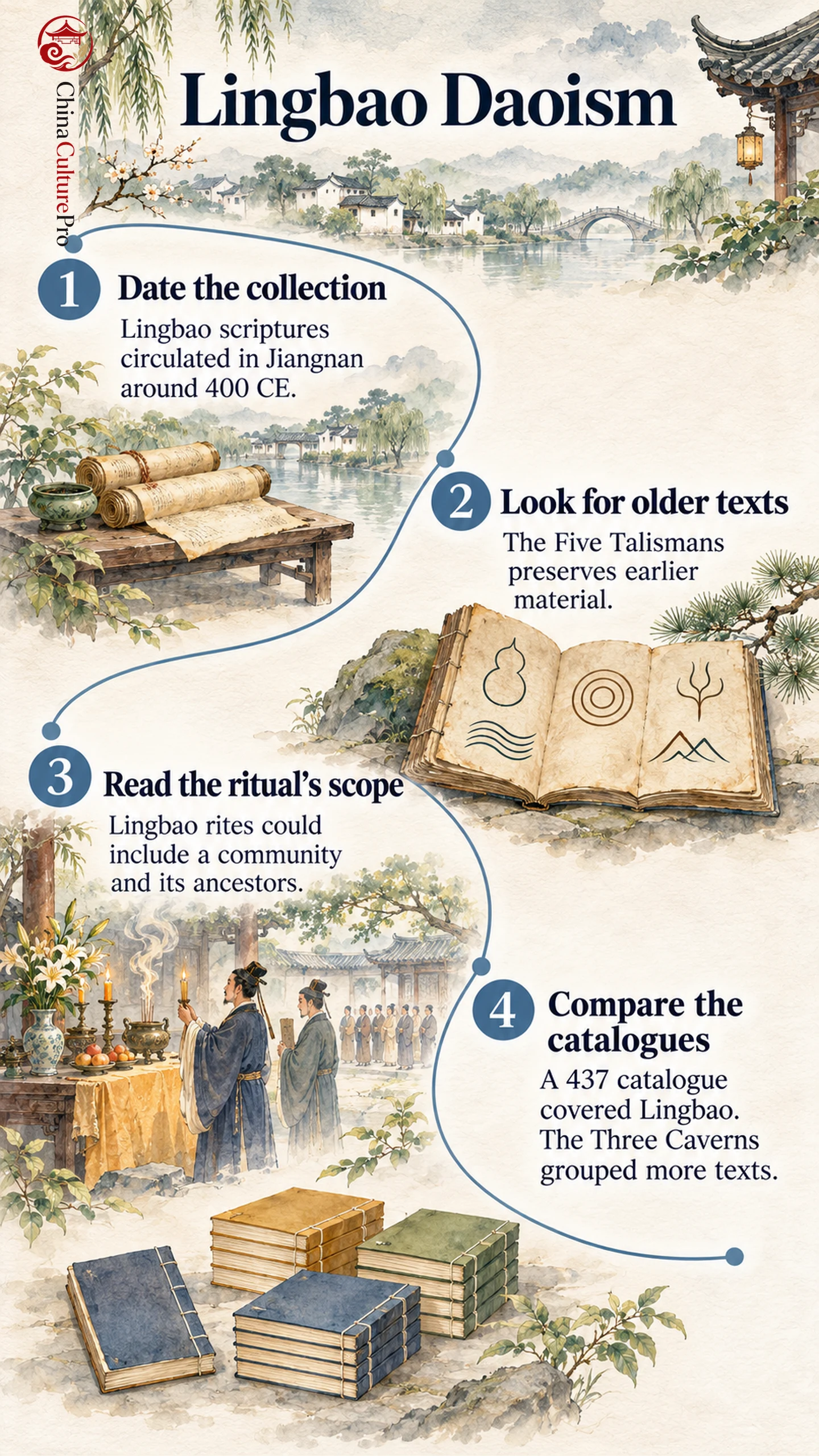
A catalogue dated 437 gives a point of reference for the early Lingbao collection. Its compiler distinguished scriptures said to come from earlier world ages from teachings framed as conversations between an adept and his instructors. Those divisions show how the collection presented its authority.[2][3]
When the Lingbao Scriptures Took Shape
Later Daoist records associate the release of the new collection around 400 with Ge Chaofu (葛巢甫, Gě Cháofǔ), a relative of Ge Hong. Some of the scriptures themselves trace revelation to the earlier figure Ge Xuan. Those statements describe different things: a tradition’s account of where the teaching came from and a date for the circulation of a recognizable body of texts.[1][2]
The Scripture of the Five Talismans of the Numinous Treasure preserves older material within the wider tradition. Its surviving introduction contains material that Ge Hong cites. That connection helps explain how the name and some of the texts can be older than the collection associated with Ge Chaofu.[2]
What Universal Salvation Meant in Ritual
Lingbao incorporated forms of prayer and ritual from earlier Daoist communities and adapted Buddhist elements, including a version of the bodhisattva vow. The resulting texts frame salvation as something directed beyond an individual practitioner. Lingbao sources also describe practices for delivering ancestors from the netherworld.[1][2]
This scope affects who appears in the ritual. One Lingbao example gives the priest a role in sending inner gods to deliver petitions to high celestial deities. This practice adapts visualization to a ceremony performed on behalf of others. The broader guide to religious Daoism explains how priest, liturgy, and sponsors relate in communal rites.[1]
How Lingbao Shaped the Daoist Canon
The Three Caverns (三洞, Sāndòng) organized scriptures associated with Shangqing (上清, Shàngqīng), Lingbao, and the Three Sovereigns (三皇, Sānhuáng). Lingbao texts described a celestial ordering of teachings that helped shape this later system, in which each of the three collections was linked with a heaven. The system gave texts a position in relation to one another and informed ranks in priestly ordination.[1][2]
Lu Xiujing (陸修靜, Lù Xiūjìng) helped organize the tradition through his catalogue and codification of ritual. The catalogue of 437 treated the Lingbao corpus specifically. The Three Caverns had a wider reach because it classified multiple bodies of scriptures.[1][2][3]
FAQs About Lingbao Daoism
What does Lingbao mean?
Lingbao is usually translated as “Numinous Treasure.” It can refer to a body of scriptures and ritual traditions, or appear as part of a title such as Lingbao Tianzun.[1][2]
Is Lingbao Daoism the same as Shangqing?
The Three Caverns treated them as distinct collections. Shangqing is especially associated with revealed texts and individual visualization, while communal liturgy is central to Lingbao. Lingbao also incorporated some elements from Shangqing.[1][2]
Did Lingbao borrow from Buddhism?
Lingbao texts adapted Buddhist ideas and placed them in a Daoist setting. The bodhisattva-like vow and accounts of ranked heavens are two examples.[1][2]
Fuentes
[1] Fabrizio Pregadio, Stanford Encyclopedia of Philosophy. Religious Daoism, sections 3.3–3.4 and 6.2
[2] Stephen Bokenkamp, The Encyclopedia of Taoism. Lingbao, Numinous Treasure
[3] Louis Komjathy. Reconstruction of the 437 Lingbao Catalogue