


Quick Answer: Why Is the Yellow River Important in Chinese History?
The Yellow River (黄河, Huáng Hé) shaped farming settlements across northern China and the floodplain where many later communities lived and worked. The river’s cultural importance is visible in archaeological objects, historical records and stories about how people dealt with water.[1][2][3][4]
- Farming: Early communities in tributary valleys grew millet and worked with pottery, as finds at Banpo (半坡, Bànpō) show.[2][5]
- Writing: Oracle bones from the late Shang capital at Yin Xu (殷墟, Yīnxū) document a mature writing system and royal divination.[3]
- Flood memory: Stories of Yu the Great (大禹, Dà Yǔ) and records of the lower river’s 1855 course change tell us different things about living with water.[4][6]
The river basin was one major center of early Chinese history. Other regions, including the Yangtze basin, also supported complex early societies.[7]
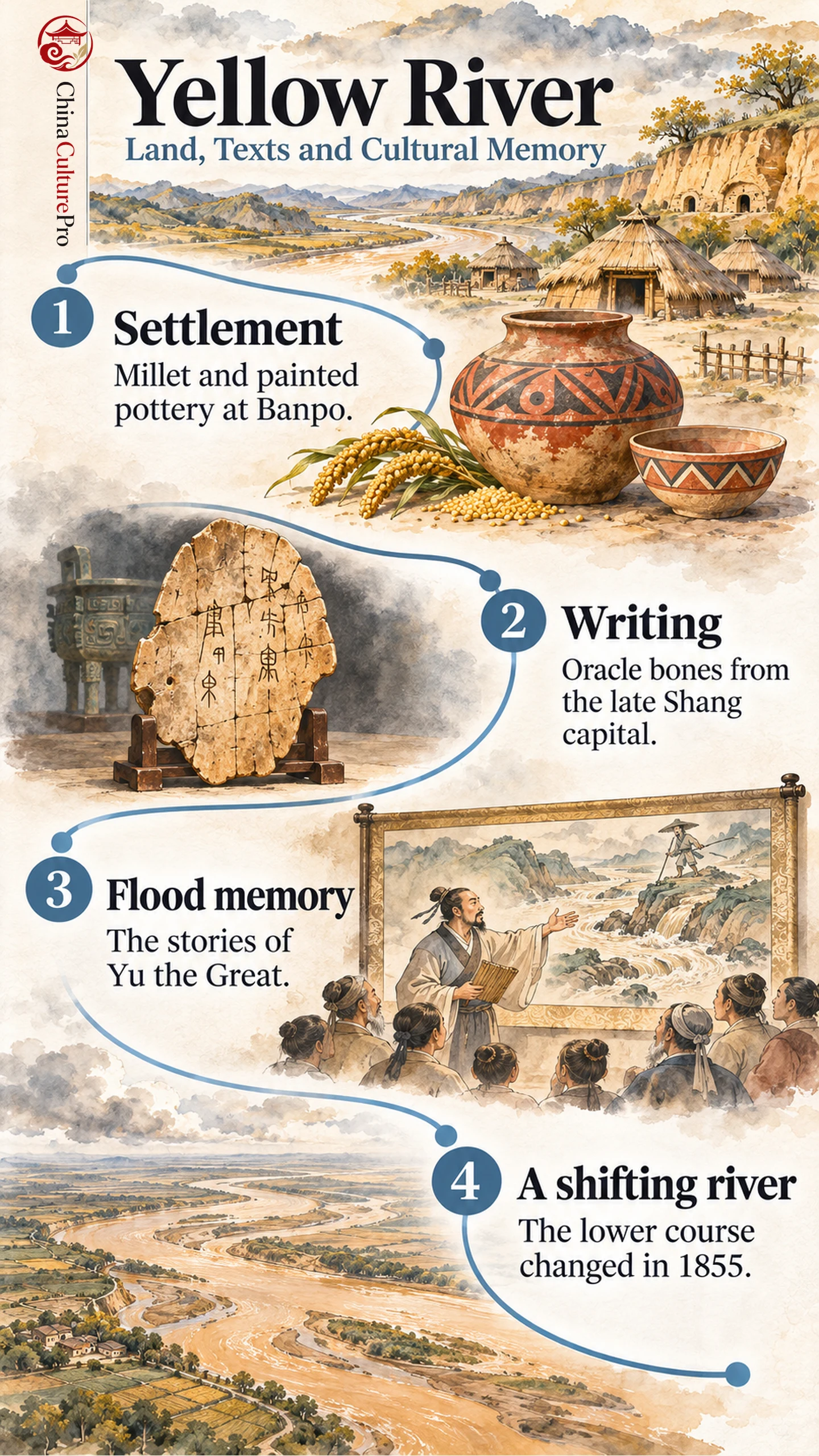
The Yellow River can appear in history as a place where people settled, a river that moved and a landscape remembered in stories. Each meaning leaves a different kind of record.
Four Ways to Read the Yellow River’s History
| 證據 | 例子 | What it can show |
|---|---|---|
| Settlement remains | Banpo in the Wei River valley | Millet, pottery and village life in a tributary valley.[2][5] |
| Inscribed objects | Oracle bones at Yin Xu | Late Shang writing, questions and court rituals.[3] |
| Classical narratives | Accounts of Yu the Great | How early Chinese authors imagined ordering land and water.[4] |
| River history | The course shift of 1855 | A documented change in where the lower river flowed.[6] |
Millet, Pottery and Village Life
The river crosses landscapes of fine yellow soil known as loess. As water wears away that material, some of it enters the channel as ochre-colored sediment. When a river carries this material onto lower ground, its deposits can reshape the landscape used for farming and settlement.[1][6]
Banpo, in what is now Xi’an, lay in the valley of the Wei, a Yellow River tributary. Pottery, stone tools and a few charred millet grains survive there. The grains add direct evidence to what tools alone can suggest about farming. Painted pottery links the village to other sites associated with Yangshao and Longshan cultures over the longer history of the region. Banpo itself is a Yangshao site.[2][5]
Yin Xu and the Written Record
At Yin Xu, the late Shang capital near modern Anyang, archaeologists recovered inscribed bones alongside remains of palaces, ancestral shrines and tombs. The royal court used oracle bones in divination, and inscriptions record questions and observations. This gives the period a source written by people who lived in it. Yin Xu stands on the Huan River, away from the main Yellow River channel.[3] Some of the inscriptions record questions about a power called Di, part of the evidence for Shangdi and early Chinese religion.[9]
Marks found on far earlier Neolithic pots present a different problem. Archaeologists can compare their forms and where they were placed on vessels. The isolated marks tell us less about language than the readable Shang inscriptions.[3][5]
Yu the Great and a River That Changed Course
In early texts, Yu the Great brings order to the land by working with its waters. The Tribute of Yu, part of the Book of Documents, names the Yellow River among the waterways it describes. The story is part of a tradition about making land habitable. Linking it to one dated Yellow River flood requires evidence beyond the text.[4]
By 1855 the lower Yellow River had a well-documented history of changing courses. That year’s shift sent the river north of the Shandong Peninsula toward the Bohai Sea. Heavy sediment loads, deposition and channel breaches help explain how the river could redirect itself across the plain. The experience of managing a large river takes a different form in the Yangtze’s cultural history, where inscriptions at Baiheliang recorded low water.[6][8]
FAQs About the Yellow River in Chinese History
Why Is It Called the Yellow River?
Its yellow-brown color comes from sediment, including fine soil the river and its tributaries erode from the Loess Plateau.[1]
Why Is the Yellow River Called a Cradle of Chinese Civilization?
Early farming villages, later political centers and a large written record in northern China contribute to that description. The geography and archaeology of other early settlements, such as Liangzhu, show a broader picture.[2][3][7]
Does the Story of Yu Describe a Recorded Yellow River Flood?
The early tradition tells of Yu ordering land and waterways. Researchers have debated whether any one excavated flood deposit corresponds to the story. Reading the story and identifying a specific event require different kinds of evidence.[4]
資料來源
[1] Cambridge University Press. Dams, Rivers, and the Environment
[2] Zhijun Zhao. New Archaeobotanic Data for the Study of the Origins of Agriculture in China
[3] UNESCO World Heritage Centre. Yin Xu
[4] Sarah Allan. The Jishi Outburst Flood of 1920 BCE and the Great Flood Legend in Ancient China
[5] Paola Demattè. The Origins of Chinese Writing
[6] United Nations. Case Study: The Yellow River
[7] UNESCO World Heritage Centre. Archaeological Ruins of Liangzhu City
[8] UNESCO World Heritage Centre. Baiheliang Ancient Hydrological Inscription, Tentative List
[9] David N. Keightley. Executive Qi in Shang Oracle-Bone Inscriptions A New Hypothesis