

Quick Answer: What Does Ye Gong Hao Long Mean?
Ye Gong Hao Long (叶公好龙, yè gōng hào lóng) literally means “Lord Ye loves dragons.” As a chengyu (成语, chéngyǔ), it criticizes people whose enthusiasm evaporates when they encounter the thing they claim to admire. In a modern example, the arrival of the dragon might be the moment a person has to act on a principle they’ve praised.[1][2][3]
- The telling detail: Lord Ye fills his home with images of dragons. A dragon arrives, and he flees.[1]
- The modern idea: The phrase points to a gap between expressed enthusiasm and how someone responds to the real thing.[2][3]
- The English sense: “They like the idea of it” can carry the criticism when followed by the action they refused to take.
The expression can sound pointed. A single declined invitation rarely makes a convincing example on its own.
The dragon is only half the story. In a classical telling, a traveler uses the fable to tell a duke what happened when the duke’s reputation for welcoming scholars met an actual visitor.[1]
What happens when the real dragon arrives
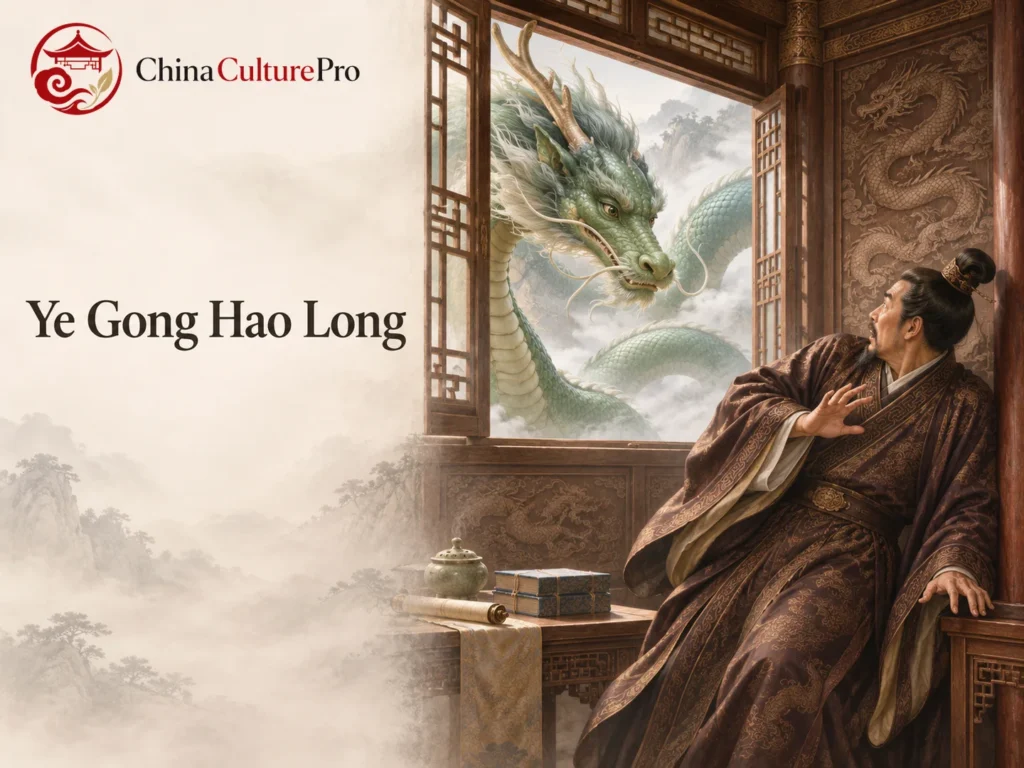
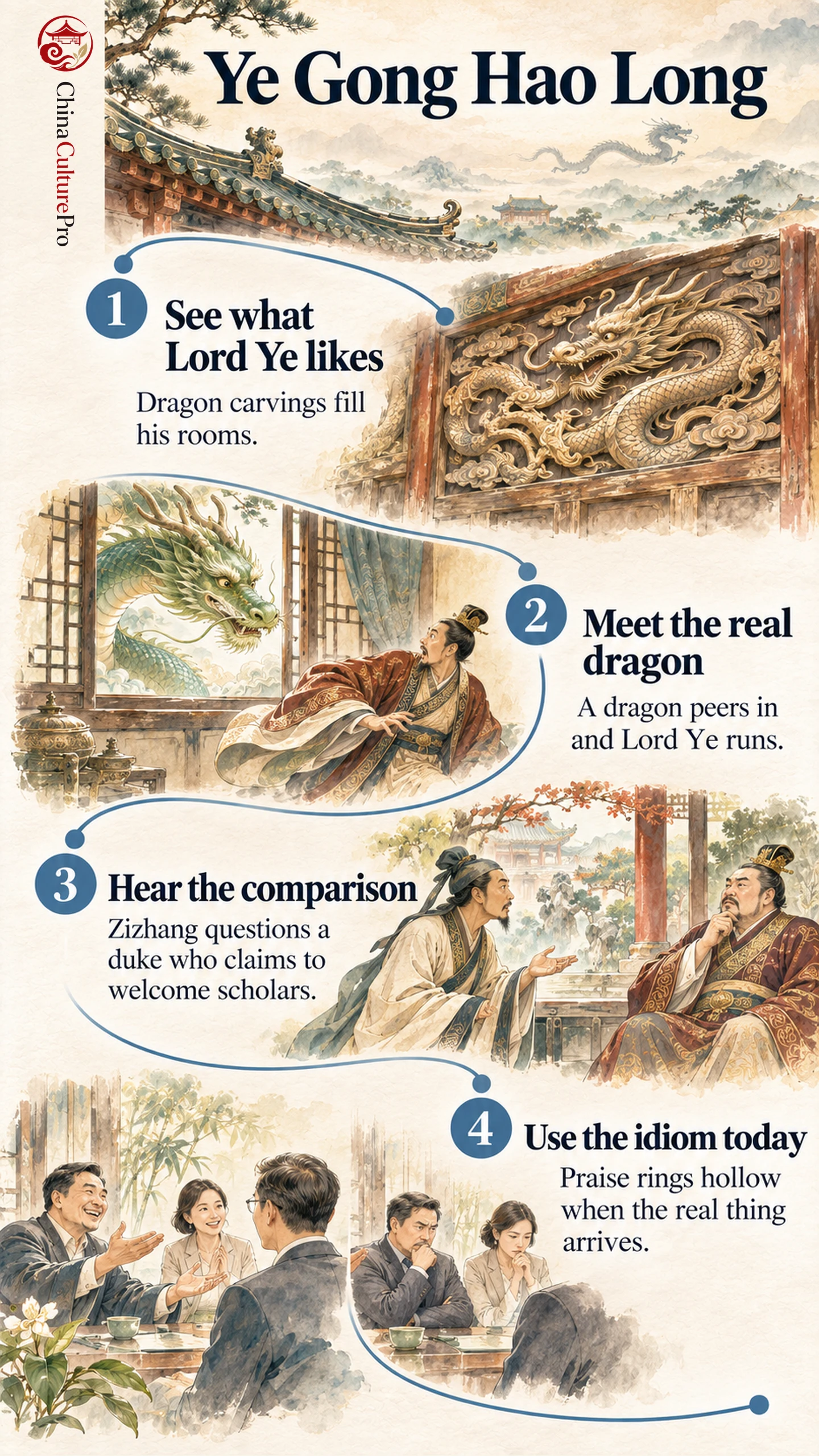
In Xin Xu (新序, Xīn Xù), Lord Ye has dragons depicted on objects and carved into the rooms of his home. A celestial dragon hears of his fondness and descends. It peers through a window, with its tail extending into the hall. The man who has surrounded himself with dragons turns and runs. The narrator draws attention to the difference between a dragon’s likeness and the creature that arrives at the house.[1]
The speaker framing the tale is Zizhang (子张, Zǐzhāng), who has traveled to visit Duke Ai of Lu (鲁哀公, Lǔ Āigōng). He has heard that the duke treats men of learning well. After seven days without the expected courtesy, he leaves a message with an attendant. The duke’s supposed regard for scholars, he says, is like Lord Ye’s regard for dragons. The story turns a complaint about personal treatment into a criticism of the duke’s reputation.[1]
A parallel version is attributed to a lost passage of the Zhuangzi (庄子, Zhuāngzǐ), quoted in a later encyclopedia. Both versions make the duke the target of the comparison. The received versions show how the fable was used, even though they cannot settle who first told it.[1][2]
When the idiom fits a modern situation
In modern commentary the expression can target a public commitment. Someone who welcomes a plan in principle and backs away as soon as it affects their own department invites the comparison. If they explain a new cost or constraint that changed their mind, their change of position alone is weak grounds for the charge.[2][3]
- Workplace feedback: 他总说欢迎不同意见,可一听到批评就不高兴,真有点叶公好龙。 “He keeps saying he welcomes different views, but gets upset as soon as someone criticizes him. He likes the idea of feedback more than getting it.”
- A group’s enthusiasm: 大家都说支持改革,可一谈到具体方案就没人愿意试,未免有些叶公好龙。 “Everyone says they support reform, but nobody will try a concrete proposal. The enthusiasm sounds a bit hollow.”
Both sentences are original examples. “真有点” and “未免有些” soften the accusation without removing it. In a formal discussion, it is usually clearer to say exactly what the other person welcomed and describe the response that fell short. Our guide to Chinese chengyu explains how the stories behind these expressions affect where they fit.
How to translate the accusation into English
In English, “they liked the idea of it” works when someone backs away from a commitment. It usually needs a second clause to reveal the gap, such as “until it was time to change the policy.” “All talk” is punchier when the focus is reluctance to act. “Lip service” is stronger because it can imply knowing insincerity, so it works best when the context gives the reader a reason to draw that conclusion.[2][3]
Keep “Lord Ye loves dragons” when the audience is learning the idiom or when the story itself matters. A brief gloss can then explain that Lord Ye wanted dragons in his decorations and fled when one appeared at his window. The broader symbolism of Chinese dragons gives context for the decorative motifs in the tale.[1][2]
FAQs About Ye Gong Hao Long
Is it pronounced Ye Gong or She Gong?
You’ll see yè gōng hào lóng in mainland references and shè gōng hào lóng in Taiwan’s education ministry dictionary. The two readings refer to the same written expression.[2][3]
Is the story about a historical person?
The historical Lord Ye was an official of Chu. The visit from the dragon belongs to the literary tale.[1][4]
Does the idiom always accuse someone of lying?
It can criticize enthusiasm that turns out to be superficial, even if the person believed their claim at first. The decisive detail is how their response changes when they face what they praised.[2][3]
資料來源
[1] Wikisource. Xin Xu, volume 5, Miscellaneous Affairs
[2] 台灣教育部。 Dictionary of Chinese Idioms, Ye Gong Hao Long
[3] Han Dian. Ye Gong Hao Long dictionary entry
[4] Henan Provincial Committee of the CPPCC. Historical Lord Ye and the surname’s local tradition