


Quick Answer: What Is Singles’ Day in China?
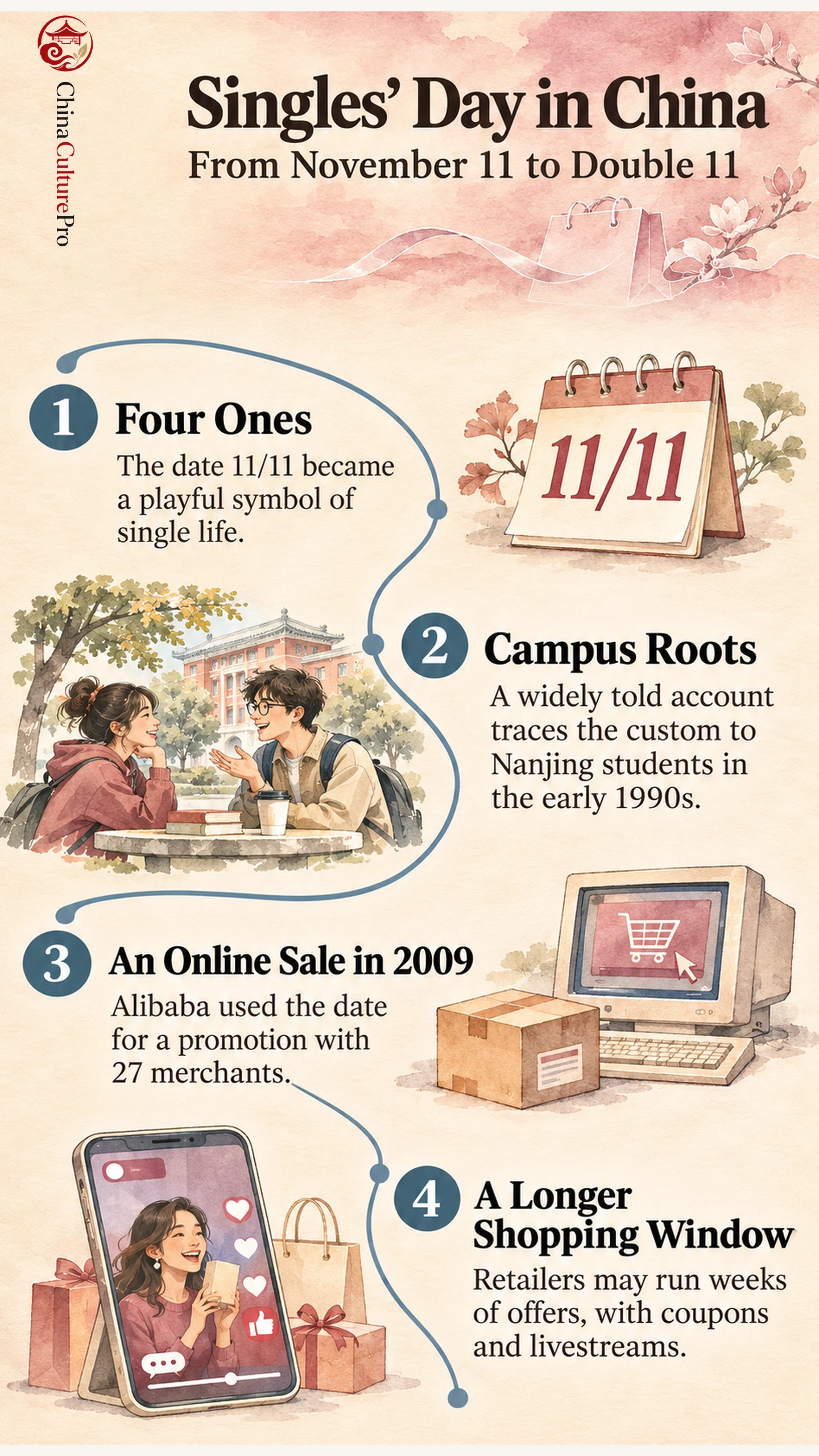
Singles’ Day (光棍节, Guānggùn Jié) is a November 11 observance that began as a joke about being single. The four ones in 11/11 resemble four solitary sticks. In 2009, Alibaba used the date for an online sale, helping turn it into the shopping event now called Double 11 (双十一, Shuāng Shíyī). [1][2][3]
- Campus roots: The best-known account places the custom at a university in Nanjing in the early 1990s. [1][2]
- Retail turning point: The first Alibaba campaign involved 27 merchants, according to the company. [3]
- Today’s calendar: November 11 gives the event its name. Individual sales campaigns can run for weeks. [4]
People can still joke about single life on November 11. In a shopping app, 11.11 usually refers to the promotion.
Imagine two messages arriving in November. One friend shares a joke about treating yourself, while a retailer announces an early offer with the same 11.11 label. The date links those messages. What changed over time was who organized the occasion and what they invited people to do. [1][2][3][4]
Why November 11 Became Singles’ Day
Write November 11 as 11/11 and you get four upright ones. The date plays on guānggùn, literally a bare stick and a colloquial word for an unmarried man. The joke gave students a reason to mark being single with their friends. Retellings describe gatherings with friends and the idea of buying yourself something instead of waiting for a romantic gift. [1][2]
The best-known story places the custom among Nanjing university students around 1993. Accounts vary on who began it, and the story of a specific group of students is difficult to establish independently. The earlier existence of the custom is easier to document. One published firsthand recollection describes students explaining it in the early 2000s. [1][2]
A campus get-together and a national holiday operate on different calendars. Friends could choose to acknowledge the date in a dorm or over a meal, and classes or work could continue as usual. For an official working calendar, the list of public holidays in China is the relevant reference. November 11 has no general public day off. [1][5]
What Changed When Retailers Adopted 11.11
Alibaba’s 2009 promotion turned the self-gift joke into a reason to visit an online marketplace. The company says 27 merchants took part. As participation grew, the date came to organize the work of retailers, payment systems and delivery services as well as the plans of shoppers. Major competing e-commerce platforms later ran their own campaigns around the same date. [2][3][4]
The two names give readers a clue about context. Singles’ Day foregrounds the idea of being single. Double 11 emphasizes the date and can refer to the retail event whether the shopper is single, partnered or shopping for a household. Self-gifting remains a theme even when shoppers use the sale to buy household supplies. The shift gives one example of changing consumer life in modern China. [1][3][4]
How the Modern Shopping Festival Works
A sales window can start several weeks before November 11, and start dates vary by platform and year. A customer might save an item, wait for a coupon to go live, watch a host demonstrate the item and then check the final price. A platform can promote all those moments as part of the same festival even when the order is placed on a different day. [3][4]
Product demonstrations and viewer questions connect the event to Chinese livestreaming culture. A host can show the size or use of an item while comments roll past. Shopping links, schedules and screenshots of offers can also circulate through Chinese social platforms. A shopper can follow a campaign by sharing offers or watching demonstrations without placing an order. [3][4]
An earlier example shows how far the format can reach beyond a product page. Alibaba described its 2017 campaign as a live show distributed through television, online video and shopping apps. Each carried parts of a retail event that once depended on a single online sale date. Later reports describe longer promotions across competing platforms. [3][4]
When comparing sales headlines, check which platforms and dates the estimate covers. A total for several weeks across multiple marketplaces answers a different question from one platform’s November 11 tally. Look for whether the number measures the value of merchandise ordered and whether the report explains how it was estimated. [3][4]
FAQs About Singles’ Day in China
Is Singles’ Day a public holiday in China?
Chinese nationwide public holiday rules give no general day off for November 11. People observe it informally or take part in retail events. [5]
Do shoppers have to be single to take part?
Retailers address shoppers of any relationship status. The singles reference comes from the older social observance. [1][3][4]
Does Double 11 last only one day?
November 11 is the signature date. Platforms may start earlier and set separate windows for individual offers. [4]
資料來源
[1] Carnegie Endowment for International Peace. What China’s Online Shopping Craze Says About Its Bubble Economy
[2] WIRED. Inside the startling, chaotic rise of Alibaba’s Singles’ Day bonanza
[3] Alizila. Alibaba CMO on See Now, Buy Now, Singles Day, Luxury, New Retail
[4] Reuters. What is China’s Singles’ Day and how is it celebrated?
[5] State Council of the People’s Republic of China. Regulation on Public Holidays for National Festivals and Memorial Days