

Quick Answer: What Is Mengding Shihua Tea?
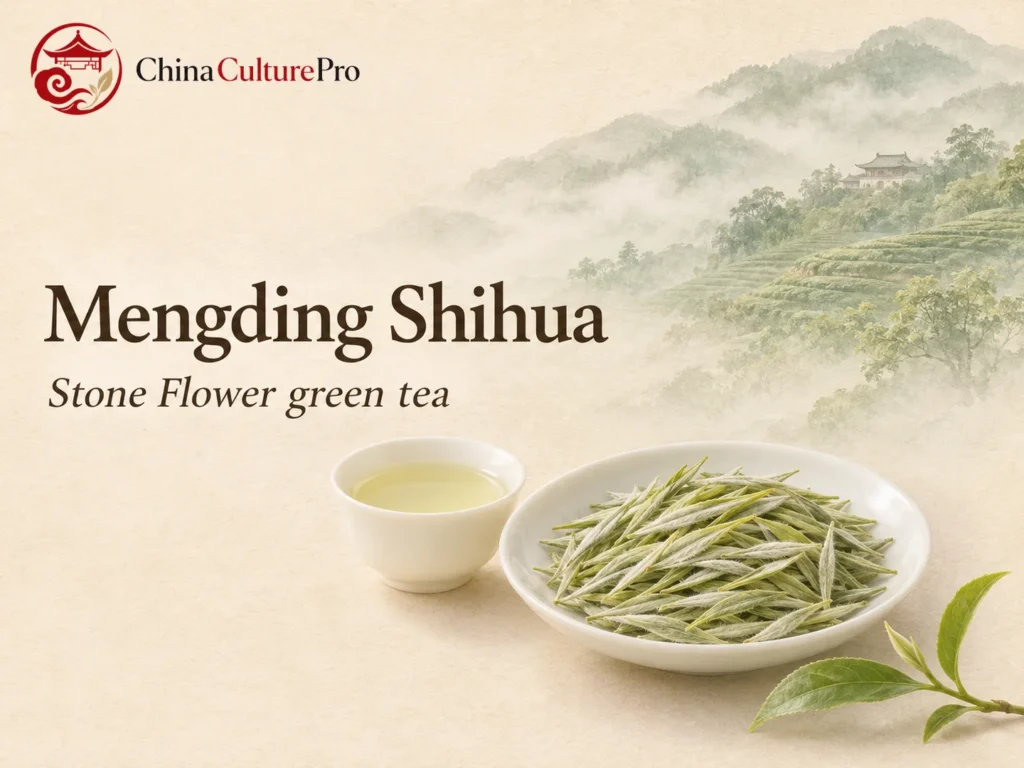
Mengding Shihua(蒙顶石花,méngdǐng shíhuā), often called Stone Flower tea, is a flat green tea from the Mengding area of Ya’an, Sichuan.[1]
- Leaf: Slender, straight, flattened buds with fine pale hairs.
- Craft: Heat fixation, pan shaping, cooling, further firing and drying create its finished form.[2]
- Cup: Fresh and gently sweet, with floral or vegetal notes depending on the batch.[4][5]
Despite its English name, this is tea leaf rather than a flower infusion. It should also be distinguished from yellow tea made in the same region.

A pale yellow-green cup and a shared mountain name can make different Mengding teas easy to confuse. Leaf shape and processing category provide a clearer starting point.
Mengding Origins: An Old Name and a Modern Product
The Tang-period Guo Shi Bu(国史补,Guó shǐ bǔ)lists Mengding Shihua among notable teas, describing small square forms as well as loose buds. That record establishes an old tea name, not proof that today’s pan-shaped green tea was made by an unchanged method in the Tang dynasty.[3]
Mengshan traditional tea-making entered China’s national intangible cultural heritage list in 2021. The protected tradition encompasses several teas, including Shihua; it is not a separate quality certificate for every modern packet bearing the name.[1]
How Stone Flower Tea Is Shaped
Tender buds undergo shaqing(杀青,shāqīng), or heat fixation, followed by shaping in the pan. The material is cooled, returned for further pan firing and finally dried at low heat. The flat bud shape develops through this sequence.[2]
The finished leaf is straight and finely pointed, with silvery down. Regional hand techniques include lifting, pressing, scattering and rubbing, adjusted to the material.[1] Check the batch description before assuming it was entirely handmade.
Shihua, Ganlu and Huangya: Three Different Teas
| 茶類 | 類別 | 要留意的分別 |
|---|---|---|
| Mengding Shihua | 綠茶 | Flat, straight, pointed leaf form |
| Mengding Ganlu(蒙顶甘露,méngdǐng gānlù) | 綠茶 | Curled, downy leaf form |
| Mengding Huangya(蒙顶黄芽,méngdǐng huángyá) | Yellow tea | Yellowed buds and a distinct warm-wrapping process |
The first two are grouped as green teas in the regional heritage record, while Huangya belongs to yellow tea. Its yellowing treatment matters more for classification than whether a finished cup happens to look slightly yellow.[1][2]
Flavor and Brewing Mengding Shihua
A spring 2026 example describes green-pea and chestnut notes with a rice-broth-like body. Another maker’s spring 2025 tea emphasizes floral aroma and lingering sweetness.[4][5] These are batch descriptions, not added ingredients or universal flavor promises.
For the 2026 example, the stated small-vessel method is:[4]
- Use 5 g of tea per 100 ml of water at 90°C, in porcelain or glass teaware.
- Give the leaves the specified 2-second rinse, then pour it away.
- Infuse for 5, 10 and 15 seconds, adding about 5 seconds for each subsequent infusion. Pour off each infusion before starting the next.[4]
This short-steeping example applies to the named lot. Keep the brewing water consistent when adjusting leaf quantity or time.
Choosing a Named Harvest
Check the harvest year, actual production origin, picking and maker. For example, one documented batch was picked on April 3, 2025, made by Zhang Peng from Lao Chuan Cha(老川茶,lǎo chuān chá)material. Those particulars identify that batch.[5]
A plant-material name and a tea category answer different questions. Likewise, spring harvest labels should be read alongside the year rather than treated as a complete description of processing or flavor.
FAQs About Mengding Shihua Tea
Does Stone Flower Tea Contain Flowers?
The named green tea is made from tea buds. Its floral tasting notes and translated name do not make it a flower tea; a separate scented blend would need its own ingredient description.[5]
Is Mengding Shihua a Yellow Tea?
It is classified as green tea in the regional heritage record. Mengding Huangya is the yellow tea in that same tradition.[1]
Is Every Shihua Batch Made from the Same Cultivar?
Do not infer that from the product name alone. A batch may identify its plant material, as the Lao Chuan Cha examples do; check the actual producer’s description.[4][5]
資料來源
[1] China Intangible Cultural Heritage Network. 绿茶制作技艺(蒙山茶传统制作技艺)
[2] Farmers Daily International / Ministry of Agriculture and Rural Affairs. 扬子江中水,蒙山顶上茶
[3] Wu Xiaoling / Sichuan Daily. 非遗里的川茶:匠心守护茶香蜀韵
[4] Jing Tea Shop. 2026 Meng Ding Shi Hua
[5] MyTeaPal Store. 2025 Meng Ding Shi Hua “Stone Flower” Green Tea