

Quick Answer
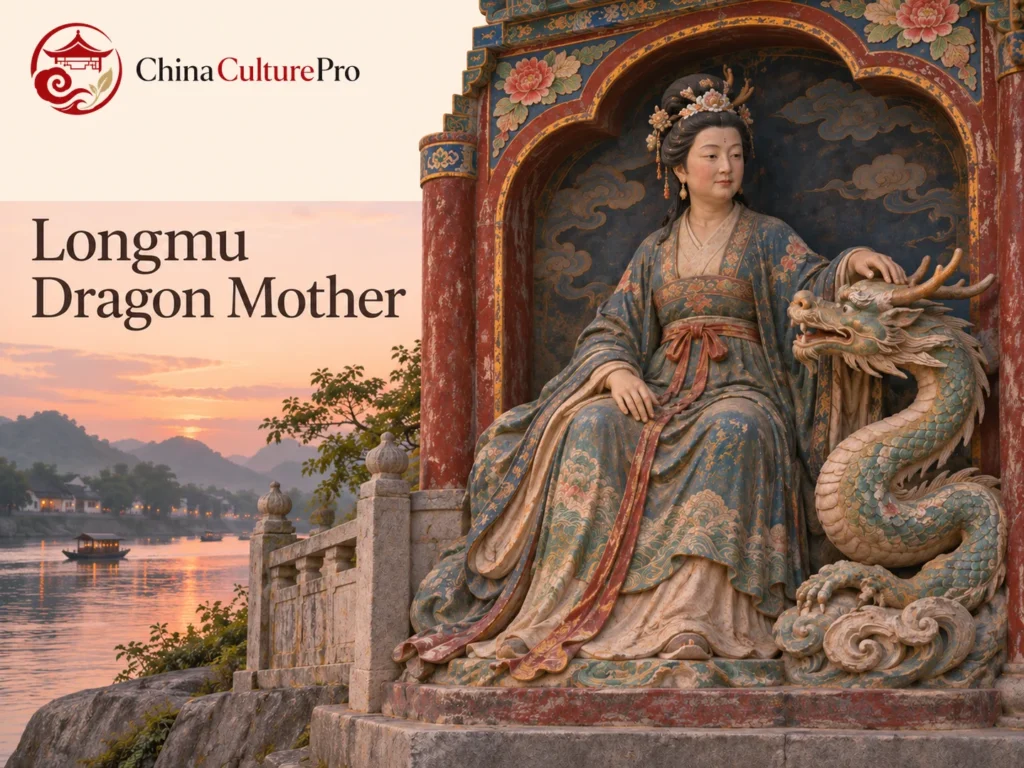
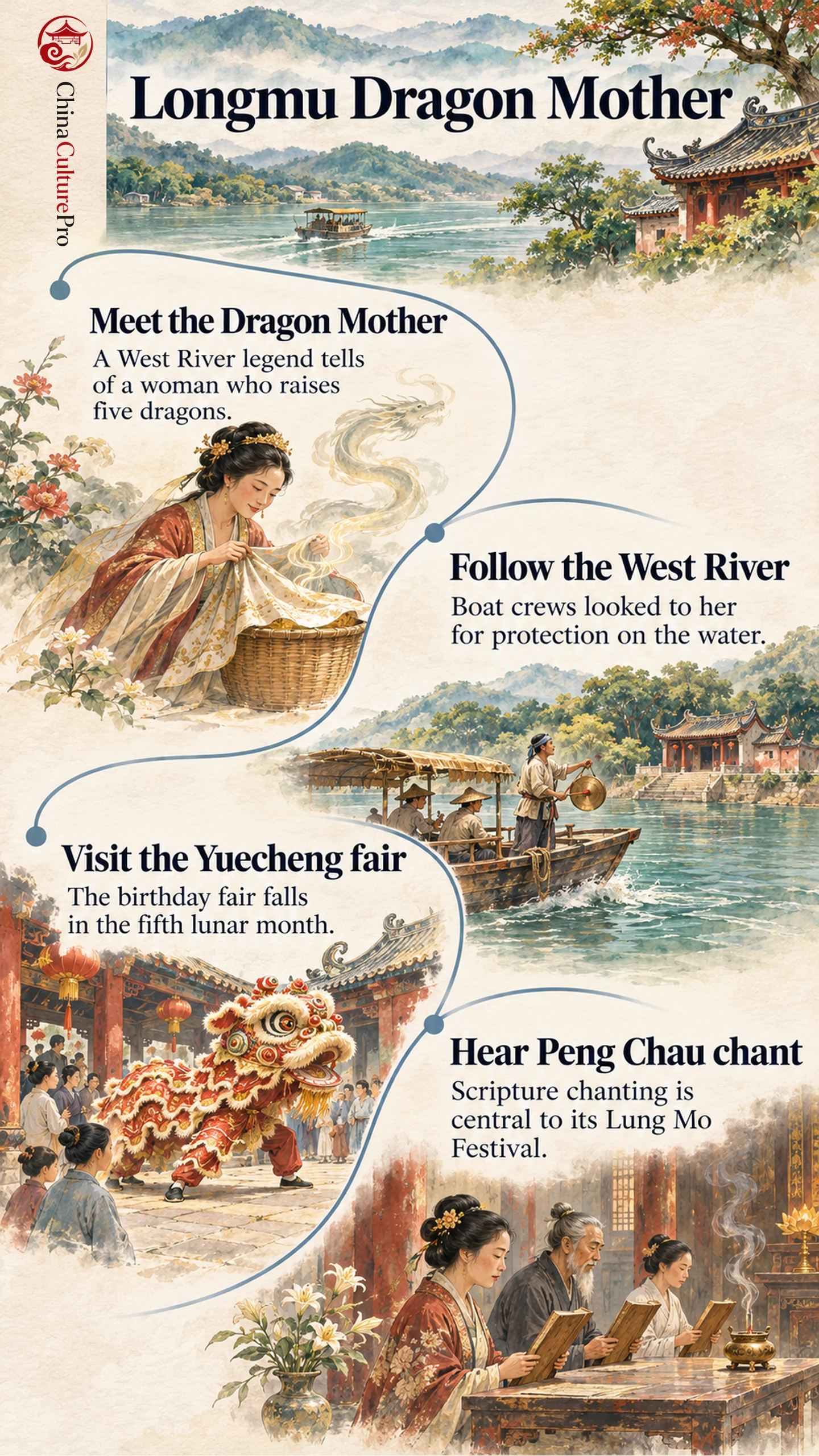
The Dragon Mother (龙母, Lóngmǔ), called Lung Mo in Cantonese, is a Chinese folk goddess associated with the West River (西江, Xījiāng) in southern China. In a widely told legend she raises five dragons. River communities sought her protection, and places such as Yuecheng (悦城, Yuèchéng) in Guangdong and Peng Chau (坪洲, Píngzhōu) in Hong Kong honor her with their own festival traditions.[1][2][3]
- The story: A woman of the Wen family raises creatures remembered as her five dragon sons.[1]
- The river: Tales of flood control and protection for boats connect the goddess to life along the West River.[1][4]
- The worship: Yuecheng has an ancestral temple, while scripture chanting is central to the Peng Chau festival.[3][5][6]
The story of the dragon sons belongs to folklore. Temple records, inscriptions and heritage inventories provide a different kind of evidence, documenting where and how people honored the goddess.[1][3][5]
In Yuecheng, the goddess’s temple overlooks the river that shaped her reputation. Hong Kong communities further in and around the Pearl River estuary also celebrate her birthday, with ceremonies that differ even when the dates coincide.[3][4]
Why the Dragon Mother Is Shown With Dragons
Accounts collected in the West River region tell of a woman of the Wen clan who nurtures creatures that grow into dragons. The five sons appear with their mother as companion deities in the tradition studied by researchers of southern Chinese religion. In stories that connect them with waterways, the sons’ ability to influence water puts the care she gave them in a wider setting. The family story gives the goddess a personal tie to creatures associated with the waterways on which her worshippers depended.[1][4]
In a shrine dedicated to her, an accompanying dragon can refer to that family relationship. A dragon on a roof ridge or pillar on its own tells you far less. To identify an image, read the temple dedication or a figure’s label first, then check how the surrounding figures are arranged. The familiar <a href="/zh_hk/%e2%80%9dhttps%3a//www.chinaculturepro.com/%e4%b8%ad%e5%9c%8b%e7%a5%9e%e8%a9%b1-%e9%be%8d%e7%8e%8b-%e5%90%ab%e7%be%a9-%e5%9b%9b%e6%b5%b7/%e2%80%9d/">Dragon Kings of the Four Seas</a> are a distinct group of named rulers, even though both traditions give dragons power over water.[1]
How the West River Shaped Her Reputation
The ancestral temple stands on the north bank of the West River in Yuecheng, a location that helps explain the goddess’s reputation among boat crews. Folklorist Ye Chunsheng (叶春生, Yè Chūnshēng) describes a tradition in which boats passing the temple would sound horns, set off firecrackers and beat gongs or drums. He also cites a Qing rebuilding inscription that describes the dangerous stretches of river near Yuecheng. That description gives the saluting custom a physical setting. The temple stood beside the very stretch of river where crews sought protection.[4][5]
People also appealed to the goddess in times of drought and flood. In a Song account discussed in a modern study, Wu Kui (吴奎, Wú Kuí) credits the goddess with answering petitions made at her temple during disasters. Later records document the temple’s enduring popularity. Historian Shuk Wah Poon found that it flourished in the 1930s even as campaigns against popular religious practices put other temples under pressure.[1][5]
How Communities Celebrate Her Birthday
In Yuecheng, the Dragon Mother’s Birthday (龙母诞, Lóngmǔ Dàn) is celebrated from the first through the eighth day of the fifth lunar month. The Ministry of Culture and Tourism also lists a separate observance in the eighth lunar month marking her attainment of the Way. The ministry’s description includes dragon and lion dances and opera offerings among the Yuecheng fair activities.[6]
Hong Kong’s inventory records celebrations at Peng Chau’s Lung Mo Temple and at the Lung Mo Buddhist Monastery in Tsuen Wan (荃湾, Quánwān). Both communities observe the festival on the sixth and seventh days of the fifth lunar month. The Peng Chau entry emphasizes chanting scriptures. The Tsuen Wan entry lists chanting alongside offerings and an auction of blessed objects. The shared dates make the differences especially easy to see.[3]
FAQs About Longmu the Dragon Mother
Is Lung Mo the same as Longmu?
Yes. Lung Mo is the Cantonese rendering used for the Dragon Mother in Hong Kong. Longmu represents the Mandarin reading of the same name.[1][3]
Is the Dragon Mother the mother of the Four Dragon Kings?
The legend discussed here gives her five dragon sons. The Four Dragon Kings form a separate group associated with the four seas. The name Dragon Mother, by itself, establishes no family tie to those four rulers.[1]
Is her birthday the same on every local calendar?
Many observances fall in the fifth lunar month. Yuecheng’s festival spans days one through eight, while the two Hong Kong entries document celebrations on days six and seven. A lunar date falls on a different Gregorian date from year to year.[3][6]
資料來源
[1] Religions. An Exploration of the Evolution of the Loong Mother Belief System in Lingnan
[2] Hong Kong Tourism Board. Lung Mo Temple
[3] Hong Kong Intangible Cultural Heritage Office. ICH Inventory, entry 3.24
[4] Ye Chunsheng. The Dragon Mother Legend and Folk Traditions
[5] Shuk Wah Poon. The Dragon Mother Cult in Yuecheng During the 1930s
[6] Ministry of Culture and Tourism. Dragon Mother Heritage in Guangdong