
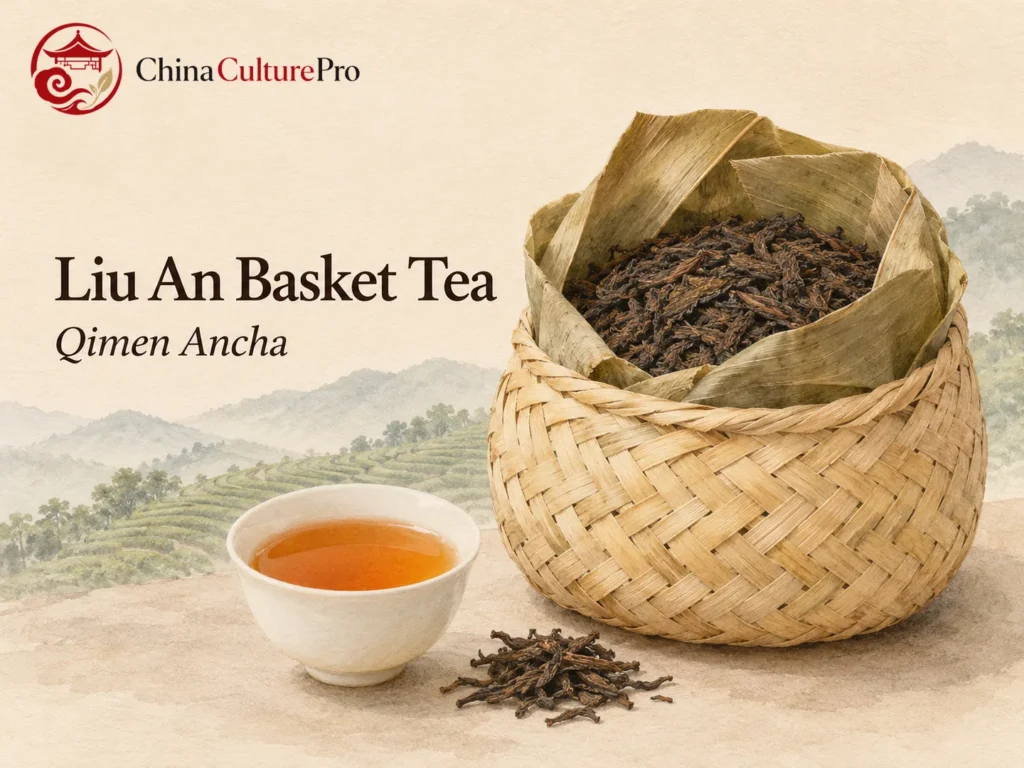

Quick Answer: What Is Liu An Basket Tea?
Liu An basket tea, also known as Ancha(安茶,ānchá), is a Qimen dark tea from Anhui, traditionally packed in a leaf-lined bamboo basket.[1][2][3]
- Craft: Initial leaf processing is followed by a separate refining phase.
- Night dew: Traditional refining includes outdoor moisture exposure.
- Basket: Steamed leaf is packed and dried in its lined container.
- Cup: Mellow, woody or roasted impressions vary with processing and storage.
This differs from Lu an Guapian(六安瓜片,lù’ān guāpiàn)green tea; basket shape alone establishes neither age nor quality.[3][4][5]
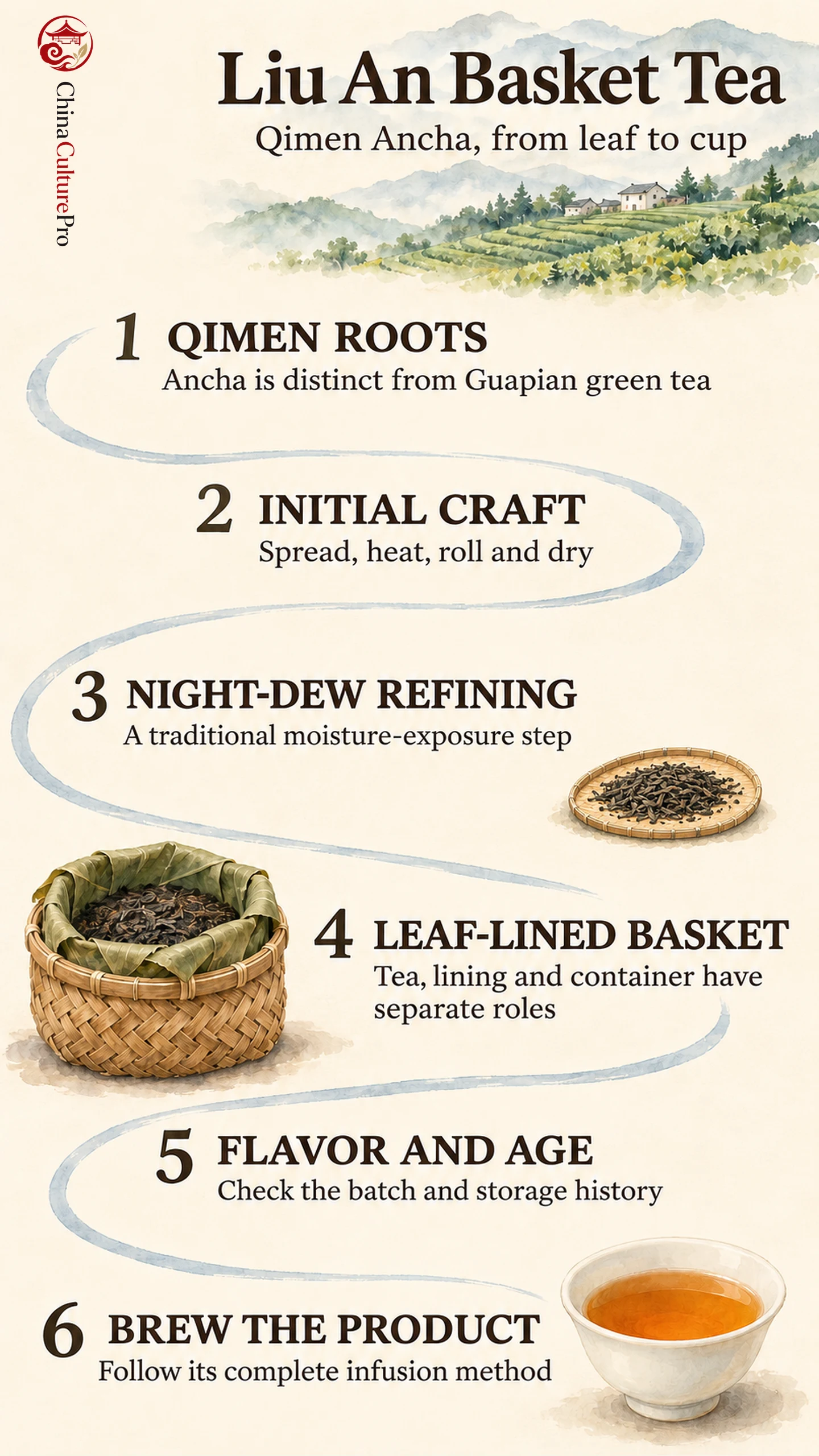
The tea, its leaf lining and the woven container have different jobs in a small basket.
Qimen Ancha and Lu an Guapian: Different Teas
Lu an Guapian is a green tea associated with Lu’an in Anhui. The basket tea discussed here belongs to Qimen’s Ancha tradition. Similar-looking English names should not override the producer’s actual origin and tea category.[3][5]
A production account describes an Ancha revival in the 1980s after a long decline. It does not establish a precise founding year.[1]
From Fresh Leaf to Night-Dew Refining
The craft has two broad phases. Fresh leaf is spread, heated for fixation, rolled and dried. Later refining prepares that material for its final basket form.[1]
Yelu(夜露,yèlù), night-dew exposure, is a distinctive traditional step. At a recorded Qimen workshop, workers spread previously fired tea outdoors overnight, then steamed it, loaded the baskets and baked them to finish. The craft entered Anhui’s provincial intangible-cultural-heritage list in 2014.[2]
Modern research has also tested “steaming and heaping” as an alternative to traditional dew wetting. The experimental treatments changed the balance of roasted, woody and fruity aromas. This illustrates process development; it does not establish that all commercial basket teas now follow the experimental route.[4]
Why the Tea Is Packed in Leaf-Lined Baskets
Ruoye(箬叶,ruòyè), broad bamboo-family leaves used as a lining, sit between the tea and its woven basket. Steaming softens the tea before it is packed firmly; the filled baskets undergo final drying.[1][2]
The lining and container are packaging materials. One documented product uses 250 g baskets; check the actual packet’s net weight.[3]
Compare tea cakes, tuocha and bricks for other deliberate forms. 老茶頭 describes naturally bound ripe-tea nuggets, a different explanation for compact tea.
Flavor and the Role of Maturation
One spring basket-tea lot has tightly worked dark reddish-brown leaf, an orange-yellow to slightly red liquor, and mellow nutty or floral notes. A separate Qimen product emphasizes soft wood, aged-bamboo aromatics and herbal sweetness. These are examples, not a universal tasting checklist.[3][6]
A traditional account describes at least three years of warehouse maturation before sale. This is a recorded custom; check whether a particular batch followed it.[1]
How to Brew and Choose Liu An Basket Tea
Start with a complete method for the actual product. For one 2018 spring lot, the documented short-infusion instructions are:[3]
- Measure leaf at 1 g per 30 ml of water, using 100°C water.
- Rinse once, then make successive infusions of 10, 20 and 30 seconds.
- Add 30 seconds to each following infusion, pouring off the liquor and adjusting to taste.
See tea rinsing in Chinese brewing for the preliminary step. Follow the product’s own advice about including any packing leaf; the basket itself is not a brewing ingredient.
When choosing tea, check the named producer, growing area, year and net weight. Tea origin labels help separate a trade name from a place claim. Keep the tea dry and away from odors according to its storage guidance.[6]
FAQs About Liu An Basket Tea
Is Liu An Basket Tea a Green Tea?
The Qimen Ancha described here is classified as dark tea. It is distinct from Lu an Guapian green tea.
Can You Brew the Basket Lining with the Tea?
Some product instructions allow a little of the intended packing leaf. Confirm that permission for your tea; it does not apply to arbitrary bamboo leaves.
Does Every Basket Need the Same Amount of Aging?
No single waiting period follows from the basket’s shape. The maker’s finishing, production date and storage history matter.
資料來源
[1] Global Tea Hut. Golden Thread
[2] Hu Wei and Wang Shilin, Anhui Economic News. 祁门:金风夜露 安茶飘香
[3] MyTeaPal. 2018 Liu An Basket Tea (2018 Spring)
[4] Zhenbin Chen and colleagues. Improving Ancha tea aroma quality via innovative processing: Characterization of key odorants by GC-MS, GC-O, Sensomics, and Chemometrics
[5] China Intangible Cultural Heritage Network. 绿茶制作技艺(六安瓜片)
[6] New York Tea Society. 2019 An Cha